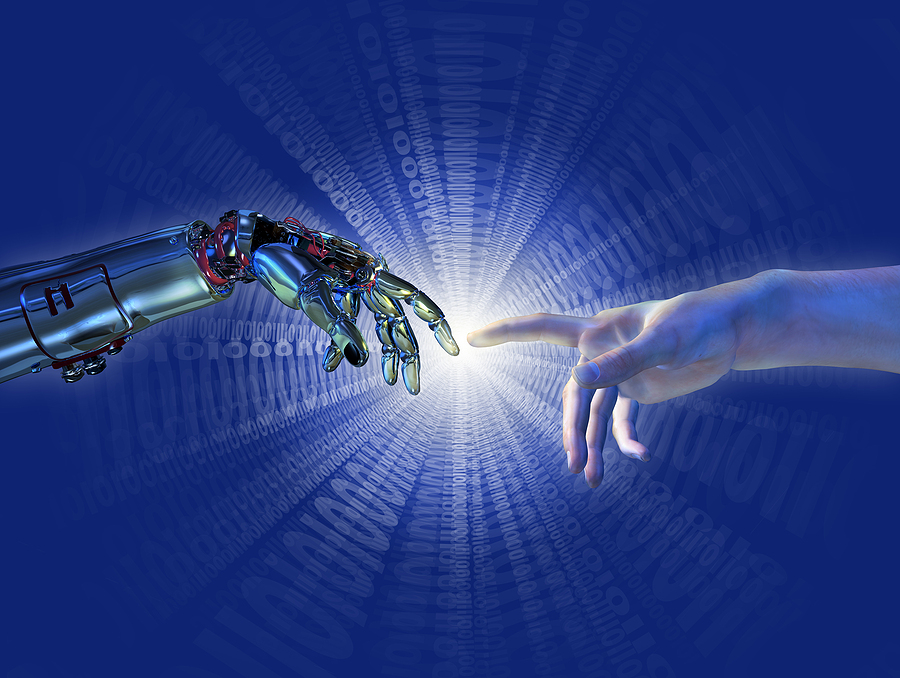
What does it mean for a human being to collaborate with a mathematical formula/algorithm? We live in an age when one can’t distinguish between a real image or AI; whether a voice is actual or replicated; a piece of “art” executed by a human or a machine. Mechanisms have been helping us since the Industrial Revolution, but now we want them to think, to have judgment. Can they be creative? Is art executed by nonhumans worthy to bear the term?
Since before the 1800s, automatons have been drawing, writing, and playing music without human intervention. Using clockwork springs, gears, pneumatics, and magnets, engineers designed movement to replicate that of people. (It was a short step to imagine bringing them to life.)
Author David Hajdu explores the invention of machines leading to generations of AI, then our partnering with these fabrications and programs to change the creation of art. He cites fascinating examples, theories, aspirations, and then comments, predominantly on the positive side. This is not a dry treatise.
It’s intriguing; scholarly, but entertaining. René Descartes’ theory that the heart, not the brain is our central mechanism, Hajdu notes, is “a conception that would be held dear by pop song writers well into the 21st century.”
Intersection of art and machines was represented by MoMA’s 1933 Machine Art, “three floors of utilitarian, machine-made objects, such as springs, pots and pans, and scientific instruments, displayed on pedestals, elevating them to the level of sculpture.” (MoMA web site) Critics faulted it for indifference to human feeling and disregard of intention. In Europe, the Surrealists specified intention.
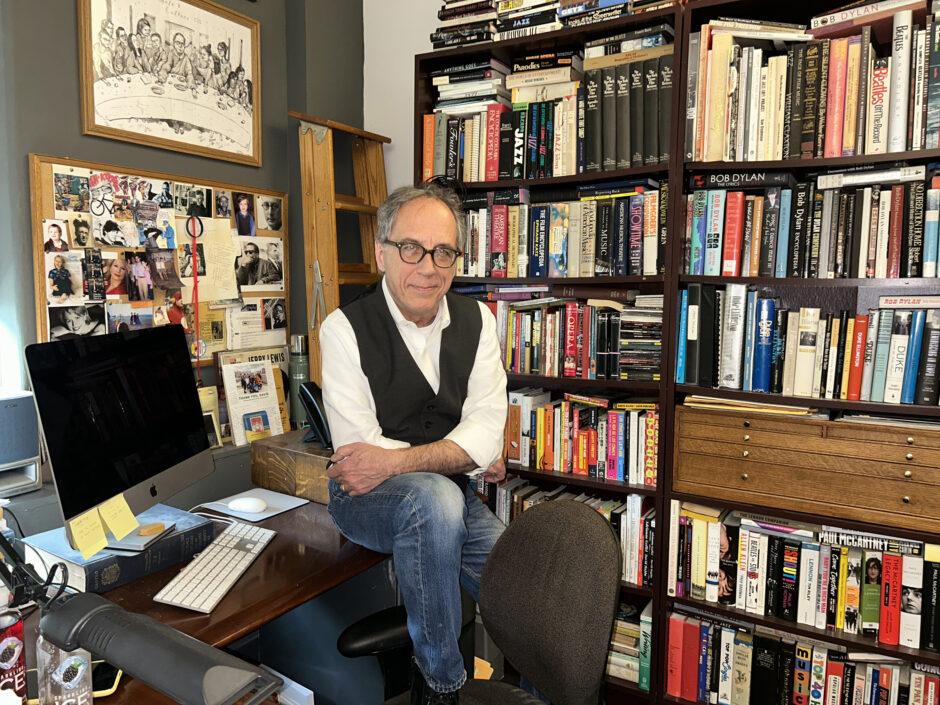
David Hajdu (Photo by Madison Rosenfield)
Music critic for the Nation (as well as a journalism professor at Columbia University), Hajdu’s chapters on music are especially rich. Player pianos arrived in every drawing room. Sound recording and advanced playback gear changed home entertainment and movies. Broadcasting and live performance advanced with microphones. Composing developed new options with the advent of the synthesizer. George Harrison, David Bowie, and Stevie Wonder are among examples reflecting the author’s knowledge of specific recordings.
In 1952, the Illinois Automatic Computer “Illiac” used electronic computing to compose. It was ten feet tall and filled nearly an entire room. ”Music is a sensible form…governed by laws of organization…”
(Dr. Lejaren A. Hiller) Composer/musician George Lewis collaborated with a single microprocessor computer to perform spontaneous jazz improvisations in real time. Today, programs can create music in the style of any composer.
Writers have entire studios in their homes. Computers are able to “sample” any musical instrument ie playing a keyboard elicits the sound of a saxophone, guitar, violin- a Stradivarius if preferred.
What about visual art? The pantograph has been used for altering the scale of things in drawing since the first decade of the 17th century. The perspectograph followed on its heels coordinating hand and eye. Camera obscura – “a pinhole in all or side of box that projected images from life onto surfaces” – was around as early as 500 BCE and flourished during the Renaissance.
Andy Warhol applied paint to crudely transferred photographs, admittedly trying to keep out the human element. At Bell Labs, biochemist Michael Nol was so captivated by microfilm plots displaying computer data, he exhibited them in a show called “Patterns.”(Bell refused to be associated.)

A decade later, painter Harold Cohn’s robotic “artist,” which resembled a four slice toaster on wheels, made its way around a six foot wide stretch of paper with a magic marker attached. At first Cohn colored in the art, then he programmed the machine to do it. “If Cohn seemed elusive or contradictory on the nature of the computer program he called his collaborator, he should be forgiven. After all, he’s only human,” Hajdu writes.
Nowadays art programs can, like music, create in specific styles, appearing to be executed in any medium. Human participation is optional. Stone and marble are sculpted by machines translating computer calculations. Only at the last do human hands refine. Is the artist only responsible for concept? Jeff Koons not only uses machines to manifest sculpture, but maintains a workshop of people, like Medieval apprentices, to execute paintings. He directs.
“Can a machine move me to tears, paint a picture which will touch generations? Does a machine have any business making art?…I don’t believe computers satisfy the criteria we attach to life, but they have lives. We can encourage them to express that condition…” (Computer scientist Simon Colton) Their condition!
Alan Turing’s Imitation Game was a test for determining if one party in a conversation is human. Results might not be so accurate today.
The Uncanny Muse – Music, Art and Machines from Automata to AI
David Hajdu
Our editors love to read and independently recommend these books. As an Amazon Affiliate, Woman Around Town may receive a small commission from the sale of any book. Thank you for supporting Woman Around Town.
Top photo: Bigstock