From a Freudian perspective, the unheimlich, the Uncanny, is a revelation of what is hidden not only to the external, but also to the self, representing the return of the familiar, or the return of the repressed. According to Freud, the rendition of the Uncanny in the German Romantic author of Gothic horror and fantasy, E.T.A. Hoffmann’s prose is unrivaled in literature. But what can actually happen to the concept of the Uncanny in a cross-medium adaptation such as Hoffmann’s stories to Jacques Offenbach’s opera Les contes d’Hoffmann – The Tales of Hoffmann? The music and the libretto convey it in many ways. And then, there are stagings that succeed in rendering the Uncanny, and there are stagings that, for reasons of speed or budget or superficiality or lack of imaginative depth, fall short of doing it justice.
Composed in 1880, this opera was left unfinished by Offenbach who confessed to the “uncanny” feeling that he would die before completing it, and that is exactly what happened on October 5th, four months before the opera’s premiere on February 10, 1881. His fellow composer, Ernest Guiraud, finished the work. The French libretto was written by poet Jules Barbier, and it was an adaptation of an adaptation: his own play Les contes fantastiques d’Hoffmann written with Michel Carré and produced at the Odéon Theater in Paris in 1851. The libretto is based on three of Hoffmann’s stories, one of which is Der Sandmann (“The Sandman”) from the collection Die Nachtstücke – The Night Pieces.
The Met’s revival of Bartlett Sher’s production of The Tales of Hoffmann opened on September 24. Overflowing with musical treasures and fantastical plots, Offenbach’s opera offers an abundance of opportunities to showcase the unsettling mysteries of its stories, and Sher succeeds in doing so, at least in the first act. The obsession with vision and eyes, a key element in conveying the Uncanny, is captured effectively through Coppélius’s wares and the many umbrellas, each with an eye in its center, swirling around Olympia. So is the doppelgänger concept—in this case triple—as Hoffmann’s romancing of Olympia while wearing the magic glasses is mirrored by two couples of dancers, as though the story were happening simultaneously to two other poets and two other mechanical dolls. This was, in fact, the best reflection in Sher’s production of what Freud exposed as an element of the Uncanny: infantile narcissism, self-love projecting on multiple selves represented by the doppelgänger, connected in fact to the superego that projects repressions onto the double. Hoffmann’s love for Olympia invokes a utopia suppressed by reality and societal constraints, and Sher’s vision exposed this to great effect. Yet the director’s further attempts, such as the hanging violin lowered from the ceiling and fluttering about too much in Act II, or the tiny mirror in which Hoffmann couldn’t see his own reflection in Act III, were superficial and almost caricatural in transmitting the disturbing elements of the Uncanny.
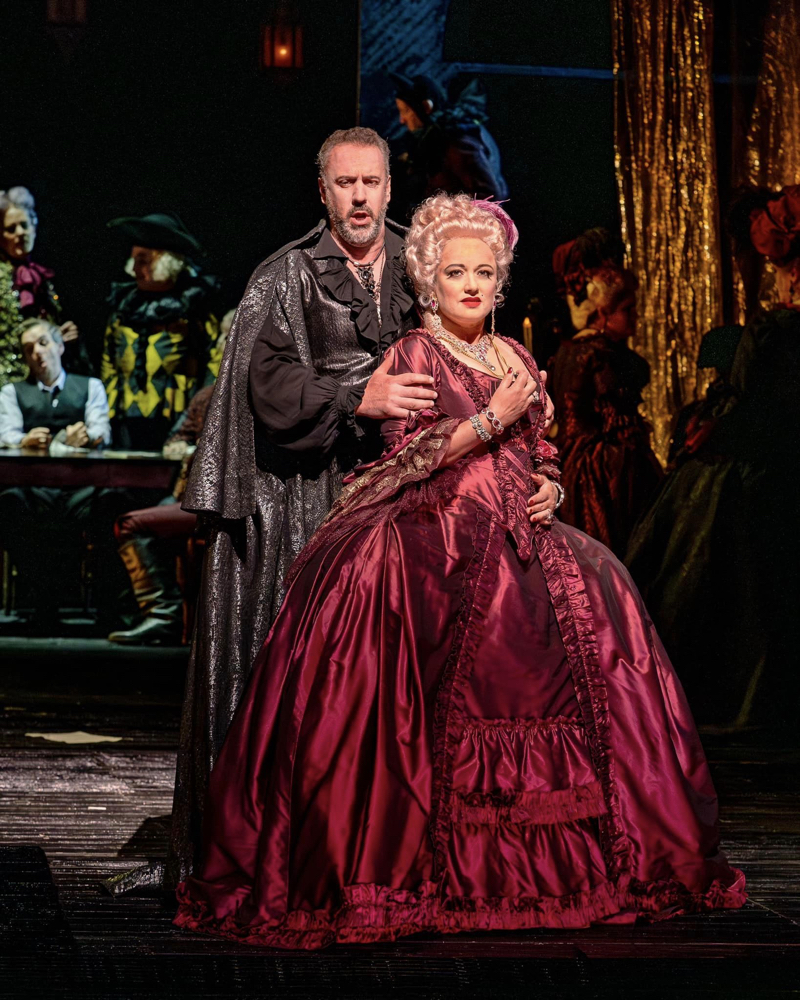
Christian Van Horn as Dapertutto and Clémentine Margaine as Giulietta in Offenbach’s The Tales of Hoffmann at the Metropolitan Opera – Photo: Karen Almond / Met Opera
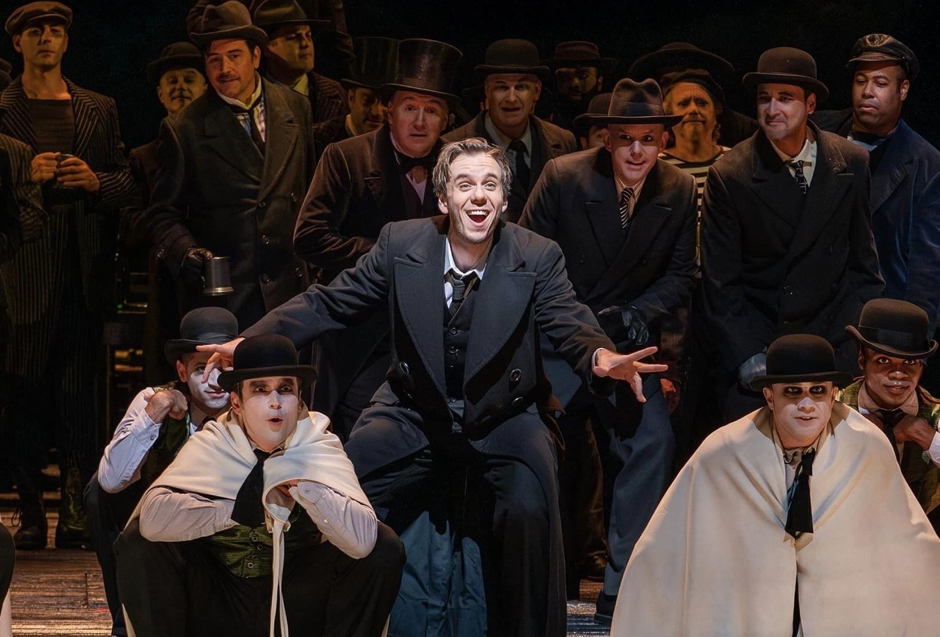
French tenor Benjamin Bernheim brought elegance, suppleness of tone, and immaculate diction to Hoffmann. To this reviewer, there are two key moments in the opera that can make or break an interpretation of Hoffmann. One comes in his Prologue aria “Kleinzach”—if the tenor can negotiate this passage beginning with “Je la vois, belle, belle comme le jour” and ending with “Dont l’éternel écho résonne dans mon coeur!” successfully, without sounding dull or strangled, then you know you’re in for a solid, if not great performance. The second key moment comes in Act III in the aria “O Dieu! de quelle ivresse” when he sings the fragment beginning with: “Comme des astres radieux” up to “Sur mes lèvres et sur mes yeux”—that incremental climb of phrases dwelling in a tricky part of the voice. Bernheim negotiated both key moments with calm and cool mastery.
The tenor was at his best in the lyrical, suave moments, such as in his declarations of love to Olympia and the duet with Antonia. He gave a bit more freedom to his emotions in the sextet, “Helás mon coeur s’égare encore” and in the Epilogue where he sounded closer to an emotionally ravaged Hoffmann. Essentially, Bernheim’s Hoffmann is too—for lack of a better word—“nice”. His sweet, gentle sound is, at times, too bright and widened to the point that it loses color. There is hardly any hint of darkness or danger in his vocal interpretation. That’s not to say that the tenderness and refinement that Bernheim brings to the role are mismatched. There is simply too much of those qualities. One longs for moments of the wounded, raw vocality of a shattered Hoffmann that should burst forth right from the Prologue. However, Bernheim was overly Bellinian in the Prologue. Then, he waited too long to set himself loose from the polished veneer of his singing, and even when he did so, he seemed somewhat distanced from his own anguish. Although, that could be a viable interpretation as well, if seen from the perspective of the detached poet who has transcended sorrow and transmuted it into words. Ultimately, in Bernheim’s case, it isn’t a question of faulty technique or flawed singing at all, but more of interpretative choices. Interpretation is a matter of taste, but this reviewer’s preference would be for a less restrained, less glossy Hoffmann.
As Hoffmann’s nemesis—the devil in four disguises: Lindorf, Coppélius, Dr. Miracle, and Dapertutto—Christian Van Horn embodied all four manifestations with lush abundance of tone and personality. His villains were not monochrome; each was granted vocal colors and behaviors of their own. In voicing the counselor Lindorf, Van Horn found a smooth, lusty, and cynical balance and created a joking, menacing dynamic in his aria “Dans les rôles d’amoureux langoureux” through commanding vocality. Van Horn’s Coppélius was rough and scoundrelly, and the bass-baritone endowed him with a grainy, almost purposefully unruly sound, making him both sinister and violent. The most sinister of all of Van Horn’s diabolical interpretations was Dr. Miracle. His boasting about curing Antonia resounded hair raising and dooming in the forbidding way he articulated the rhythmic phrases, as though there were no question of Antonia’s fate. In the trio, he hovered over Antonia physically and vocally, his voice occasionally acquiring eerie, tunnel-like resonances as if they were indeed coming from the underworld. “Scintille, diamant” crowned Van Horn’s exceptional performance, unfolding honeyed and seductive, in velvety legato topped with a brilliant final high note.
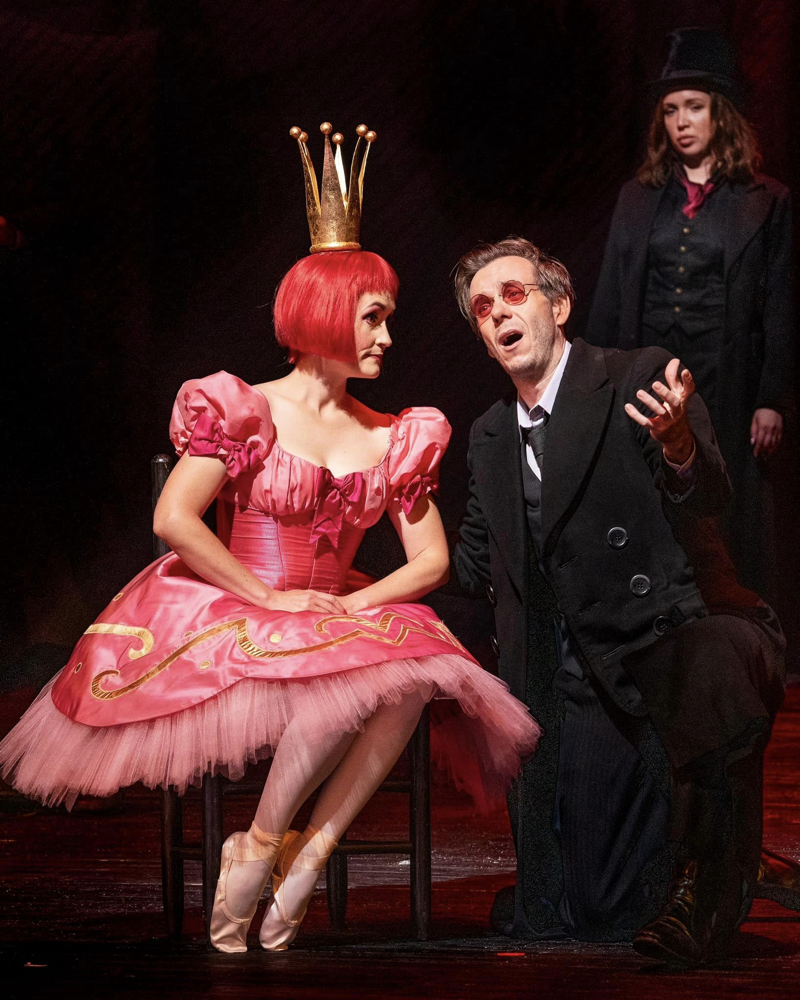
Erin Morley as Olympia, Benjamin Bernheim as Hoffmann, Vasilisa Berzhanskaya as Nicklausse in Offenbach’s The Tales of Hoffmann at the Metropolitan Opera – Photo: Karen Almond / Met Opera
In her Metropolitan Opera debut, mezzo-soprano Vasilisa Berzhanskaya displayed a rich instrument with hints of contralto darkness. At first, it felt somewhat unusual to hear her fit this large voice into the role of Niklausse, usually sung by lighter mezzos. Yet, keeping in mind that Niklausse is but a human manifestation of the Muse of Poetry, Berzhanskaya’s ample voice added a new dimension to the role, emphasizing the larger-than-life Muse’s constant presence behind the witty façade of Hoffmann’s young companion. On occasion, Berzhanskaya inflected too much unnecessary emotion into her singing, for instance “Voyez-la sous son éventail” sounded a bit heavy, sigh-filled, and wistful for the character. But in the “C’est l’amour vainqueur”aria, Berzhanskaya’s emotional power proved rousing and engulfing. Her Epilogue solo flowed in warm tones and uplifting phrases. This mezzo’s voice is full of exciting promise; she often sounded like a young Amneris, or an Azucena and Ulrica in the making, revealing qualities that one doesn’t often expect in a trouser role, which made Nicklausse more of a force to be reckoned with rather than a humorous, savvy counterpart. In the context of Sher’s vision, in which the Muse appears to partner with the devil to thwart Hoffmann’s loves so that the poet can belong only to the Muse, this substantial voice made total sense.
Erin Morley’s Olympia is always a treat and a crowd favorite. This evening, she surpassed even herself in delivering an extraordinary performance. “Les oiseaux dans la charmille” is Morley’s plaything: she does with it whatever she desires, and the outcome is stunning. Whether it’s the playful embellishments rising into breathtaking vocal stratospheres or her incredible physical command of the doll’s movements, Morely owned both role and audience, and received the loudest ovation of the night. From her aria to the dance with Hoffmann to all of her movements on stage, she sustained the illusion of the mechanical doll all throughout the act, never lapsing for one second into Erin Morley the human.
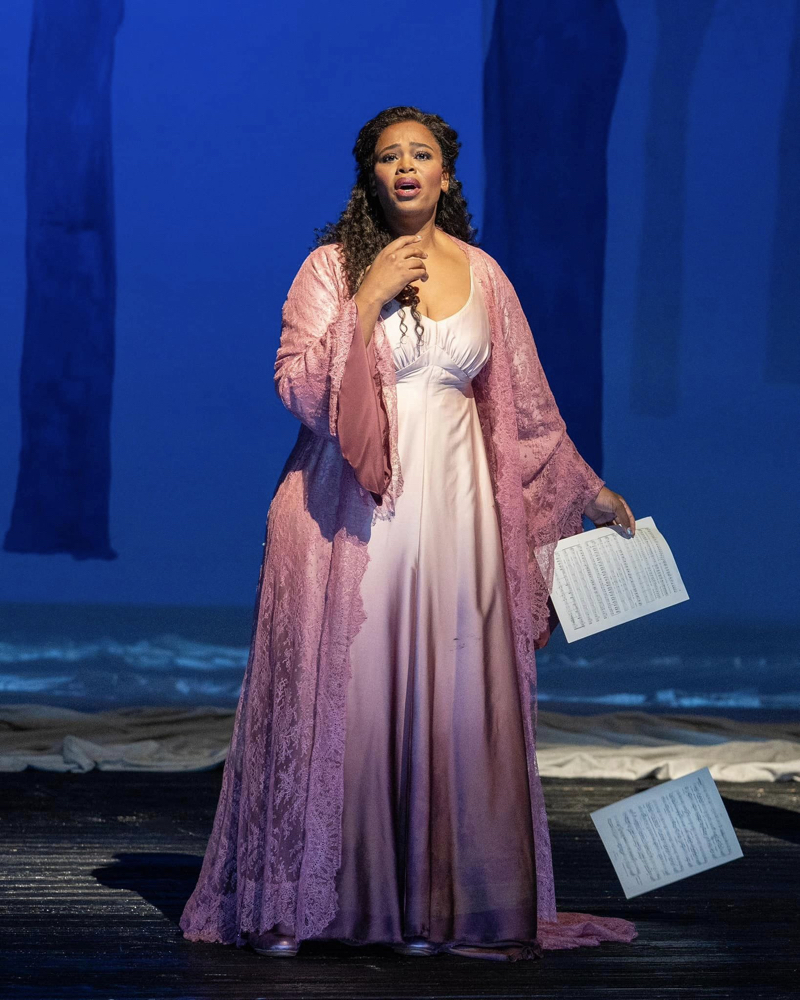
Pretty Yende as Antonia in Offenbach’s The Tales of Hoffmann at the Metropolitan Opera – Photo: Karen Almond / Met Opera
Sadly, the disappointment of the evening was Pretty Yende in the role of Antonia. Yende possesses one of the most beautiful voices among the sopranos active on the world’s operatic stages today. Her voice has a unique timber and resplendent presence and is capable of a myriad of colors and nuances. But on Tuesday night, something was off. From the beginning, it sounded like her tones had no focus especially in the passaggio. Instead of being the superb, limpid rendition one would expect from Yende, the aria “Elle a fui, la tourterelle” seemed uncertain and all over the place, especially in the difficult phrases of “Mon bien-aimé, ma voix t’appelle / Oui, tout mon coeur est à toi” and “Mon bien-aimé, ma voix t’implore / Ah! que ton coeur vienne à moi”. She seemed to recover control in the duet with Hoffmann that had moments of ravishing beauty, but it didn’t last long. In the trio with Van Horn and Eve Gigliotti—who gave a vocally regal performance as the mother—Yende sounded overwhelmed by the rising waves of music and abandon that the role requires. Her voice showed an occasional wobble and hollowness at times. Only during the more mezza-voce parts, did the usual beauty of her tone return. Perhaps it was just an off night, perhaps it was the orchestra under Marco Armiliato’s baton that didn’t always take into consideration the balance between the singers’ voices and the instruments and often sounded rhythmically muddled, perhaps it was just first night’s nerves. One would hope that Yende will eventually regain full mastery of her glorious voice.
Clémentine Margaine brought her customary lusciousness of tone to the role of Giulietta, and every note she sang proved a treat of vivid, juicy roundness. The Barcarolle was one of the most magnificent moments of the evening: the combination between Margaine’s and Berzhanskaya’s voices electrified in their perfectly synchronized dynamics and flow. In the duet with Hoffmann, Margaine sounded ardent and sensual, while the sextet served to showcase her wonderfully rich and present vocality.
In his four secondary roles, Aaron Blake entertained through comedic flair and a playful, pleasant voice, especially in Frantz’s aria. The only detriment to his lovely comedic presence was the overuse of spastic body movements as Cochenille—here it was definitely a case of less would be more. Bradley Garvin gave a credible, moving performance as Antonia’s father, Crespel. Tony Stevenson made for a smooth-toned, wily Spalanzani, while Jeongcheol Cha proved remarkably intense vocally, particularly as Schlémil, Giulietta’s spurned lover.
Whether truly uncanny or just intimating it, this production of Les contes d’Hoffmann is absolutely worth seeing. As the run progresses, undoubtedly, some of the disappointing or rough patches will get smoother. What is even more promising is that the vast range of vocal splendor from this overall marvelous cast will thrill and enchant even more.
Les contes d’Hoffmann at the Metropolitan Opera runs through October 18 – Info and tickets
Top: Benjamin Bernheim as Hoffmann in Offenbach’s The Tales of Hoffmann at the Metropolitan Opera – Photo: Karen Almond / Met Opera