Presented by host Louis Rosen under the aegis of 92Y
Bob Dylan’s transformation between 1962 and 1965 is as profound as those years of cultural change. Host Louis Rosen points first to the artist’s musical longevity. Dylan’s debut recording was in 1962, his latest 2020. “Who in the history of songwriting and popular music has been able to sustain a career in commercial music that long? And we don’t think of him as commercial.” Before an examination of the Freewheelin’ Bob Dylan, his second release and the one that brought him into public awareness, Rosen takes a look at roots and context.
When Robert Allen Zimmerman arrived in New York City from Hibbing, Minnesota in 1961, he’d already read poems by Dylan Thomas and changed his surname. Back home, he’d been in bands covering the likes of Little Richard and Elvis Presley. By the time he reached the University of Minnesota, however, penchant for rock gave way to folk music.
“The thing about rock’ n’ roll is that for me anyway it wasn’t enough … There were great catch-phrases and driving pulse rhythms … but the songs weren’t serious or didn’t reflect life in a realistic way.” (Dylan to Cameron Crowe in liner notes on Biograph)
We watch a brief, 1945 film of one of Dylan’s most important influences, Woody Guthrie (1912-1967). Similarity is obvious. In January, 1961, Dylan seemed to be “doing” Guthrie, Rosen tells us, following in the footsteps of Ramblin’ Jack Elliott (1931-) Guthrie made him realize songs could be about many things. “Popular music in the country at the time was not the music Dylan was looking for when he moved to Greenwich Village.” Rosen divides what was happening into the commercial and the bohemian.
We see a clip of The Kingston Trio performing “Tom Dooley” as an example of the commercial – three clean cut young men, two guitars and a banjo, in very short haircuts and short-sleeved, striped shirts – the epitome of what bohemian’s called “square.” Folksinger Dave van Ronk, said, “Most of the music was so precious and corny, you could lose your lunch.” Conversely, the commercial crowd felt bohemians were trying to imitate something they’d never be.
Dylan was looking for the authentic strain. Rosen plays us old time Appalachian artist Clarence Ashley (1895-1967) singing “The Coo Coo Bird.” Ashley accompanies himself on fast, clean clawhammer banjo. (Traditional banjo is played with an upticking motion with fingers and a downpicking motion with the thumb. Clawhammer is downpicking – only the thumb and middle or index finger are used hitting the string with the back of the fingernail.)
The artist may have heard Coo Coo on Harry Smith’s American Folk Music – six discs released by Folkways Records comprised of 85 country, folk and blues songs originally issued from 1926-1933, to which Smith had no legal right. The invaluable collection, considered a Bible to those reviving traditional folk music in the 1950s and 60s, is now in The Smithsonian. “We all knew every word of every song on it, including the ones we hated.” (Van Ronk in his liner-note essay for the 1997 Smithsonian reissue.)
After popularity on Open Mic Nights, Dylan became a regular performer at The Gas Light. Jim Kweskin (The Jim Kweskin Jug Band) said, “He was electric, magnetic. It was more his presence than the music.” Van Ronk called him “kinetic” and, interestingly, compared Dylan to Charlie Chaplin. “I played folk songs with rock n’ roll attitude,” Dylan wrote. “That and my repertoire are what made me different.”
Girlfriend Suze Rotello (the woman with him on the cover of Freewheelin’) was a strong influence on Dylan for several years. More sophisticated, she introduced him to art museums, exposed him to wider reading, particularly beat and symbolist poets, and opened his eyes to left wing politics. Suze took Dylan to see a production of Kurt Weill/Bertolt Brecht’s Threepenny Opera. The song “Pirate Jenny” struck him. (We watch Lotte Lenya sing. ) “This is a wild song. Big medicine in the lyrics. It leaves you breathless,” Dylan would later write. He started reading stories in police gazettes. “I could see that the type of song I wanted to write didn’t exist.”
The young musician made his first recording as harmonica sideman and backup singer on a Carolyn Hester folk album. A good review brought John Hammond and a record contract. (Hammond was the talent scout/producer responsible for discovering artists as diverse as Benny Goodman, Billie Holiday, Pete Seeger, Aretha Franklin, and Bruce Springsteen.) His first album for Columbia, Bob Dylan, was heavy on blues and folk with only a couple of original songs. Hammond found the rawness appealing.
We listen to “Talkin’ New York” in which Dylan purposely mispronounces Greenwich Village and to the storysong “Rambling Gambling Willie.” Rosen reminds us we’re hearing unedited takes and points out that the harmonica rack Dylan was now employing is difficult to navigate.
The track on the album most people noticed was “Song for Woody.” Dylan called it the first piece of good writing he’d done: Hey, hey, Woody Guthrie, I wrote you a song/About a funny old world that’s coming along/Seems sick and it’s hungry, it’s tired and it’s torn/It looks like it’s a-dying and it’s hardly been born…The album sold poorly. Dylan was called “John Hammond’s Folly.”
“He’d record 34 songs for the next effort,” Rosen tells us. “Columbia was trying to figure out how to market Dylan even as he was evolving. Folk singers didn’t perform songs they’d written…He wasn’t an overtly political thinker, but he did soak up what was around him… Dylan makes a distinction between a topical song and a protest song, identifying with the former.”
We listen to “Let Me Die” based on an old Roy Acuff ballad that was inspired by the fallout craze including “duck and cover.” (Children were told to hide under their desks in case of a nuclear explosion.) : I will not go down under the ground/Cause somebody tells me that death’s comin’ round…The host says that in conservative Minnesota, salesmen peddling shelters were sent away: Let me die in my footsteps/Before I go under the ground…You might parallel refusal to take cover with refusal to wear a mask, war and Covid seeming intangible.
A minor scandal occurred when Dylan was told he couldn’t perform “Talkin’ John Birch Blues” on a network variety show. (The John Birch Society is an American anti-communist organization named in honor of a missionary killed in a confrontation with Chinese Communist soldiers.) We listen.
“Dylan feels we’re all complicit in the world’s failures, he points a finger at all of us. One of the earliest songs to reflect this was `Who Killed Davey Moore’ about a boxer pressured to pummel his opponent,” Rosen says. Equally guilty – lyrics say – are the bloodthirsty crowd, his manager, bettors, etc. It wasn’t me that made him fall, they all declare. Don’t say murder, don’t say kill/It was destiny, It was God’s will… An unfortunately familiar attitude.
This second record also contains “Blowin’ in the Wind,” the song for which, Rosen notes, Dylan will be most famous. We hear a snippet of Paul Robeson performing “No More Auction Block for Me,” its melody exactly the same as ‘Wind. Folk songs were traditionally built on top of one another. Judy Collins tells a story of being in a Woodstock cabin with a bunch of people and, suffering insomnia, wandering towards music in the middle of the night. She sat on the floor with her back to Dylan’s door as he wrote. “A Jewish White guy from Minnesota wrote one of the major Civil Rights anthems,” Rosen observes.
“Let’s think about the pop charts Summer 1963. The Beatles were not here yet. Pat Boone’s doing pretty well. By the time the second album was released in June, Dylan had been reinvented. The blues part of his repertoire was now much smaller than that of original material. As Dwight Eisenhower rages against the military industrial complex, Dylan writes a song unlike anything he’s done before or will do after,” Rosen says. “Masters of War” rails: Like Judas of old/You lie and deceive/A world war can be won/You want me to believe/But I see through your eyes/And I see through your brain/Like I see through the water/That runs down my drain…
A more personal, more tender side also emerges with “Girl From the North Country,” adapted from a traditional folk song. We watch a video of Dylan performing. The artist has always been notable for channeling every bit of expression/emotion into his lyrics, showing almost nothing on his face, barely varying delivery.
“The song that will change everything while not being able to be understood as literal, the one that comes out of symbolist poetry and the beats, arrives fall 1962 just before The Cuban Missile Crisis. We forget how close we were to the edge of nuclear war. Metaphor upon metaphor create an apocalyptic setting,” says Rosen. We listen to the six minute “A Hard Rain’s Gonna Fall.” “What does it mean? Ask yourself. Ambiguity doesn’t signify lack of meaning,” Rosen reminds us, “It signifies multiple possible meanings.”
“Musicians realized the game had changed. Some tried to follow, others went decidedly elsewhere. Let’s close with a cold, nonchalant love song, `Don’t Think Twice, It’s All Right.’” We listen. “The folk music scene had been like a paradise. I had to leave like Adam had to leave the garden. It was just too perfect…” (Dylan)
“By the time the next album comes out, he’ll have moved further beyond. That’s what we’ll talk about next time,” Rosen promises.
A fascinating look at both Bob Dylan’s music and the atmosphere in which it evolved.
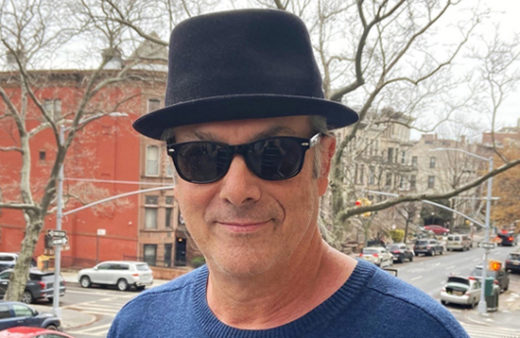
Photo of Louis Rosen Courtesy of the host
There are three more individually priced programs on Bob Dylan:
Bob Dylan: The Times They Are A-Changin’ and the Politics of Song Sunday, March 7, 2021, 1:30 – 3:30 pm
Bob Dylan: Bringing It All Back Home – Another Side Sunday, March 21, 2021, 1:30 – 3:30 pm
Highway 61 Revisited, Blues, Poetry and Electricity Sunday, April 18, 2021, 1:30 – 3:30 pm
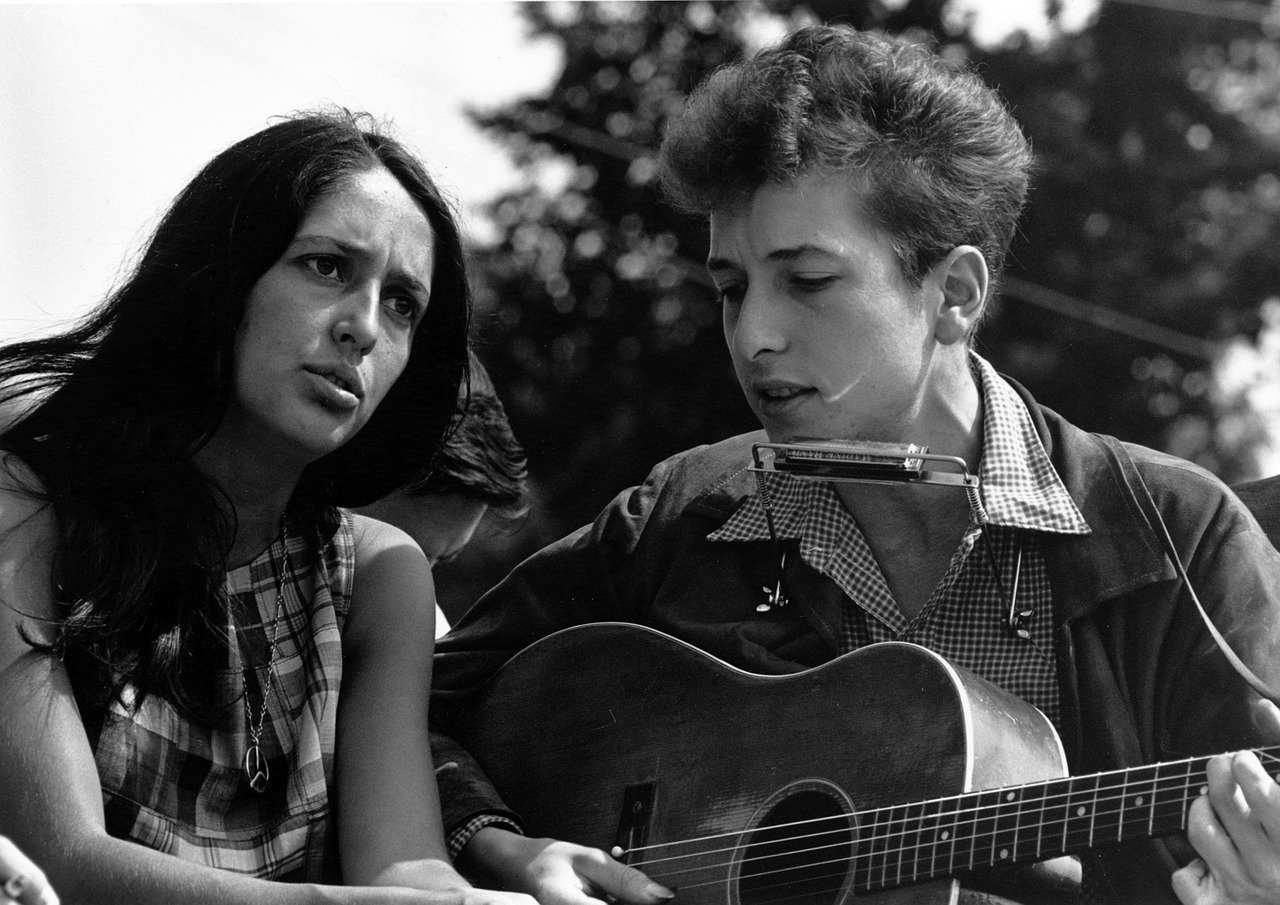
Top photo: Joan Baez and Bob Dylan
Credit: Image by WikiImages from Pixabay