Architectural Historian/Author Frances Marone under the aegis of The Park Avenue Armory.
Edith Wharton nee Edith Newbold Jones (1862-1937), novelist and short story writer, was born into New York aristocracy at the height of its Gilded Age. Her father’s wealthy, socially prominent family is said to be the origin for “keeping up with the Joneses.” The Astors were cousins. Her mother was a Rhinelander. After the Civil War, when currency depreciated, the family lived successively in France, Italy, Germany, and Spain before they returned to the city. Edith learned French, German, and Italian. A prime example of sexist and class customs, she never went to school (unlike her brothers) but was educated at home by tutors.
Many of the author’s male relatives were involved with The 7th Regiment Armory in the mid-19th century. Familiarity allowed Edith to feature it in several books. A fabulous ball held there appears in her last unfinished novel, The Buccaneers.

“Edith Wharton was one of the great American novelists, also one of the great New York novelists,” says Marone. “The Age of Innocence, arguably her best known and loved work, turned 100 in 2020. With it, she was the first woman to win a Pulitzer Prize. She was well known here at the time, but it had been years since she lived in New York. Edith disliked Manhattan and spent the major portion of her adult life abroad, the last 30 years in France. Many artists turned toward the avant-garde. Edith was not among them. Instead she became deeply nostalgic.”
Marone shows us Edith’s house then and now – it stands. After her husband’s death, Mrs. Jones turned the building into “bachelor apartments,” for the single and affluent. These are included in Edith’s book The House of Mirth.
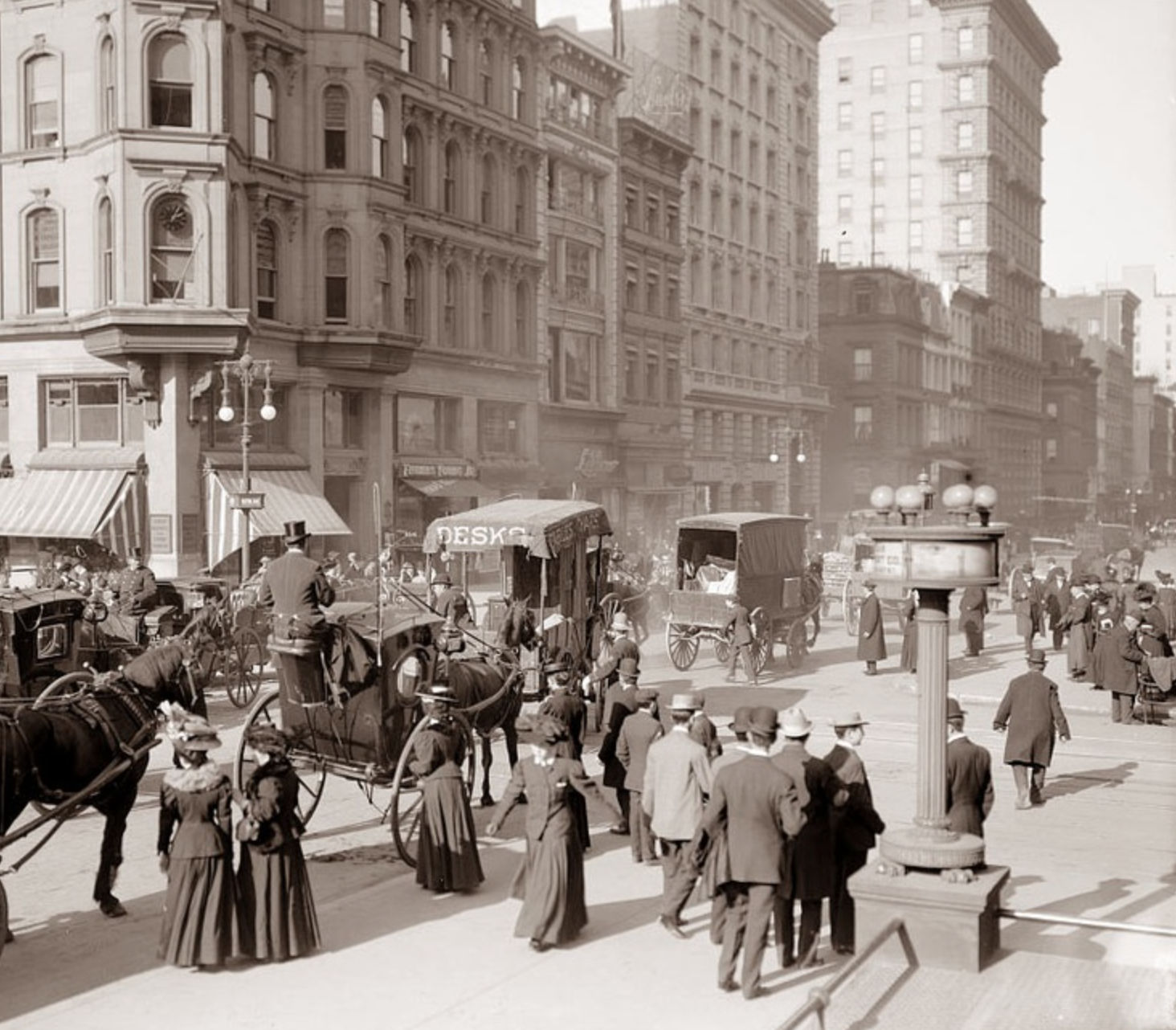
We’re guided through Madison Square at the time: The extravagant Fifth Avenue Hotel (at which Innocence finds itself on New Year’s Day), the famously luxurious Delmonico’s restaurant – which introduced America to haute cuisine), Edwin Booth’s Theatre, The National Academy of Design which Marone calls “Ruskonian” in appearance (high gothic derived from the works of the architect and theorist John Ruskin), and The Union League Club, where plans for The Metropolitan Museum were hatched.
Edith made up stories as a little girl, often carrying a blank book as a prop. At 15, she was paid to translate a German poem (printed under a pseudonym), then, through her father’s connections, published her first short story Fast and Loose in The Atlantic, followed by a book of poems simply called Verses. Writing was not considered a suitable endeavor for women. She came out to society at 17 and was swept into a social whirl acutely described in her books. We see paintings of her by Edward Hanson May at 17 and 19, when she married Edward (Teddy) Robbins Wharton.
“In The Age of Innocence, Newland Archer marries May Wellend in Grace Church. You could worship anywhere you pleased on Sundays, but had to be married, baptized, and buried from Grace Church. Edith was not,” Marone says. She conjectures that a broken engagement could’ve blemished her profile. “If you look hard enough in the city of ceaseless change, you can still see vestiges of houses in which both Edith and her characters lived.” We look at the original building of The Metropolitan Museum where the Countess meets Archer. “It’s odd, “ Countess Olenska said. “I’ve never been here before. Ah well, someday I suppose it will be a great museum.”
“The marriage began conventionally,” Marone says. “Teddy didn’t work (it was vulgar), they traveled. Edith hadn’t given much thought yet to being a professional writer. The urge grew. She began to submit poems and short stories to Scribner’s Magazine. (They would later publish her novels.) Her husband did nothing to discourage her despite custom. He was in awe of her talent. Few in her position would have been so fully indulged.”
The couple bought a house on Park Avenue and Edith’s passion for interior design was indulged. Her taste was airy and bright, stark contrast to heavy Victorian décor. Marone shows us photos. Edith’s first book in 1897 (with the architect Ogden Codman Jr.), was The Decoration of Houses.
Edith and Teddy traveled at least four months a year. She kept a travel journal that was later published as The Cruise of the Vanadis. Her first published novel, The Valley of Decision was set in 18th century Italy. The author’s sister-in-law was friends with Henry James and sent him the book.

James wrote to Edith “There it is around you. Don’t pass it by – the immediate, the real, the ours, the yours, the novelist that it waits for – do New York! The first- hand account is precious!” Next came The House of Mirth, the best-selling novel Scribner’s had published to date. The Whartons purchased The Mount, a large estate in Lenox, Massachusetts that James called “a delicate French chateau mirrored in a Massachusetts pond.” It’s now a museum. Edith decorated. There are photos.
She’d only spend a few years there, however. Teddy Wharton suffered from acute depression which turned serious. Edith had an affair with respected New York Times journalist Morton Fullerton, divorced her husband, and moved to France. With several inheritances and literary money, by late middle age, Edith would be “filthy stinking rich with hundreds of millions of dollars” and a tireless, ardent supporter of the French war effort.
The Age of Innocence, its title borrowed from a 1788 Joshua Reynold’s painting of a little girl, was published to acclaim in 1920. Eight years later, it was adapted to the Broadway Stage by Margaret Ayer Barner with Katharine Cornell as Madame Olenska. A not very successful 1935 film starring Irene Dunne was next, then Martin Scorsese’s 1993 version – an excellent representation in which Michelle Pfeiffer plays the heroine. Wharton wrote of The Age of Innocence that it had allowed her to find “a momentary escape in going back to my childish memories of a long-vanished America…”
Marone reveals many people in Edith’s life who inspired specific characters in the book. The ball at the home of Julius Beaufort, an English banker who has frequent affairs, was based on that of horse fancier August Belmont. In the novel as in life, we’re told, “he delighted in mildly shocking members of his social set.” Marietta Reed Stevens, owner of The Fifth Avenue Hotel, was the model for Mrs. Lemuel Struthers who threw scandalous parties attended by intellectuals and artists. “Edith’s social set looked down on her. She was ‘new’ money.”
The character Sillerton Jackson, guru of New York society and its pedigrees, rose out of Egerton Winthrop, lawyer and clubman, who served as Edith’s intellectual mentor for years, guiding her reading. Highly moral Mrs. Manson Mingot, who rules over New York from her mansion by Central Park, is a reflection of Edith’s aunt-by-marriage Mary Manson Jones who built three houses on Fifth Avenue between 57th and 58th Streets. Marone calls the area then “an inaccessible wilderness.” Not only that, but the buildings were made of garish cream colored stone.
“Archer is a type of man who reoccurs in Edith’s fiction, a man of good background, but with very strong yearnings for a life including art, literature and ideas. The characters are invariably unable to break through conventions and ultimately very weak. Edith’s best friend, Walter Van Rensselaer Berry was the model for all of them,” Marone remarks.
“She had known him since she was 21 and expected him to propose but he never did,” Marone says. At his death in 1927, Wharton called Berry, “the great love of all my life,” and wrote to a mutual friend, “All my life goes with him. He knew me all through, and would see no one else but me.” They’re buried beside one another in Versailles.
With Edith Wharton’s last novel, The Buccaneers, she notably returns to the 1870s Gilded Age New York of her girlhood. Aria da Capo.
An excellent lecture, well illustrated.
Francis Morrone is an architectural historian, writer, and author of 13 books as well as architectural guidebooks to Philadelphia and to Brooklyn. He is the recipient of the Arthur Ross Award of the Institute of Classical Architecture and Art, Landmarks Lion Award of the Historic Districts Council, and New York University’s Excellence in Teaching Award, and was named by Travel + Leisure magazine as one of the “Thirteen Best Tour Guides in the World.”
Free: Park Avenue Armory, Malkin Lecture Series.
Edith Wharton wrote an autobiography: A Backward Glance
Top photo: Unknown author, Public domain, via Wikimedia Commons