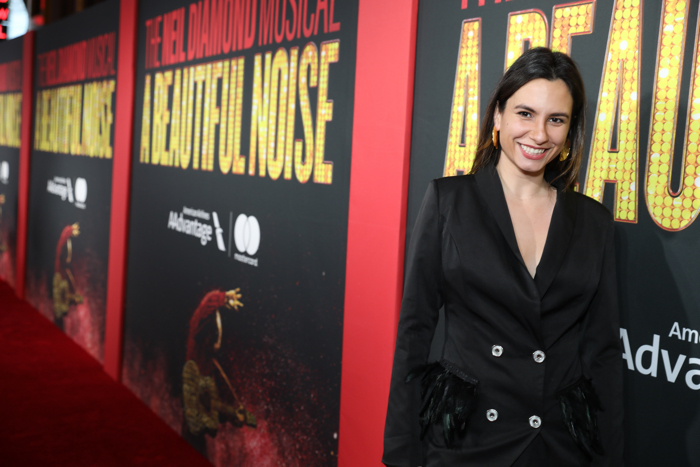
Marina Montesanti is a New York–based theatre director and Tony Award–nominated co-producer whose work moves between Broadway, Off-Broadway, and immersive performance. With Iconic Vizion Productions, she co-produced the Broadway productions of Fat Ham and A Beautiful Noise: The Neil Diamond Musical. She also recently served as Producer for the immersive revival of Into the Woods at Camp Pouch. As a director, her work includes The Visit, In The Bronx Brown Girls Can See Stars Too, Lizzie, the new musical EXIST and others. She has also collaborated on projects with Roundabout Theatre Company, BAM, Gibney Dance, Signature Theatre, and The Metropolitan Opera. Marina holds an MFA in Directing from Columbia University and a BFA in Dramatic Arts from The New School.
Can you point to one event that triggered your interest in your career?
I don’t think there was a single turning point. It felt more like a series of moments when the world opened up, and I recognized that feeling from the very first one. The earliest was pure childhood wonder: seeing a play at school and realizing something could feel so much larger than I was, and that the overwhelm of it was so joyful and electrifying. I knew I wanted to be part of that world. Then, in middle school, I worked with two extraordinary teachers, Jean and Kate, on a production of Oliver! and began to understand theatre as rigor, something shaped through rehearsal and commitment, and I learned how to approach the work with intention. Later, in high school, I moved to South Africa and studied with Ed Sheblack, who helped shape my taste: what to read, how to look at work, and how to understand the artistic lineage I was stepping into. So it was never one decisive moment. It was an ongoing sense of arrival, each time recognizing the work more clearly as my own.
What about this career choice did you find most appealing?
What appealed to me most about this career was the combination of imagination and rigor. I was always drawn to the way theatre creates whole worlds out of almost nothing, and how the imagination can operate with its own precise internal logic. Even when I was young, I loved discovering how much inquiry lived inside the work, and it brought me real joy to explore that in rehearsals or even in small gatherings with friends. Rehearsal became a place where practice, concentration, and listening mattered, and where having a voice in the process mattered too. Theatre was also a space where the only way anything could succeed was if everyone was fully present with one another. That kind of shared attention felt rare in other environments I knew. And being in spaces where English was not everyone’s first language only strengthened that bond. We were communicating through care as much as through words. That sense of collective presence was, and still is, profoundly satisfying.
What steps did you take to begin your education or training?
I knew very early that I wanted to be in New York for my undergraduate training. I wanted to learn from professors who were actively working in the field, and I was looking for a program where I could truly focus on directing, since so many theatre programs are centered primarily on acting. Graduate school felt different. By then, my career was already beginning to take shape, and a major influence on the decision was Anne Bogart. I had admired her work for years, and when I learned she would soon be retiring from Columbia University, I felt a strong pull to study with her while I still could. The chance to learn directly from her, and to carry forward the values she shaped in the field, felt deeply meaningful. From there, the decision to return to school became an extension of choosing growth, and continuing to challenge and refine my practice felt like a gift I was giving myself.
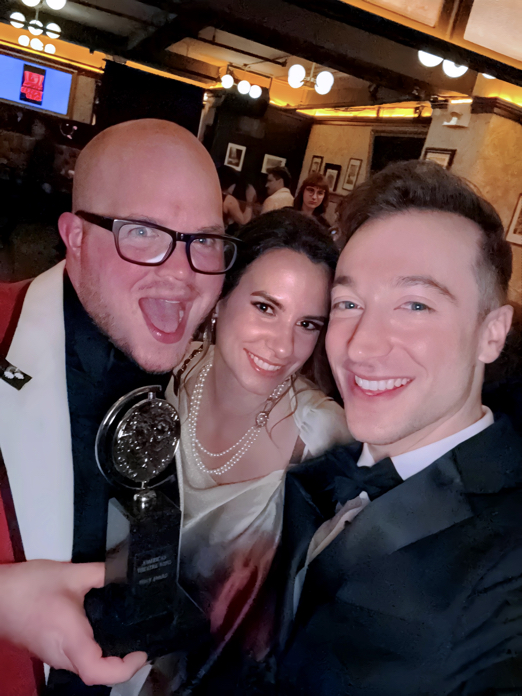
Jack Knowles (with the Tony Award), Marina Montesanti, and Miles Sternfeld
Along the way, were people encouraging or discouraging?
I heard encouragement at different points along the way, and it meant a great deal when it came. But I also came to understand that outside response, whether enthusiastic or uncertain, was never the determining force. Very early on, the work itself became the anchor. I wasn’t pursuing theatre to be affirmed, and I wasn’t stepping away when affirmation wasn’t there. I was already committed to finding a way forward, with conviction and humility toward the practice. The direction came from within, from the work itself, and from the lessons that came with putting myself out there.
Did you ever doubt your decision and attempt a career change?
I never felt the desire to leave the arts entirely, but there were moments when I stepped into parallel roles that existed close to directing. Early in my career, I accepted some of those opportunities, while quietly agreeing with myself that if they ever stopped deepening my work as a director, I would step away rather than build a new identity there.
I absolutely had a period where I questioned everything, and it lasted longer than I wished it had. I was entrusted with leadership very young, which was an extraordinary privilege, but it also meant forming beliefs quickly and carrying responsibilities before I fully understood my relationship to them. Because of that, I drew conclusions about the industry too early, conclusions I have since taken apart and rebuilt with much more clarity and nuance. Part of the journey for me was realizing how tightly my sense of purpose and worth had become woven into the work. Untangling that took time.
Today I can say, with joy, that I love what I do. I bring love and curiosity into my work, and my relationship to it now feels spacious rather than defining. In many ways, I have found my way back to myself within the life I chose.

Eric Emauni, Marina Montesanti, and Tina Johnson-Marcel (Photo credit: Michaelah Reynolds)
When did your career reach a tipping point?
For me, the tipping point was the first year when I worked continuously as a director. The year before, I truly could not see how directing would ever be financially sustainable. I remember reaching a point of asking myself, “How on earth am I going to make this work? The leap feels too big.” And then suddenly, there was a year where the projects followed one another, and the life I had been building quietly for so long began to take shape in a real, tangible way.
Can you describe a challenge you had to overcome?
Challenges arise constantly in this field, so for me the real work has been learning how to meet them without being derailed by them. I try to understand what is happening as clearly as possible, learn from it quickly, and then let it go so it does not cloud the next decision. That ability to stay steady, reflective, and forward-moving has been one of the most important skills I’ve developed and keep developing.
What single skill has proven to be most useful?
Being solution oriented, preparing with care, living up to the trust already in the room, and remaining adaptable have been the most useful skills. Directing is as much about people as it is about the work, and those qualities help the process stay collaborative and humane.

What accomplishment are you most proud of?
I am most proud of the relationships and sense of community that continue after a production ends. When artists tell me they remember the room, or when I see friendships that began in rehearsal still going years later, it feels like the work did what it was meant to do. Teaching has brought me a similar kind of pride. Watching a student discover their own voice and begin to trust it brings me a great deal of happiness.
Any advice for others entering your profession?
Stay curious about the work itself. This profession asks you to keep learning how to see, how to listen, and how to be present with other people in a room. Try things and allow yourself to fail with kindness toward yourself and others. Notice the artists who inspire you and observe how they move through the world when the spotlight is not on them.
Over time, you begin to recognize what kind of theatre wants to move through you. It is rarely a sudden revelation. It is more like a quiet bell that keeps ringing. Pay attention to that sound, and keep a sense of play alive in your work. The combination of curiosity, discipline, awareness, and play will sustain you far more than certainty ever will.
Marina’s Website
Marina’s Instagram
Photos of Marina by Miguel Herrera