Reading Peter Kuitenbrouwer’s Maple Syrup: A Short History of Canada’s Sweetest Obsession, I found the title apt—except for the word “short.” A forester, journalist and avocational tapper of trees, he’s too meticulous a researcher and likely too invested in this sticky subject to keep the storytelling brief.
That said, Kuitenbrouwer spins a pretty good tale, with an opening chapter that may explain his intense emotional connection. As a child in the seventies, he never felt a permanent sense of home until his itinerant hippie parents bought farmland in Quebec that included a hillside of sugar maples. Some of his fondest (and most harrowing) memories have him and his sister trudging, in early spring, through waist-deep snow to collect sap in buckets hanging off spiles drilled into the trees.
Kuitenbrouwer then begins his historical narrative, first putting to rest any notion of Canada’s early colonists teaching the First Peoples how to tap sugar maples. No, the Native tribes had been boiling sap for medicines and confections for millennia before the Europeans arrived to usurp their lands, annihilate their cultures, and turn their sacred sugar bushes into raw materials for floors and furniture
Kuitenbrouwer goes on to trace from early production methods to mechanical advances that all but obliterated family sugar shacks boiling saps in wood-fired cauldrons to thousands of trees leeching sap into sturdy plastic tubing that runs down to hillsides into the giant stainless-steel vats of sterile, modern refineries that reduce sap into syrup.
These methods are made possible by government efforts to regulate pricing and production, and the creation of enforced cooperatives (the author refers to them as cartels) that, by stockpiling barrels of syrup, ensure that producers get paid even in years with unproductive yields. Weather feeds into climate change, which poses a serious threat to the industry.
At times, especially when describing the families of maple syrup outliers fighting for fiscal autonomy over government protections, Kuitenbrouwer reminded me of a few friends who – when a short synopsis of a recent event would suffice – branch off into TMI about in-laws, nephews and nieces’ educational pedigrees and fabulous careers. But no one could accuse Kuitenbrouwer of not having done his homework.
There’s one amusing chapter about the Great Maple Syrup Heist of 2010, which was brilliant in conception and execution (until the perpetrators all got caught). At this point, the book made me think of Tom Miller’s highly entertaining Extra Virginity: The Sublime and Scandalous World of Olive Oil. If Maple Syrup suffers by comparison, it’s probably not Kuitenbrouwer’s fault.
Think of it: Canadians versus Italians. Maple syrup versus olive oil. In Miller’s book we get tankers from North Africa, stealing in at night to ports in Palermo and Naples. In their holds: thousands of liters of substandard product that will be surreptitiously sold, transported, packaged in pretty (and pretty deceiving) tins. In Miller’s book we get intrigue: a cast of colorful Italian characters, some motivated by grift, graft, and the Mob; others brave crusaders driven to honor birthright, authenticity, and tradition. All this, opposed to, well maple syrup, which—no matter the grade or shade—always tastes great. Still, if you’re fascinated by the history of Canada, and have ever wondered how Canadian maple syrup makes its way from the sugarbush to supermarket shelves, this book is filled with a wealth of information and answers to all your questions.
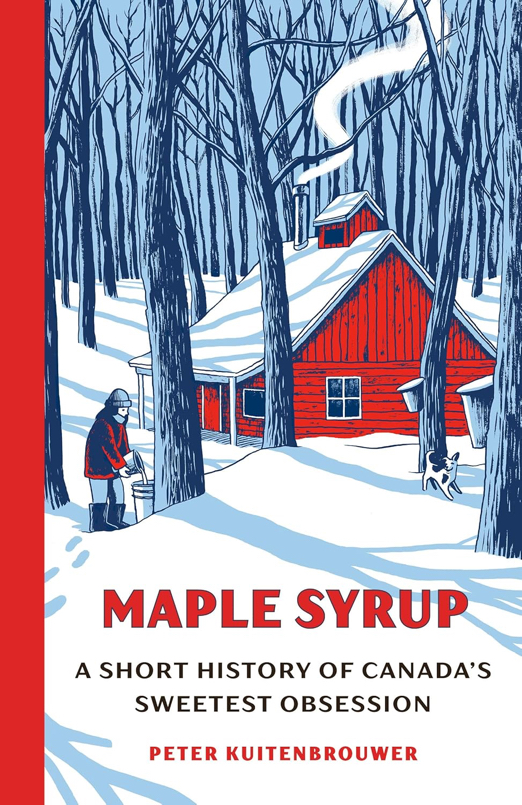
Maple Syrup: A Short History of Canada’s Sweetest Obsession
Peter Kuitenbrouwer
Top Bigstock: Pail used to collect sap of maple trees to produce maple syrup in Quebec. Copyright: Mbruxelle