In the 1880s south, families commonly depended on washerwomen to clean apparel and household linen. Though most customers were White, African Americans who were able also made use of outside help. Laundresses carried gallons of water from wells, pumps, and hydrants to scour, boil, and rinse clothes. They made their own soap (from lye and wheat bran) and starch, spending long days hunched over washtubs and jerry-rigged ironing boards. Laundry was traditionally picked up on Monday and delivered Saturday.
Washerwomen ostensibly earned between four and eight dollars a month, but were frequently underpaid, remunerated with replacements such as hand-me-downs, rice and beans, or not paid at all. Free women found it difficult to help support their families.
The play opens with a cottony, heartbeat thump, rhythmic scraping perhaps from washboards, banjo and fiddle music. We’re in a rough-hewn residence, 1881 Atlanta, Georgia. Scenic design (Jason Ardizzone-West) is evocatively detailed, revolving to expose blank walls for title projections.
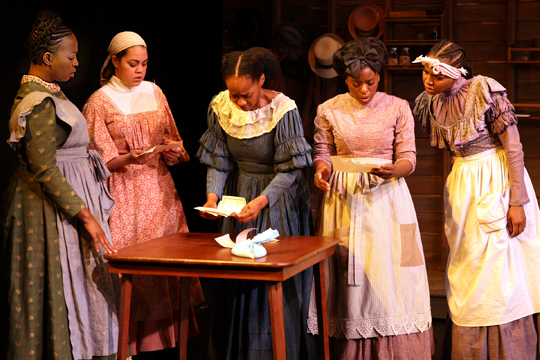
Anna (Eunice Woods), Charity (Alicia Pilgrim), Jewel (Kerry Warren), Thomasine (Margaret Odette), and Jeanie (Bianca Laverne Jones) each step into a soft spotlight, their names projected. Costumes by Gail Cooper-Hecht are historically accurate and aesthetically pleasing.
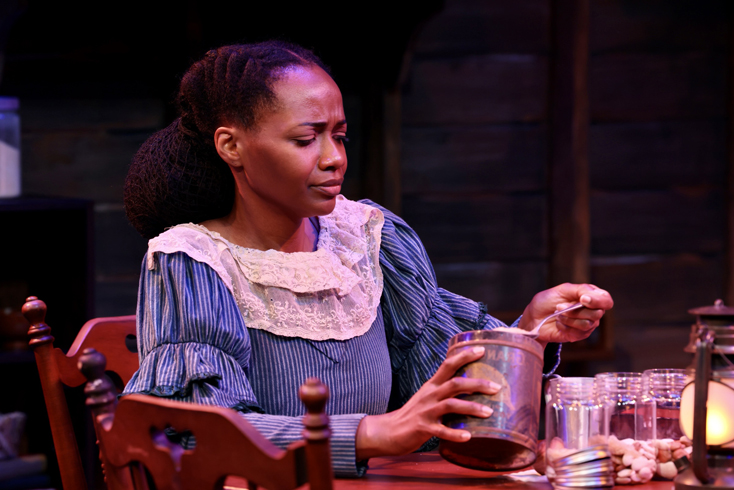
Eunice Woods (Anna)
The women work out of a house left to Anna by her husband, extremely unusual despite changed laws allowing wives to inherit. Anna is up late placing rice, beans and what looks like rock sugar into jars as payment to her laundresses in lieu of money. Best friend, Jeanie doggedly reassures her things will get better, but Anna has more than her staff about which to worry. She can’t pay her property taxes ($35) and might lose the house.
We learn about the women’s lives and struggles. Thomasine’s husband drinks and hits her. She’s courted by another man, but is afraid to make a move because of the children. Charity coos about her husband William and hopes to get pregnant. Jewel, a lighter complexion than her peers (an interesting casting decision), goes to school “to give me more power,” a fact reflected by her vocabulary and knowledge of history.
Jeanie, like Anna, is a (seemingly older) widow. Her son lives elsewhere. About to be a grandmother, it’s her great dream to visit him. Each woman has singular character. Southern accents are excellent, though Bianca Laverne Jones’s Jeanie sometimes speaks too fast to keep hers intelligible. Attempts to get paid are politely made door to door. Each is slammed (audience jumps) some accompanied by coarse language.

L-R: Bianca Laverne Jones (Jeanie) Kerry Warren (Jewel)
When Anna tenders the idea she might have to shut the laundry, Jewel suggests they strike. “We need a plan and we gotta have the church on our side.” The Washing Society is formed by a handful of women. Anna is their defacto spokesperson. At the Summerhill Baptist Church she nervously addresses an initial gathering, often quoting the Bible. They resolve to demand one dollar per dozen pounds of clothes. “You either live fightin’ or die lyin’ down.”
Between Act I and II, soundtrack is Beyonce’s “Freedom,” the only nod to today. It works. Not mentioned in the play is that the strike was timed to coincide with the International Cotton Exposition, doubly disrupting the city. Local authorities fined, threatened and arrested strikers. Their husbands were fired from jobs.
Anna and Charity are arrested and threatened with the chain gang. Anna is wounded, but the jail is wary of organized attack and releases her. Charity goes home with her husband. Newspapers began to feature the strike. There’s a scab among the women made desperate by economic conditions. Jeanie, at first present, but resistant, is coming around.
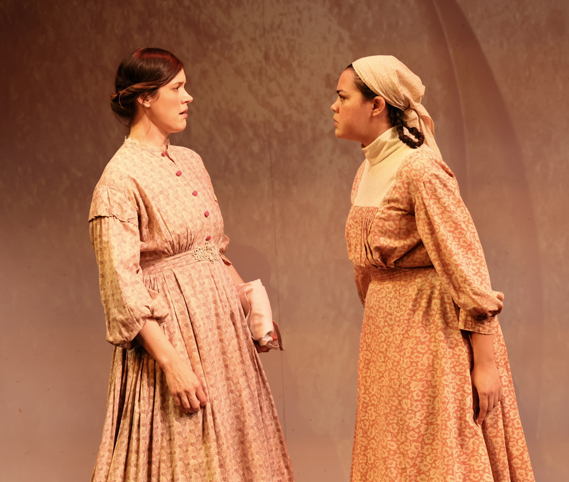
L-R: Rebecca Haden (Mozelle), Kerry Warren (Jewel)
They (local washerwomen) have effected an organization which has been joined by two hundred. Several outrages by the society have already been perpetrated on outside washerwomen that will call down the law on them…We must stop those washing amazons… The Atlanta Constitution (newspaper)
With help of volunteer Black lawyers, a letter to the mayor was drafted agreeing to pay a licensing fee …And then we will have control of the city’s washing at our own prices, as the city has control of our husband’s work at their prices. Don’t forget this…We mean business this week or no washing. There were 486 members at the time.
The group is shocked and suspicious when White washerwoman, Mozelle (Rebecca Haden), expresses her wish to join. (White women comprised less than two percent of the city’s laundresses.) “I need this. My mama is sick and I raisin’ two kids since my husband left.” (There’s more to this story, making it particularly sympathetic.)
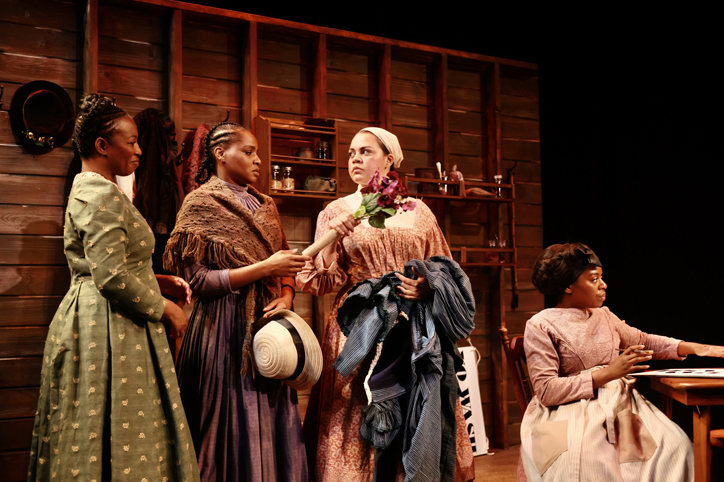
L-R: Bianca Laverne Jones (Jeanie), Margaret Odette (Thomasine), Kerry Warren (Jewel), Alicia Pilgrim (Charity)
She’s given 30 membership cards and comes back for more. Like many of the women, Mozelle can’t write her name. She uses an “x.” Though her plight is no different than that of African Americans, law enforcement treats Whites with some lenience.
Their number grows to 1500, then double that. “I never thought I’d see the day when we’d be the ones with clean clothes,” Jewel comments. Kicked out of her college, she’s now canvassing full time. Desperate people leave their wash at the door. It’s summarily returned untouched.
The Atlanta Washerwomen’s Strike was the first successful, interracial, organized labor strike of post-Civil War. That we see no celebration, just resumption of business at a living wage, is the single flaw in writing.
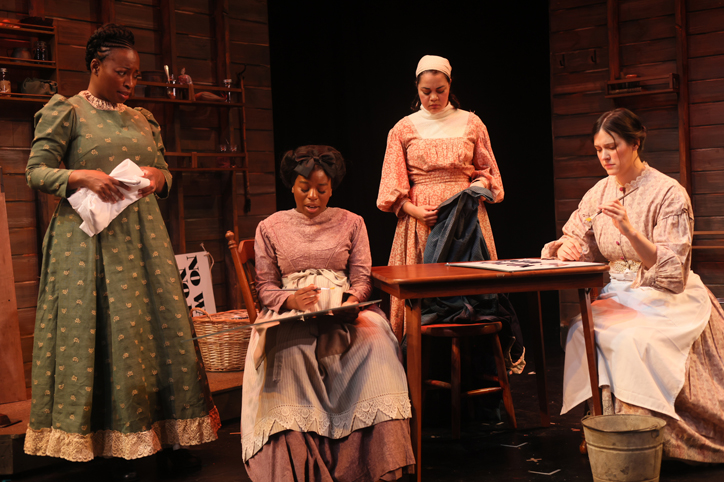
L-R: Bianca Laverne Jones (Laurie), Alicia Pilgrim (charity), Kerry Warren ( Jewel ),
Rebecca Haden (Mozelle)
Playwright Kelundra Smith offers individual and historical detail holding attention as the story unfolds. There’s no trace of the pedantic. Women are believable and sympathetic. Varied situations effectively present a cross section of those affected. Audience gets a sense of the Society’s evolution and ancillary consequences. The piece is well written, illuminating, and entertaining.
Direction (Awoye Timpo) is distinguished by finesse. We feel for the women, but even in the worst circumstances, nothing is played over the top. Pride and forbearance are as palpable as fear. Physical acting and stage composition are both excellent. Pacing allows characters to credibly think and feel. Use of sounds and music is wonderful.
Brief choreography (Adesola Osaklumi/Jill M. Vallery) is infectious and perceptibly African influenced. Bill Toles’ sound design is terrific. Both music and distinctive percussion add atmosphere and bridge components of the piece.
Additional projections (Abhita Austin) are the single discordant visual note in this production. Moving geometric shapes appear both meaningless and distracting.
Photos by Hollis King
Opening: L-R: Bianca Laverne Jones (Jeanie), Kerry Warren (Jewel), Eunice Woods (Anna), Alicia Pilgrim (Charity), Margaret Odette (Thomasine)
Woodie King Jr.’s New Federal Theatre presents
The Wash by Kelundra Smith
Directed by Awoye Timpo
Through June 29, 2025
New Federal Theater
WP Theater
2162 Broadway at 76th Street