

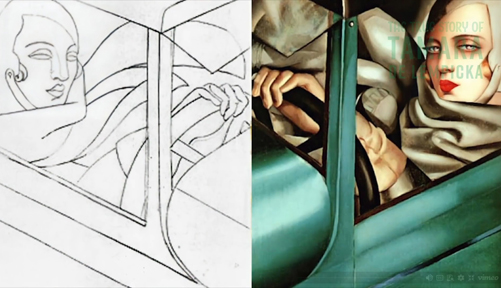
“There are no miracles. There is only what you make.” Tamara De Lempicka
Tamara De Lempicka, née Tamara Rosa Hurwitz (1894-1980), was a Polish, Art Deco painter with distinctive talent whose best known work at the height of its notoriety, unashamedly celebrated sex. Educated and praised, she grew up a proud, independent woman with an extravagant personality.
Always extremely stylish, Tamara loved and appreciated beautiful things, but judging by the film, did not have the character of someone who’d been spoiled. Though driven and only intermittently a full time mother, she’s repeatedly described as gracious and warm. Fleeing first Poland, then Paris in wartime, the painter broke through a misogynistic art community to establish herself, became her family’s breadwinner, and was fortuitously granted a resurgence of recognition late in life.

Left: “Portrait of Miss Poum Rachou” (Kisette) 1933 Center: “Study for “Girl Drawing” (Etude pour “jeune fille dessinant”), 1932, Pencil on paper
Producer/Director/Co-Writer Julie Rubio’s labor of love is beautifully crafted to feature every aspect of the heroine’s trajectory. Granddaughter Victoria De Lempicka and great-grandaughters, Marisa De Lempicka and Christina De Lempicka, participate on screen. We hear from well spoken gallerists, museum directors, curators and collectors as well as a reporter from Discovery Poland and a former studio assistant.
Drawings and paintings including charming, early watercolors, striking portraits of the idle rich (collected by such as Barbra Streisand, Madonna, Donna Karan, and Tim Rice), representation of her daughter, still lives, and later diversification of subject are wisely held on screen for long enough to take them in.

Portrait of a man (incomplete) (Tadeusz de Lempicki),1928 Paris, Musee National d’ Art Moderne
Born into the cultural elite, the artist was schooled in Switzerland, spending summers in Saint Petersburg with a grandmother who exposed her to art and told the young woman she could do anything. There she met her attorney husband, Tadeusz. Likely a political activist, he was arrested and imprisoned. Tamara slept with an official to secure his release and the couple fled to Paris. They lived by selling jewelry sewn into her clothing.
When Tadeusz both beat her and refused to work, Tamara became mistress to Baron Raoul Kuffner, a wealthy art collector from the former Austro-Hungarian Empire. He apparently didn’t support her, however. Divorce necessitated making a living for daughter Maria Krystyna “Kizette” and herself. It was Tamara’s sister Adrienne, an architect, who reminded her sibling that she used to draw and paint.

Left: “Adam and Eve” 1932 Right: Portrait de Marjorie Ferry (1932), set a new auction record for her work, selling for £16.2 million ($21.1 million)
Simultaneously studying art, she embarked on a career, at first signing work T.DE Lempitski, aware of prejudice. She was an immigrant, a woman, a mother and a Jew. “I was the first person to paint cleanly. That was the basis of my success,” Tamara said.
She became part of the militant Femmes Artistes Modernes showing exhaustively outside the mainstream, including The Salon des Tuileries and the Salon des femmes peintres. In an effort to broaden audience, Tamara painted Kizette. There were magazine covers and some commercial work. Wonderful home movies give life to the subject. “In my opinion, she created herself, created a brand,” comments Cristina De Lempicka.
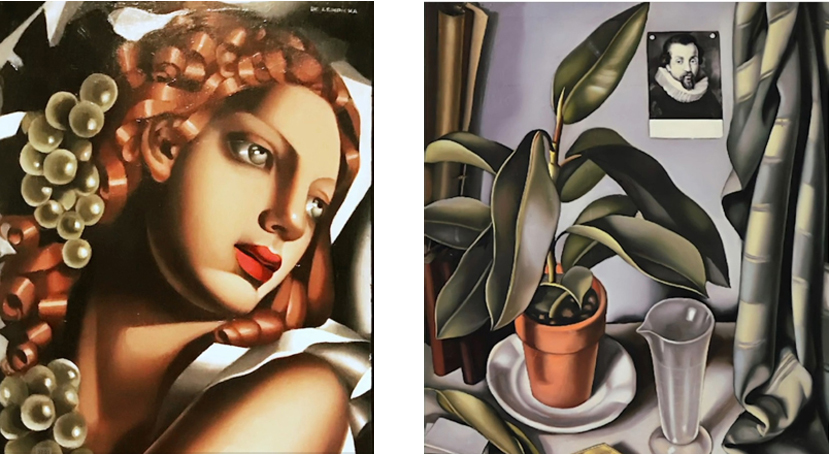
Left: Brilliance (L’éclat )1932, Oil on wood panel; Right: Succulent and Flask (Plante grasse et fiole)1941
“I don’t paint people because they’re famous, I paint those who inspire me and make me vibrate,” Tamara De Lempicka said. This, of course, excluded commissions. Many of her models were picked up on the street. A good proportion of these became lovers. The cultured lesbian community in Paris was strong and supportive. Still, painting a woman taking pleasure in her own body was decidedly avant-garde. She was nicknamed “Le Perverse Ingres.”
“Whether this woman exists or not, you look right into her soul,” states one collector. Commissioned to paint the fiancé of New Yorker and oil man Rufus Bush, Tamara was determined to take on Manhattan. In 1929, she came to New York, leaving Kizette to celebrate Christmas with her disapproving mother. When the Baron’s wife died in 1933, they married in Paris, though she remained a libertine. The family then moved to Los Angeles. She was called “The Baroness with A Brush.”

Photo of Tamara 1950 by Willy Maywald
With less of a market for portraits and her style, Tamara expanded first to still lives and then abstract work. Baron Kuffner died of a heart attack in November 1961. The artist sold everything and took three around the world trips after which she retired and moved to Houston, Texas to be with Kizette and her family. In the late sixties she was again discovered. Several large scale shows ensued. Tamara De Lempicka died among family in 1980. Years later, the stage play Tamara preceded a musical called Lempicka, whose author is among those admirers interviewed.
Tamara De Lempicka: The Art of Survival premiered October 11, 2024, at the Mill Valley Film Festival. On October 26, it will be screened at Roxie Theater in San Francisco with a Q&A to follow and on January 11, 2025, at the de Young Museum. In January there’s a screening at the San Diego Jewish Film Festival. Step by step. The producers are talking to HBO and/or hoping to bring it to New York.
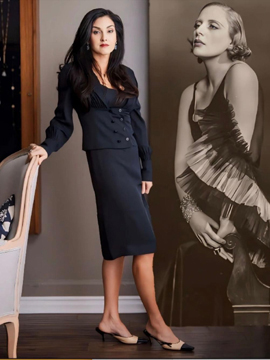
Julie Rubio (Photo courtesy of Blake Wellen)
“… looks behind the veneer of the publicity she generated for herself examining the bisexual, Jewish artist who embodied talent, resilience, passion, and a relentless pursuit of artistic freedom.” Julie Rubio
The film is a splendid endeavor, rich, illuminating, and entertaining.
(Passion By Design-The Art and Times of Tamara De Lempicka by Kizette De Lempicka)
All Lempicka and Art images Courtesy of Tamara De Lempicka Estate LLC
Opening: “Autoportrait”- Self portrait 1925 – commissioned by the German fashion magazine Die Dame for its cover
Tamara De Lempicka: The Art of Survival – A Documentary
Co-Writer, Director, Producer – Julie Rubio, president of Women in Film San Francisco Bay Area
Co-Writer, Creative Producer – Amy Harrison
Editor – David Scott Smith and Nikki Hausherr