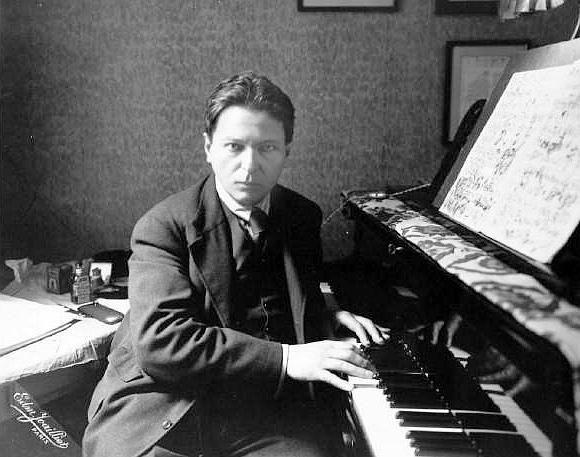
When a dear friend gave me the 3-CD set of George Enescu’s Complete Works for Piano Solo, a magnificent musical and emotional universe opened up to me. Having grown up in Romania, I knew some of George Enescu’s music from a very young age. In fact, I doubt that there is any Romanian alive who does not instantly recognize Enescu’s Romanian Rhapsody No. 1 from its very first notes. “Iconic” does not even begin to describe the piece; its blend of folk themes and lyricism, vivacity and tumult, dance and playfulness, impetuosity and longing is inscribed in our national DNA, permeating air and language; it is the musical essence of all that is intrinsically, elusively Romanian. But discovering Enescu’s works for piano solo reveals artistic depths and wonders that only the piano can coax out of a composer, from the most delicate intimacy to dark, jagged moods to haunting tenderness and pathos, avalanches of sonoral colors, and intricacies of rhythm and tonalities that fascinate the senses.
The above-mentioned are just a few gems in Enescu’s oeuvre that includes symphonies, chamber music, songs, and one opera. Enescu’s genius manifested in every aspect of his work, not only as a composer but also as a violinist, pianist, conductor, and teacher. Cellist Pablo Casals described him as “the greatest musical phenomenon since Mozart.” Enescu’s most famous student, violinist Yehudi Menuhin, considered his teacher to be “the most extraordinary human being, the greatest musician, and the most formative influence” and declared: “Enescu gave me the light that has guided my entire existence.”
George Enescu was born on August 19, 1881, in the village of Liveni, Romania, the eighth child of Maria and the landholder Costache Enescu. His mother considered George a miracle as he was the first child in the family to survive; the first seven died in infancy. At three years of age, the boy already showed signs of innovation: after having heard a folk music ensemble play, he created the semblance of a violin by sewing thread to a piece of wood. A year later he began studying the actual instrument, rapidly catching up to the piano virtuosity he was already developing. Convinced that he wanted to be a composer, he penned his first piece for piano and violin at only five. In October 1888, he became the youngest non-Austrian student ever admitted at the Music Conservatory in Vienna, and three years later he played in a private concert for Emperor Franz Josef and the court. He started performing for the Viennese public at the age of eleven and his prodigious mastery of the violin inspired Viennese critics to dub him “a Romanian Mozart.”
Enescu continued his studies at the Conservatory of Paris where he had the chance to learn from composers Jules Massenet and Gabriel Fauré, among other noted teachers who acknowledged his genius. At sixteen, he presented his first orchestral piece, Romanian Poem, in Paris. Soon after, he debuted in his home country at the Romanian Athenaeum astounding audiences as violinist, composer, and conductor. His renown and career blossomed swiftly throughout Europe, eventually taking him to the United States where he made his debut in 1923 conducting the Philadelphia Orchestra at Carnegie Hall. He returned to the U.S. frequently and conducted several American orchestras, even becoming one of the candidates under consideration to replace Arturo Toscanini as principal conductor of the New York Philharmonic. He is fondly commemorated at the University of Illinois, where he spent time in 1948, 1949, and 1950 as a visiting artist and professor. He also taught at Harvard University and at Mannes School of Music as well as at several prestigious conservatories in Europe.
Intrinsic to his artistry, Romanian folk music influenced many of Enescu’s compositions; his most widely recognized being the two Romanian Rhapsodies (1901). Echoes of folk music resound even in his opera Oedipe, which tells the entire story of Oedipus’ life and portrays the title character as a brave individual not a mere victim of the Fates. In its rich harmonic universe and complex rhythms, Oedipe is considered to be Enescu’s absolute masterpiece. Many singers who perform the opera are impressed by Enescu’s ability to balance the words of the libretto by Edmond Fleg with the music, thus illuminating the psychological depths and nuances of the Oedipus myth with inventiveness and sophistication.
It has been written that George Enescu, the man, was an elegant, handsome, and soulful charmer who captivated the attention of all at society soirées and admired women perhaps as much as they admired him. He lived several romances, but gave his heart unconditionally to a princess, Maria Cantacuzino, nicknamed Maruca. A lady-in-waiting to Queen Marie of Romania, the ambitious Maruca had married into the noble Cantacuzino family, thus acquiring the title of Princess. Enescu met her at Peles Castle in Sinaia and he fell irremediably in love, beginning a passionate and public affair that estranged Maruca from her children not to mention from her philandering husband. Still, after her husband’s death, Maruca did not rush into Enescu’s arms to make their love official. She became involved with Romanian philosopher Nae Ionescu while Enescu suffered in silence and almost destroyed the score of his Oedipe, which he had dedicated to her. When Ionescu left Maruca, she had a nervous breakdown and Enescu put his concerts on hold to return to Bucharest and care for her. At last, in 1937, Enescu and Maruca married in a small private ceremony. Their marriage proved difficult as she became increasingly peculiar, yet he remained insanely devoted to her. Towards the end of his days, as they lived in Paris on the brink of poverty, she sold several of his manuscripts and one of his violins. According to a few biographical accounts, when he took his last breath, Maruca was not at his side.
Throughout his life, Enescu was perpetually torn between his desire to devote more time to composition and the economic pressures to perform. During the First World War, he lost his savings and was forced to commit to an intense schedule of concerts. In 1946, as he decided to settle in Paris permanently, in protest of communism in Romania, again he needed to perform as much as possible, for financial reasons. By then, he was already struggling with a spinal condition that made it challenging to play an instrument, so he focused mostly on conducting. A meticulous artist, he constantly revised old pieces and his music scores were filled with details and precise instructions for performers. His memory was extraordinary. Yehudi Menuhin recalls what is now a frequently-recounted scene from his childhood student days with Enescu: the composer Maurice Ravel asked Enescu to play through his new violin sonata with him, and after going through the score only once, Enescu performed it right away from memory. Like Mozart, the Romanian composer could also create entire pieces in his head before writing them down.
While he is recognized as one of the 20th century’s greatest composers, Enescu’s body of work is not as widely known as the rare genius of his creations would merit. There are many reasons for this, including the composer’s own lack of interest in promoting himself as well as the challenges he faced throughout his life, and the two world wars. It is not an immense body of work, but his astonishing musical realm abounds in expressive forms ranging from late Romanticism to modernism, uniquely crafted and subtly—or sometimes not so subtly—haunted by that initial musical influence from his childhood, Romanian folk music. Many agree that Oedipe should be included into the standard repertoire of international opera companies. Oedipe’s U.S. premiere did not take place until 2005. London’s Royal Opera House offered a mesmerizing production in 2016, and in 2019 the opera was presented at the Salzburg Festival. In his native country, Oedipe has been performed at the Bucharest National Opera and as part of the George Enescu Festival. Established in 1958 in the composer’s honor, the Festival is held every two years. It has developed into an international sought-after event with famous guest orchestras, soloists, and conductors performing at every edition. This year’s tickets have sold out instantly, as always, and the program, opening on August 28, displays an exciting array of stars of the classical music world.
Today, on the 140th anniversary of Enescu’s birth, how can one even begin to fully honor the Romanian genius’ distinctive artistry that blazed through the first half of the 20th century and continues to awe those who encounter his works? The inimitable musical fire that was Enescu burns brighter than ever for all who take the time to explore his works, not only by listening to them or playing them, but also by producing and promoting them. There was so much more that Enescu wished to offer the world; before his death, he told a friend: “If I could put down on paper everything that I have in my head, it would take hundreds of years.” It is my hope that it would take much less for all of his music—beyond Romanian Rhapsody No. 1—to be included seasonally in concert venues all over the world. It is my dream—not the personal and proud dream of a Romanian (okay, it is that too) but the dream of a human whose life is constantly enriched by music—that more and more people will discover the imaginative, soul-thrilling, and complex musical treasures of George Enescu. Through his music, emotions acquire new, surprising colors, and so do our perceptions and pleasure in listening. Life is infinitely richer because he existed.
List of compositions by George Enescu
The National Museum George Enescu
George Enescu: His Life and Music by Noel Malcolm
Top photo, public domain.