When playwright Philip W. Chung noticed an Asian man in the cast of Charlie Chaplin’s 1917 short,
The Adventurer, he was sufficiently intrigued to do some digging. The “actor” (minor uncredited roles
in three films) was Japanese immigrant Toraichi Kono.
To Chung, Kono’s fraught story at first appeared to reflect our shameful past. As he subsequently wrote
in an introduction, however, “…sadly, here we are once again facing the same issues…anti-immigrant sentiment, the “foreigner” as danger to “real” Americans, and the threat of deportation to a country that’s not your home.”
“Everybody’s gotta have somebody to look down on.” (“To Beat the Devil”- Kris Kristofferson) So – American Indians, African Americans, Communists, The Yellow Peril, Jews, LGBTQ, immigrants…
This is a true story.
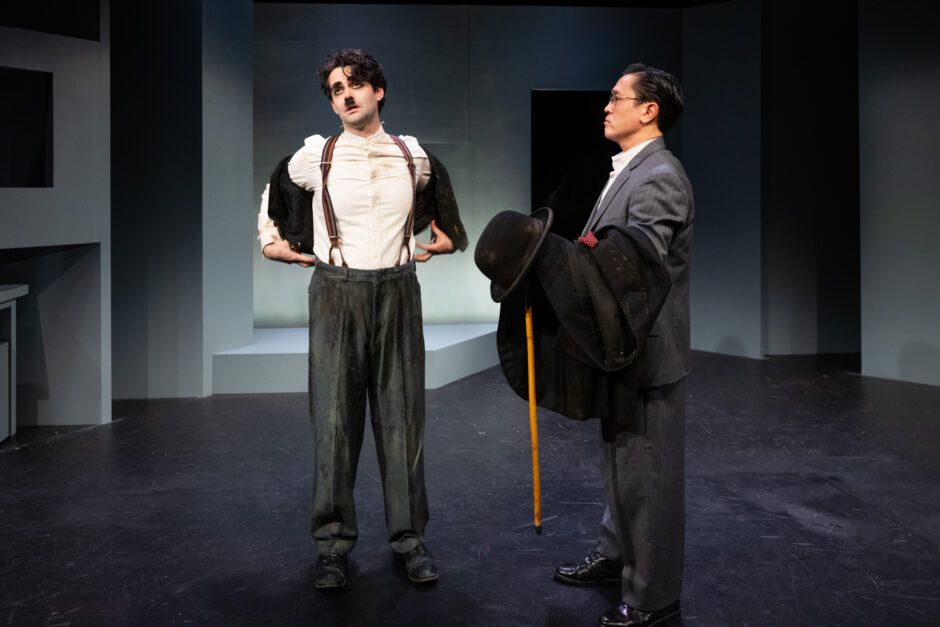
Conlan Ledwith (Charlie Chaplin); Brian Lee Huynh (Toraichi Kono)
We meet Kono (Brian Lee Huynh) in Hollywood collecting the Little Tramp costume as Charlie Chaplin (Conlan Ledwith) sheds it. Having had a number of sustenance jobs, he’s employed by the icon successively as chauffeur, valet, good right arm and confidant for what will be 18 years. Most of Chaplin’s staff were Japanese as a national stereotype presumed discretion.
The hero becomes indispensable, even cleaning up consequences of his boss’s infidelities and traveling with him. Because of duties, Kono is rarely home with wife Isami (Kiyo Takami) and two subsequent children. It’s she who keeps him from further acting since the profession was culturally thought to be demeaning. Isami is lonely but defers. That the character is framed by projections of falling cherry blossoms adds poignancy.
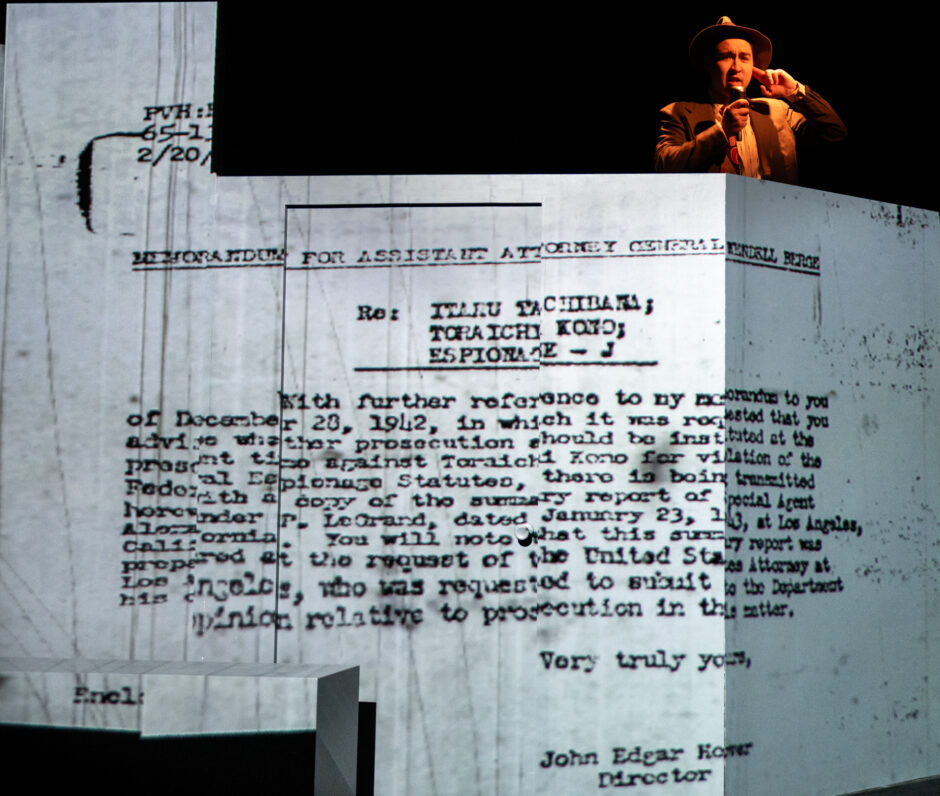
Letter about the case from J. Edgar Hoover
Projection design (Cynthia Chen) is splendid. A combination of archival news footage and period photos enhance most scenes. Movies are evoked with blurred images and sound (Howard Ho), both skirting licensing fees and present without distracting. Blossoms and rain are poetic. Sheryl Liu’s set design offers irregular panels on which engineered images are projected. Platform furniture emerges from cut-outs. A successful symbiosis.
Chaplin’s films are chronologically woven through narrative. The Kid (1921) is produced after the death of his first child. Ten years later, during City Lights, Kono is charged with reigning in hung-over actress Virginia Cherrill. (He’s always calm and authoritative.)
Three of Chaplin’s four wives are included. Paulette Goddard (married to him 1936-42) insisted on reviewing everything Kono had independently managed. His integrity questioned, the proud immigrant quits assuming a new job will be easy to secure. It is not. Formerly respectful, influential people he’d met disparage him in bigoted terms. When Isami falls ill and medical bills accrue, Kono tries to see Chaplin, but is prevented by a snide business manager. Here’s where his life goes into freefall.
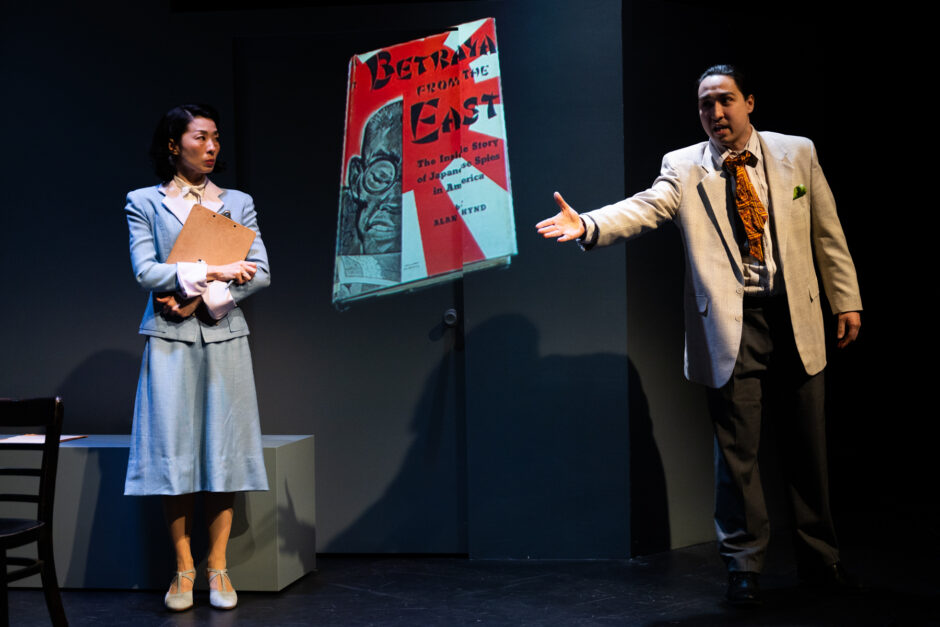
Kiyo Takami (the prosecutor); Cody LeRoy Wilson (Alva Blake)
U.S. tensions with Japan cause him to fall under suspicion of espionage due to peripheral association (a favor called in) with Commander Itaru Tachibana (Jae Woo). The bombing of Pearl Harbor and Hiroshima provokes President Franklin D. Roosevelt to set up internment camps. The so-called “relocation centers” are surrounded by barbed wire and watchtowers. Rooms are monastic; sparse possessions allowed. President Trump has reestablished Guantanamo Bay as a similar facility. The FBI (James Patrick Nelson as bigoted agent Horn) arrests Kono. He’s incarcerated.
We learn details at a trial. Kono’s been confined six years. Defense attorney Wayne Collins (Robert Meksin), who dedicated himself to the plight of persecuted Japanese (he would represent 3000),
took the case. Brash, second rate actor Alva Blake (Cody LeRoy Wilson) whom Kono had kept away from Chaplin years prior, is a witness for the prosecution. Seeking both revenge and self-aggrandizement,
he lies. Kono enacts what actually occurred. Some of what the audience observes, however, is not
shared with the court. The protagonist’s sense of honor ruled his life no matter the outcome.
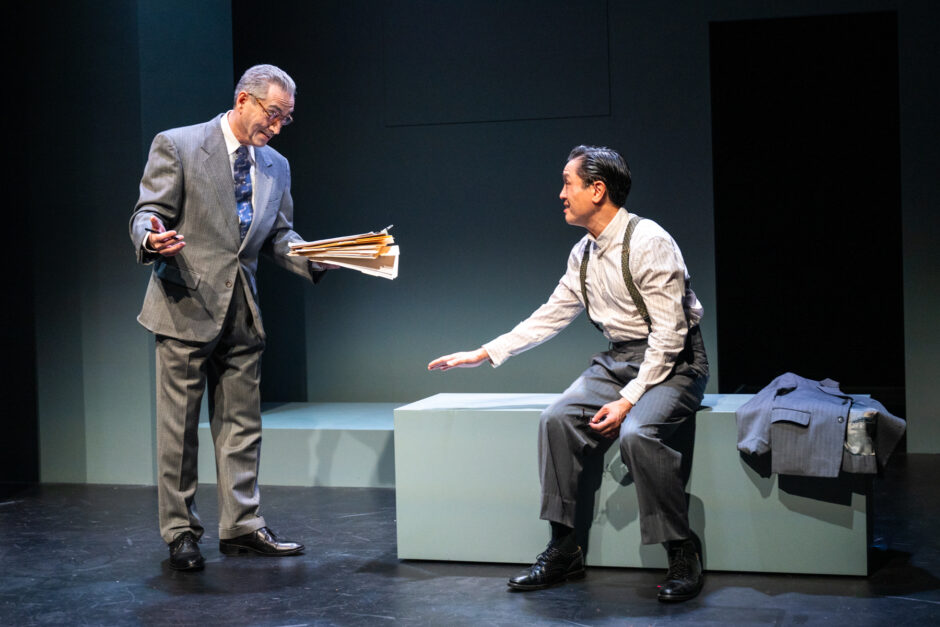
Robert Meksin (Wayne Collins); Brian Lee Huynh (Kono)
Chung’s play is fascinating, touching and well wrought, if a bit too long. Because of its rich, complex nature, a surgeon might be required to trim. Character attributes are exemplified rather than called out; condemnation of American prejudice evident not declared – a testament to accomplished writing. Kono’s wife and Collins are particularly well defined and manifest. Context is clear and disturbingly topical.
Director Jeff Liu effects great nuance and excellent pacing. Two-handers with Kono and his wife are deft. Comprehension of Japanese behavioral mores and bearing suffuses narrative.
Brian Lee Huynh is persuasive except for a brief parenthesis at Isami’s bedside when Kono seems neither in love, helpless, nor coping with imminent loss. Otherwise, reticence estimably serves the portrayal. Huynth brings grace and dignity to his role.
Kiyo Takami embodies both Kono’s delicate wife and the hard-headed, focused prosecutor with distinction and skill.
Conlan Ledwith’s Charlie Chaplin delivers clown physicality with elan. Other personification is credibly abrupt and hard-headed. One wonders about the icon’s actual character.
As Wayne Collins, Robert Meskin manifests commitment and empathy. His many shaded performance creates a whole person.
Costumes (Karen Boyer) are excellent but for one notable lapse: Charlie Chaplin’s pinstriped suit looks cheap and fits poorly, while valet Kono’s pinstriped suit is well styled and fits as if custom. Inappropriate.
Also featuring Emma Kikue in multiple roles.
Photos by Russ Rowland
Pan Asian Repertory presents
My Man Kono by Philip W. Chung
Directed by Jeff Liu
Through March 9, 2025
A.R.T./NY Mezzanine Theatre
502 West 53rd Street