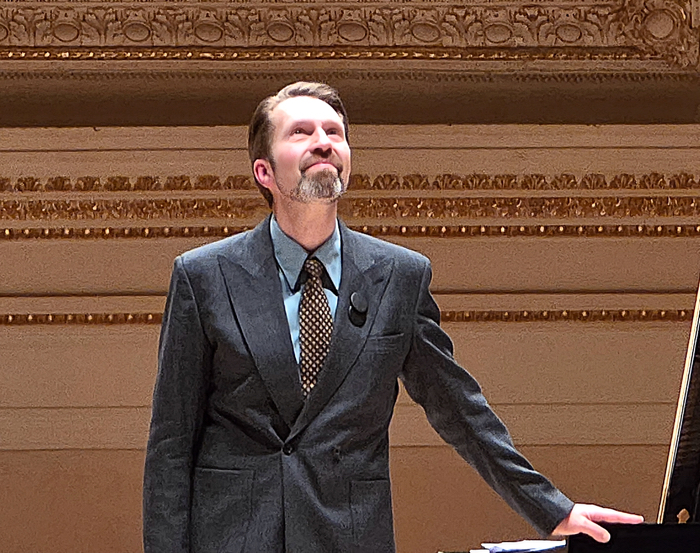
On an evening when stepping outside felt like plunging into the core of winter, Carnegie Hall became a sacred refuge for those brave enough to venture outdoors. The mood of the entire evening felt indeed sacred, reverent, hushed, and awe-filled, from the first moment that pianist Leif Ove Andsnes touched the piano keys and revealed a universe of unparalleled artistic mastery. Andsnes’ touch is unique, from vigorous, crisp, and lithe to the most delicate, softest, plush contact with a piano I have ever heard, like a snow leopard on the move barely touching the pure snow, creating an aura of supreme majesty and grace.
There are all kinds of softnesses in piano playing, but Andsnes has an inimitable way of bringing forth pianissimi and floating them to the listener, as though the entire process were infused with that special oblique translucence of Nordic light that carries subtle mysteries and longings within it. Perhaps it is tempting to detect that, since Andsnes is Norwegian, and because of my recent stay in Norway, the contact with the distinctive magic of his country causes me to perceive such esoteric influences in his playing. But even if I did not know his nationality, his style and presence still come across as enigmatic, hypnotic, and breathtaking just as the landscapes and the mesmerizing light of his native country.
The evening began with Schumann’s Klavierstücke—Piano Pieces—four pieces that date from 1838-1839 at the height of Schumann’s dispute with his beloved Clara Wieck’s father who was opposing their union. It’s a sort of manifesto of love despite difficulties, with Romanze being the most famous and most expressively adoring of Clara. Andsnes played the pieces with warmth, sensitivity, masterful contrasting dynamics, brilliance, and flawless legato.
After barely a breath, he dove right into György Kurtág’s Játékok or Games, a collection of whimsical, fleeting, jagged pieces. The composer, who will turn 100 on February 19, has created these collections as an open-ended series for one and two pianos, beginning over 50 years ago and now counting 11 volumes with hundreds of these pieces. His vision behind Games was to approach the piano as a child who may see the instrument as a toy, and thus feel free to experiment, playing with the keys in soft, strong, imaginative ways. Andsnes chose to perform some of Kürtag’s homages: to his teacher Ferenc Farkas, to German composer Georg Kröll, to musicologist Janós Demény. The pianist brought forth the playful, scintillating, angular facets of these pieces without seeming abrupt. Doina—the name for a characteristic Romanian folk song—floated as an unresolved mystical dream.
Kürtag’s Games flittered into silence and instantly gave way to the first book of Janácek’s On the Overgrown Path. Andsnes traveled through Janácek’s vivid tapestry of musical narrative and nature imagery with ease, control, and consummate power. He painted these tone poems in increasingly profound colors and moods, from dreamy and radiant to piercing and passionately romantic, poignantly capturing the sadness of “Unutterable Anguish”, foreboding of “In Tears”, and the otherworldly omen-filled theme of the barn owl in “The Barn Owl Has Not Flown Away.”
The second half of the program belonged to Schumann, with the delightful and often performed Carnaval. This is another type of ode to Clara that also briefly evokes Schumann’s first fiancée, Ernestine von Fricken. Both women have parts dedicated to them: Chiarina and Estrella, respectively, alongside inspirations by commedia dell’arte characters, real-life composers Chopin and Paganini, and Schumann’s invented alter egos, Florestan and Eusebius. Andsnes constructed an engaging musical realm with refinement, agility, and depth, flowing from intimacy to grandeur, from sparkling musical wit to poetic lyricism with unmatched charm and command.
As the final ovations roared, Andsnes offered two encores: a luminous, nimble rendition of Chopin’s Tarantelle in A-Flat Major and a delightful, sprightly yet tender “good-bye” via Mozart’s Rondo in D Major, K.485.
A mesmerizing evening of complete surrender to the exceptional, spellbinding artistry of a piano genius!
Photos by Maria-Cristina Necula