Every minute, 32 people in the United States experience intimate partner violence. Eighty-five percent are women. Why do they stay?
Abusers threaten harm to wives and children. They use guilt or love-bombing to confuse and control, making women question reality or feel responsible for the abuse. They often cut women off from friends and family leaving them without a support system.
The woman may be financially dependent. Some are taught that leaving a marriage/relationship is religiously shameful or forbidden. After prolonged abuse, a woman may believe she deserves the treatment or that she can’t do better.
Many survivors still love their partners, especially if there are children involved or if the relationship had good moments. That emotional complexity can make leaving even harder. Much of this applies to Izzy, though she/the playwright masks them well.
A trailer park. Louisiana 1989. There’s no fourth wall. Izzy places blue toilet cleanser in the tank and waxes poetic about color. Husband Ferd hates blue water. He also hates her writing. “I imagine people reading it, but I gotta get it outa my head and on paper.” Hiding in the bathroom, she writes with an eyebrow pencil on toilet paper, gently folds each poem and sequesters it in a Tampax box. (Kudos to the production for actually writing on tissue.)
It all started in middle school when Izzy recited Trees by Joyce Kilmer. “I decided right then and there oma gonna be a poet.” She acquired a journal (too dangerous now that she’s married). “Hardships have hidden gifts,” her ma used to tell Izzy. “I’m still lookin’.” The heroine married at 17. Ferd was five years older. He asked her parents’ permission, never hers. “Better to have a broken arm than no arm at all,” her ma said. Ferd made her laugh and did a good impersonation of Elvis. That was before.
A supportive teacher recommended her to Louisiana State University too late. Izzy was already under Ferd’s thumb. She never followed up. Now she cleans and cooks and writes, bracing for what might walk in the door; discovering what error she committed, enduring punishment. “I can fake an orgasm but not a hug.” Writing is her secret truth.
Rosalie, a trailer park neighbor and Izzy’s only friend, takes night courses at a local college – free to those who can’t afford tuition. Turns out she’s a reader too. Izzy shares her secret. The next day, Rosalie walks her up the road to a library. “It’s a lot better place to read and write than your bathroom.” The library card, in a back pocket of her jeans, signifies respite.
When Ferd is passed over for a promotion, Izzy reflexively jumps up with an excerpt from a Shakespeare speech. “Those words are not just in books, they’re in me.” He wallops her. Tricking her husband into allowing it, she enrolls in the poetry class. Poems are sprinkled throughout the play. Though sonnet form is sometimes employed (a stretch), content reflects unfussy expression. The work is pithy and superb.
Encouraged, Izzy even submits poems to a contest. Those she submits are not, however, the ones received by judges. Winning brings everything to a dangerous head, yet neither responsively, nor predictably.
Playwright Jamie Wax creates a brutal, yet finespun story. Interior monologue is believable. The strength of Ferd’s hold on Izzy is so infuriating, audience spontaneously applauds at gestures of defiance. Unexpected humor peppers the play. Only with the arrival of the contest sponsors do details parenthetically seem manufactured.
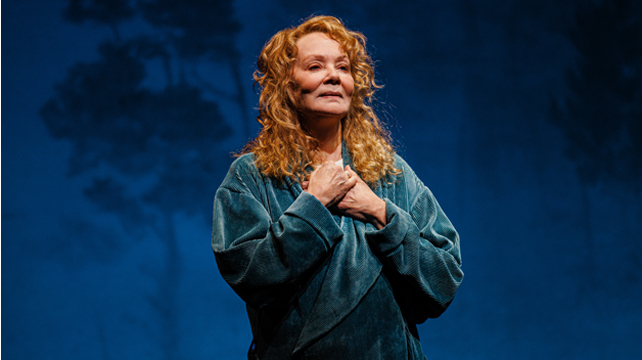
Jean Smart seamlessly creates an empathetic, traumatized victim as well as ancillary characters. Southern accent is spot on, joy in creating and expressing (aloud) palpable, visceral upset never over the top. Acts of rebellion exhilarate. The multifaceted actress has proven this aspect of her talent outside comedy, in the Emmy-winning Hacks, and in Mare of Easttown, but live performance is vibrant, superlative.
Director Sarna Lapine is equally skilled at both small business and physical reaction. One beating finds Izzy not just with a limp, but an after tremor which continues as she exits the scene. There are dozens of minute, nuanced responses. Timing is expert.
Scenic design by Mikiko Suzuki MacAdams effectively confines action to a section of the small bathroom, then sliding open panels to reveal a scrim of tree silhouettes in the yard. Sectioning off emulates suffocation of Izzy’s small world.
Donald Holder’s lighting design is symbiotic and effective. Sound design by Beth Lake ranges from southern country music by T Bone Burnett to audible, psychological emphasis .
Photos by
Call Me Izzy by Jamie Wax
Directed by Sarna Lapine
Through August 17, 2025
Studio 54
254 West 54th Street