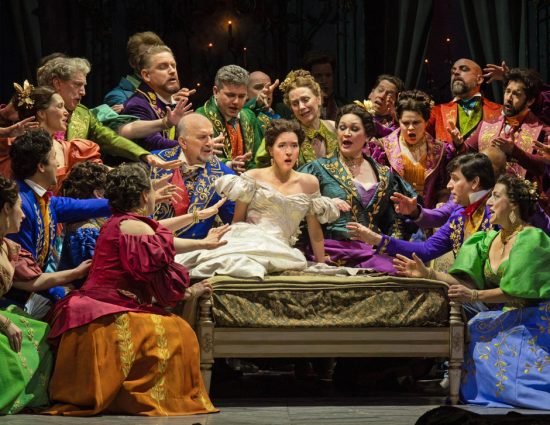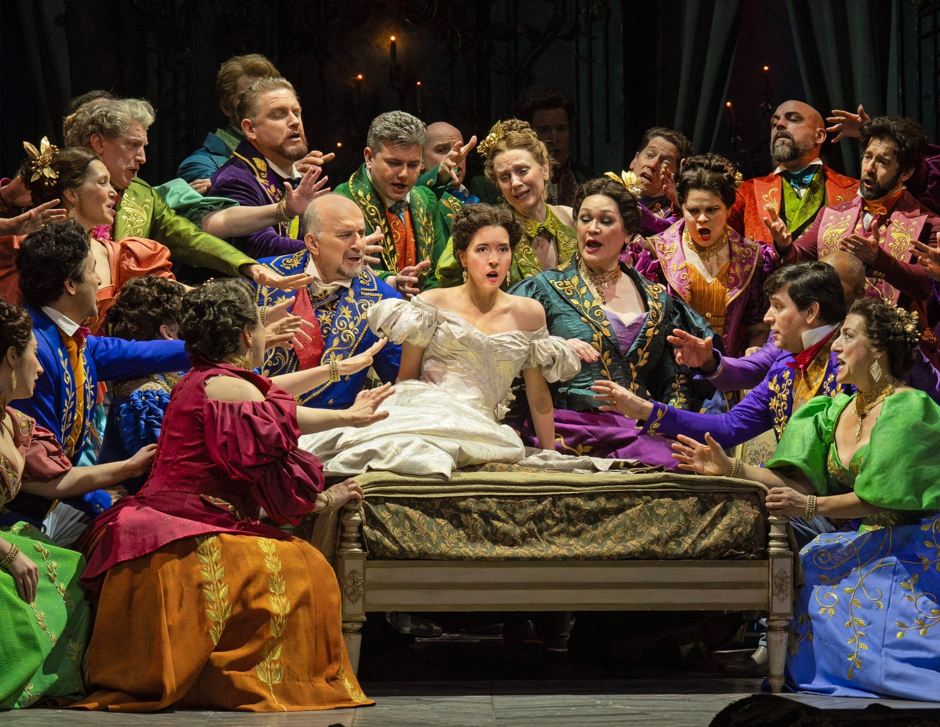
After a three-year absence, Michael Mayer’s production of La Traviata has returned to the Metropolitan Opera, bringing with it a renewed sense of visual splendor and interpretative depth. Time has not diminished its impact; rather, the hiatus seems to have deepened its emotional resonance. The production’s visual identity remains striking. The vividly colorful costumes by Susan Hilferty continue to dazzle, particularly in both opulent scenes at Flora’s parties, on the beautiful vine-leaf ornamented background of the turquoise walls and the enveloping, mesmerizing lighting design by Kevin Adams. In the opera’s final moments, the gently falling snow, as Violetta approaches death, creates a visual that is as visually arresting as it is emotionally devastating.
One of Mayer’s unusual directorial choices here is the inclusion of Giorgio Germont’s daughter as a silent, recurring presence, an invention not found in the original. She first appears during the overture as part of a tableau foreshadowing the tragedy to come, and later accompanies her father to Violetta’s country house. The most poignant moment arrives in Act III, where the daughter crosses the stage in a bridal gown with an immense trailing veil, an ethereal-looking image that underscores the theme of societal conventions and pressures shaping the narrative, but that also shows the haunting, transparent, imposed construct of those themes in contrast to Violetta’s heartbreaking, human tragedy.

Piotr Buszewski as Alfredo and Lisette Oropesa as Violetta in La Traviata – Photo: Ken Howard / Met Opera
The ardent, sublime heart of this performance is Lisette Oropesa, returning to the role of Violetta after having displayed, to great acclaim, her glorious bel canto artistry in I Puritani at the start of this year. Her portrayal is touching and emotionally nuanced, reflecting Violetta’s transformation from a playful, seemingly frivolous courtesan into a figure of profound understanding and selfless love. Oropesa’s voice molds to this evolution: from the diamantine flirtiness in her first act duet with Alfredo to the silky vulnerability of “Ah, fors’è lui” and the rebellious brilliance of “Sempre libera” to the anguished resignation of “Dite alla giovine” in the duet with Germont and the torrential passion of “Amami, Alfredo”, Oropesa’s voice scintillates and flows like an unending, abundant river of colors and emotions. As a spectator, you may find yourself in a state of hypnosis and instant addiction: spellbound by the myriad of hues in that voice and craving for more. Her “Alfredo, Alfredo, di questo core” soars heartbreakingly ethereal as though she has already left this world, only to return and powerfully convey the deeply affecting sorrow of “Addio, del passato.” And the heart-wrenching “Ma se tornando” in Act III is almost unbearable as Oropesa’s tone darkens and smolders underneath with the rage and pain at the realization that even Alfredo’s arrival would not save her. By the time we get to her final subdued utterings in “Prendi, quest’è l’immagine” as she gives Alfredo her portrait, I would venture to say that countless tears were already flowing in the house. Multifaceted, profound, and complex, Oropesa’s Violetta is one for the ages.
Sadly, her singing partners fell short of matching her level of artistry. Making his house debut, tenor Piotr Buszewski displayed a beautiful voice. But occasionally imprecise intonation, indecision about the direction of certain phrases, and an abrupt use of dynamics, made his singing feel like a roller coaster ride, and not in the best way. Just when he would manage to complete a gorgeous phrase, he would then change something in his emission or dynamics or intention and leave the listener confused or wanting. In “Un dì felice” he did offer lyrical warmth and tenderness, and his “De’ miei bollenti spiriti” brimmed with youthful ardor.
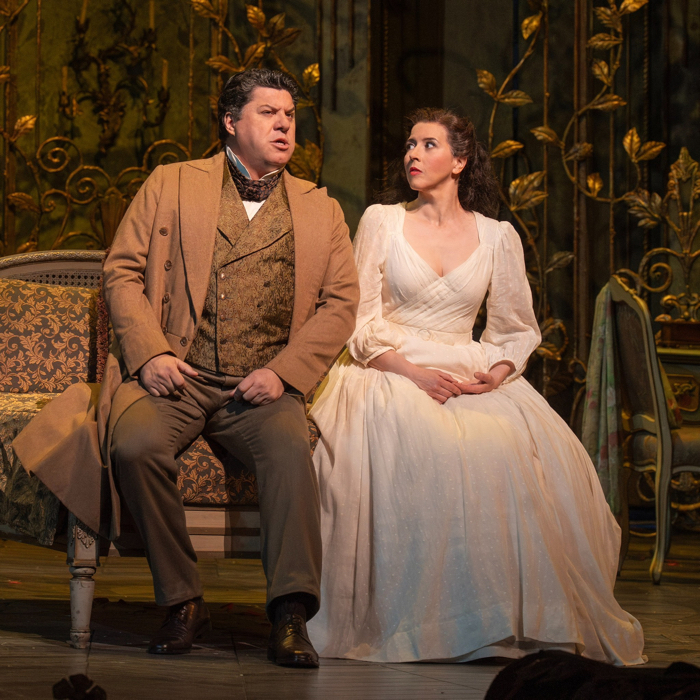
Luca Salsi as Germont and Lisette Oropesa as Violetta in La Traviata – Photo: Ken Howard / Met Opera
The major astonishment to this reviewer was Luca Salsi. I have heard Salsi in a few operas among which were Otello and Tosca. My reviews have been full of admiration for him, because both as Iago and Scarpia, he managed to maintain suave legato and seductive tone throughout. So, the shock was all the greater when he did not do that as Germont. Perhaps he wanted to channel a harsher version of the father. Still, if a baritone can offer moments of beautiful singing in villainous characters like Iago and Scarpia, how can that same baritone resist endowing Germont with such moments? “Di Provenza” alone is an invitation and showcase for smooth legato and splendor of tone. Unfortunately, I found Salsi adopting a tendency to bark words relatively often, and while there were some moments of appealing phrasing, overall, his Germont sounded harsh and grainy. I would like to believe that this was a conscious dramatic choice on his part.
The supporting cast contributed solidly to the overall success of this performance. Edyta Kulczak’s Flora is lively and charming, while Dwayne Croft lends Baron Douphol imposing colors. As Dr. Grenvil, Richard Bernstein brings nobility and vocal authority to the character. Notably, two members of the Lindemann Young Artist Development Program—Tessa McQueen as the soulful Annina and Ben Reisinger as Gastone—offer promising glimpses into the next generation of future potential star singers.
Maestro Antonello Manacorda showcased impressive musical command and mastery, attentive to dynamics and nuances, and supportive of the singers. He led the orchestra and chorus in a vibrant and affecting performance of substantial vitality and emotional power.
La Traviata runs through April 10. Amanda Woodbury sings Violetta on April 3, alongside Arturo Chacón-Cruz as Alfredo and Anthony Clark Evans as Germont.
La Traviata returns May 3-June 6 with different casts.
Top photo: Lisette Oropesa as Violetta in La Traviata – Photo: Ken Howard / Met Opera