
Growing up north of Boston on the coast, I became a fan of shellfish at a very early age. Lobster, soft shell clams, shrimp, scallops, crab: it wasn’t just the taste and texture I loved, but also the hands-on pleasure of twisting, cracking, squeezing, digging and dipping that preceded the eating. By five I could dismember my own lobster and find the hiding places of every morsel of meat. By ten, I’d tried escargots and liked them. (Full disclosure: my father had recently sold a fancy-food deli.) By twelve, I was downing raw cherrystones and littlenecks—hold the cocktail sauce—with oysters soon to follow.
But mussels? At the beach, we saw them as nearly inanimate objects clinging to seaweed in tidal pools at low tide. At the harbor, they were grimy, gnarly, and barnacle-encrusted—attached by tangled threads to ropes and pilings of docks and piers. That is to say: not the kind of shellfish you’d eat.
But piles of shells found in middens (archeology-speak for trash heaps) suggest that coastal peoples have been consuming mussels for at least 20,000 years. From texts, we know that mussels have been cultivated since ancient Rome; and recipes, using familiar ingredients like wine, herbs and aromatics, have been around since the Middle Ages.
Here in America, mussels living along pristine shorelines provided a valuable source of protein for indigenous communities that also used the shells to create ornaments. By the late 19th century, however, pollution, damming and other forms of habitat destruction had made most mussels unsafe to eat.
It wasn’t until the advent of aquaculture—specifically the 1973 establishment of the first mussel farm on Maine’s Damariscotta River—that the much-maligned mollusk would begin its slow but steady ascent to respectability. But getting there would take time. Nearly twenty-five years later, food writer Amanda Hesser’s piece in The New York Times suggests Americans were still not convinced.
Hesser acknolwedges that mussels, or, as she calls then, “the wallflowers of shellfish,” a “terrible image problem,” but farming, she writes reassuringly, has made them “a different animal”. Different in which way? “[M]eatier, grit-free and in need of only a light rinse before cooking.” On the bivalve’s reviled “beard”—made up of wiry self-made threads and used to glom on to hard surfaces—mechanical trimming has made it “so small the cook can forget about it,” i.e., “no more than a goatee.”
Today, we can feel good about buying mussels, and good about eating them, too. Mussel farming is a sustainable practice. As filter feeders, mussels take in phytoplankton and exude filtered water that improves the ecosystem by inhibiting the growth of harmful algae. With some farming techniques, mussels also create artificial reefs—boosting biodiversity by providing habitats for other marine life. Plus they’re low in fat, high in iron and healthy lipids that counteract ‘bad” cholesterol.
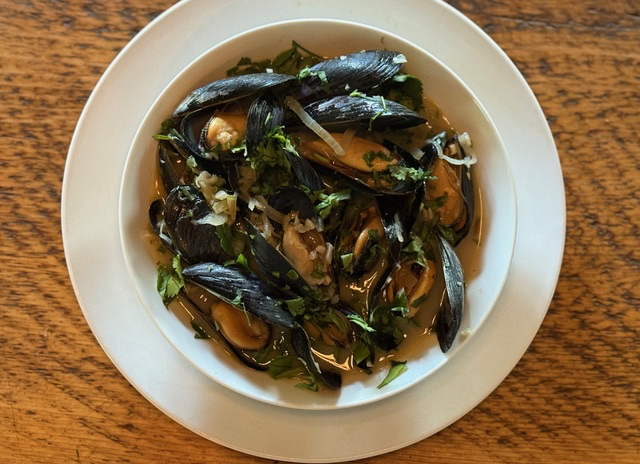
But since virtue alone cannot dictate pleasure. And on that front, mussels come through, too. With their buttery texture and a sweetness mixed with just a hint of brine, mussels are delicious. Their creamy bifurcated bodies against opalescent shells make for a dramatic presentation. They’re also amenable to a range of preparations and ridiculously easy to cook. How many foods let you know the precise moment they’re done? With mussels, once the shells open, turn off the heat.
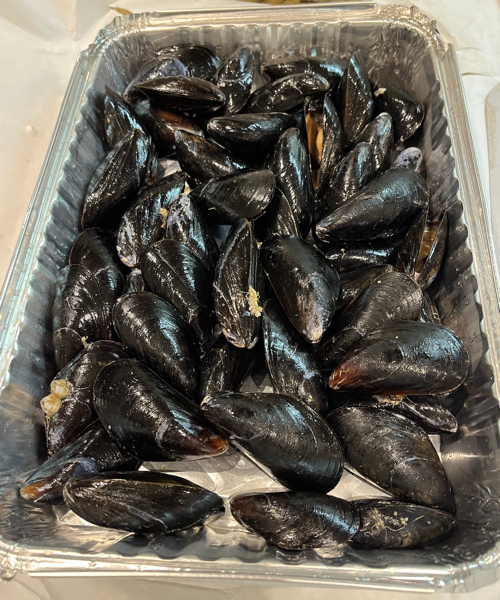
One pound of mussels will yield about four ounces of meat. A two pound mesh bag will feed two or four if served over pasta. Usually, when I cook for four, I’ll buy two bags and look forward to a few leftovers the following day. Below are three recipes to suit your mood, your guests, and the ingredients you may already have on hand.
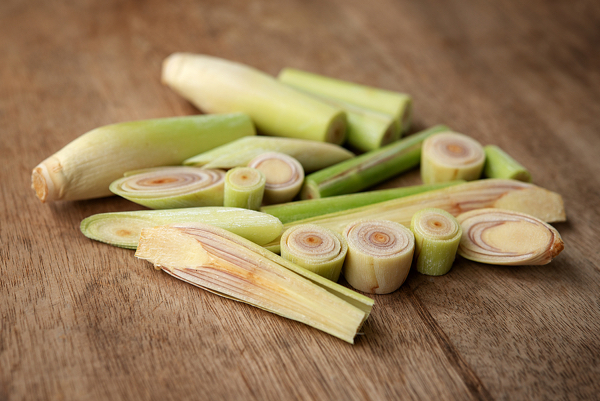
Fresh green lemongrass slices (Bigstock photo)
THAI MUSSELS
In this, my new favorite way of cooking mussels, the fat of the coconut milk eliminates the need for oil or butter. After checking out the ingredients, scroll down to find out about a cool hack* to fall back on when you’re missing one, two, three or more.
Ingredients
- 2 lbs. mussels
- 1/3 cup dry white wine
- 1/2 can coconut milk
- 2 T finely chopped lemon grass, (tough outer layer removed)
- 2 Makrut or kaffir lime leaves, thinly sliced or chopped (available in Asian markets)
- Zest of 2 limes
- 1/4 cup fresh lime juice
- 2 T minced garlic
- 2 T Asian fish sauce
- 1 T white sugar
- 1 ½ T Thai red curry paste (optional)
- 1/2 cup chopped cilantro
Directions
- Combine white wine, coconut milk, lemon grass, lime leaves, lime zest, lime juice, garlic, fish sauce, sugar, two T of the cilantro, and (optional) curry paste in a large pot. Stir to dissolve sugar and paste and bring to a boil for about three minutes.
- Add mussels. Stir and cover, frequently lifting the cover to stir and see if the mussels have opened. As soon as they have, turn off the heat and ladle into bowls.
- Top with remaining cilantro.
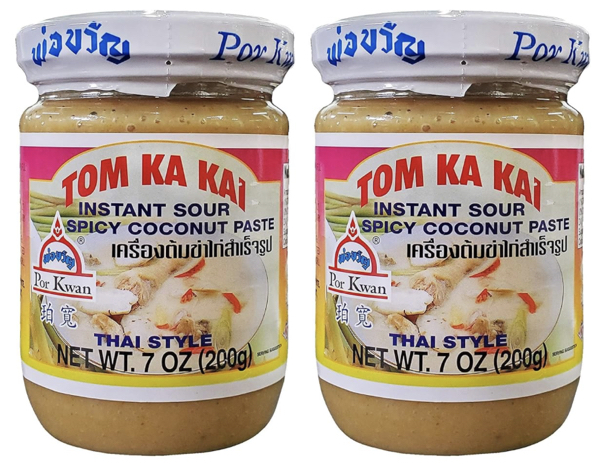
Cool Hack: A broth made of few tablespoons of Tom Ka Kai paste and a cup of water will pretty much fill in for whichever ingredients you don’t have. Technically a soup base (the soup often appears on Thai restaurant menus as Tom Kha Gai), it contains, in addition to a few relatively innocuous but unpronounceable ingredients, coconut milk, shallot, lemon grass, garlic, kaffir lime leaf, galanga, sugar, and salt. Even when I may have every ingredient, I add a couple of teaspoons of the paste to boost the flavor of the broth. Available at Whole Foods, Asian markets, and on Amazon.
MOULES MARINIÈRE – French
Ingredients
- 2 lbs. mussels
- 4 T butter
- 1 leek, thinly sliced – white and tender green only
- 5 shallots, thinly sliced
- 3 fat garlic cloves, thinly sliced
- 1 cup dry white wine
- 4 T minced Italian parsley
- Kosher salt and freshly ground pepper to taste
- 1/4 cup heavy cream or crème fraîche
- 1 baguette or loaf of crusty bread, sliced, brushed with olive oil and toasted in a hot oven or stovetop (only if you can watch it carefully)
- Aïoli (optional, for serving)
Directions
- In a large stockpot or Dutch oven, melt two T butter. Add the sliced garlic, leek, and shallots and sweat them over low heat until soft but not browned. Season with salt and pepper.
- Add the wine and turn up the heat to reduce it by half, about three minutes. Add cream or crème fraîche and return to a boil.
- Add the mussels and two tablespoons of parsley. Stir and cover, checking under the cover frequently to see if the mussels have opened. As soon as they have, turn off the heat and ladle into bowls.
- Top with remaining parsley; tuck in a slice of toasted bread. Serve with aïoli if you have it. Alternatively, ladle the mussels and sauce over pasta.
*Aïoli: you can make this homemade mayonnaise by whisking together one egg yolk, 1 T lemon juice, and a clove or two of crushed garlic, then slowly—drop by drop—whisking in oil until you have a thick emulsion. While one egg yolk can absorb about 3/4 cup of oil, results may vary according to size of the yolk, type of oil, humidity, barometric pressure, and possibly the political climate. Best to feel your way to deliciousness, if not perfection.
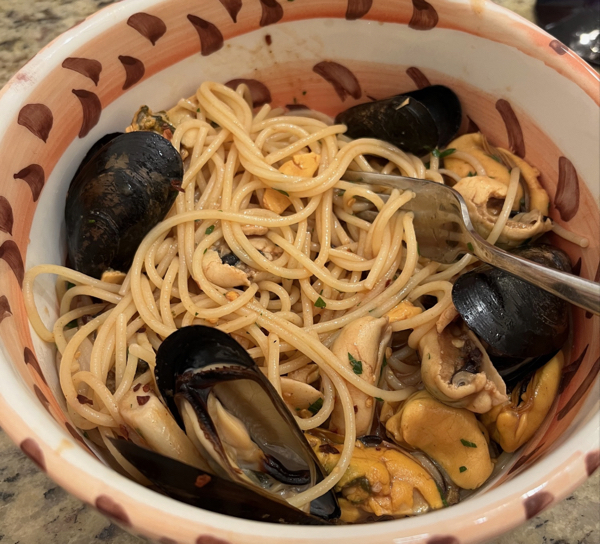
ZUPPA DI COZZE – Italian
A close relative of Moules Marinière, Italian-style mussels are cooked with wine, tomatoes, and olive oil instead of cream and butter.
Ingredients
- 2 lbs. mussels
- 4 T extra virgin olive oil
- 1 cup of thinly sliced white onion and/or shallot
- 4 T finely chopped fresh fennel (optional)
- 5 fat garlic cloves, thinly sliced
- 1 cup dry white wine
- 1 1/2 cups chopped cherry tomatoes.
- A few threads of saffron (optional)
- 4 T chopped parsley
- Torn basil for garnish
- Kosher salt and freshly ground pepper to taste
- 1 baguette or loaf of crusty bread—sliced, brushed with olive oil and toasted in a hot oven or stovetop (only if you can watch it carefully).
Directions
- Soak saffron threads (if you’re using it) in one tablespoon water.
- In a heavy pot, heat olive oil. Add onion, garlic and (optional) fennel, and sweat over low heat until the aromatics are soft but not browned. Season with salt and pepper.
- Add wine and turn up the heat. Cook until the wine is reduced by about half, about three minutes. Add tomatoes and two tablespoons chopped
- Add mussels and two tablespoons of the parsley. Stir and cover, frequently lifting the cover to stir and see if the mussels have opened. As soon as they have, turn off the heat and ladle into bowls.
- Top with the remaining parsley and torn basil; tuck in a slice of toasted bread. Alternatively, spoon the mussels and sauce over pasta.
Top photo by Carolyn Swartz