
Every stylist I know has the same November problem. Clients want to see the winter direction before they spend money, and pulling together a proper mood board means borrowing pieces, booking a friend with a camera and losing a Saturday. So I set up a small experiment around a fictional client: Jess, who runs a two-person styling studio in the West Village and sends her clients a seasonal lookbook every quarter.
The question was simple. Could an AI image model give Jess usable mood boards and lookbook pages, with her colors, believable fabrics and the same model across every look, for less time and money than a shoot? I made 15 images over one afternoon and measured what came back.
The brief
Jess’s fall capsule is built around four colors: camel (#C19A6B), burgundy (#7B1E2B), olive (#6B7445) and cream (#EFE6D2). The board needed a camel wrap coat, a burgundy cable-knit sweater, olive corduroy trousers, a cream silk scarf, brown ankle boots and small gold hoops, laid flat on linen and shot from above. I put the exact hex codes into the prompt and asked for no text, no logos and no labels.
I ran everything through Seedream 5.5, an image model that makes new images from a written description and can also edit an image you hand it. You pay per finished image, with no subscription. My first three boards were billed $0.013 each; every standard-size image after that came to $0.016. The model page says its live price table is what counts, so check it before you budget. A 2K image cost $0.028, and edits added a small charge for the reference photo, so most edits landed at $0.022.
Test 1: does it stick to the palette?
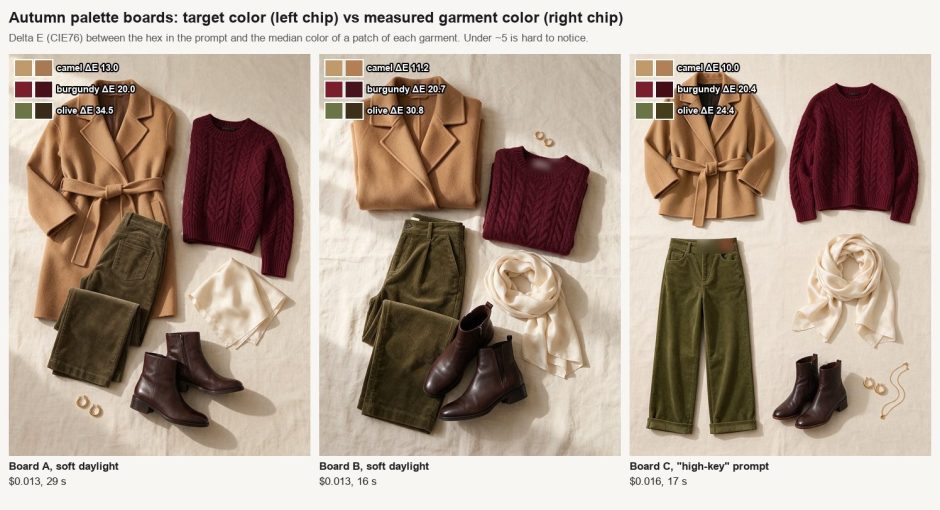
At a glance, all of them look like a real stylist’s flat-lay. Every board had every item, the styling was tidy, and the light was the soft window light you see on good fashion accounts. Each took between 16 and 29 seconds of generation time.
Then I measured the color. For each garment I took the middle color of a patch of fabric and compared it with the hex code using Delta E, the standard score for how far apart two colors look. Under about 5, most people would not notice.
Camel came closest, at 11 to 14. Burgundy drifted darker, toward oxblood, at 20 to 28. Olive was the worst, at 31 to 35. The trousers came out as a deep brown-khaki that reads as olive on the board but would not match a real pair on a rail. When I rewrote the prompt to ask for bright, high-key studio light, one board improved (olive down to 24.4) and the next did not (30.4). The model likes rich, moody color, and it shows.
One more catch: I asked for no labels, yet small neck labels with unreadable pseudo-lettering turned up on all five boards, plus a waistband patch on one. I blurred the most visible ones in the figure above. Zoom in before you post anything.
Test 2: the same model in four looks

Lookbooks fall apart when the model’s face changes from page to page. I generated one fictional model first: early thirties, chin-length auburn bob, freckles, green eyes. Then I fed that image back to the Seedream 5.5 API four times and asked for a new outfit and setting each time: a brownstone stoop for fall, a candlelit doorway for the holidays, a snowy park for winter and a riverside railing for spring.
To check consistency without just trusting my eyes, I ran each result through a face-recognition model and compared it with the original. Scores were 0.75, 0.82, 0.54 and 0.71, where anything above roughly 0.36 counts as the same person. The lowest score was the winter look, where a beanie hides most of her hair. To me she is clearly the same woman in all four, freckles included. Each look took 14 to 18 seconds.
A useful surprise: for the spring look I left the size on auto, and it came back at 2K (1664 x 2496) and was billed $0.034 instead of $0.022. If you want predictable costs, set the size yourself.
Test 3: changing one piece, and fabric up close
Clients often ask, “Could I do that sweater in green instead?” I asked the model to change only the sweater to deep forest green and leave everything else alone. It did exactly that in 14 seconds. Comparing the before and after pixel by pixel, nothing outside the sweater changed in any meaningful way, and the cable pattern and folds stayed put. This was the most useful result of the day.
For fabric detail I asked for a close-up of a herringbone tweed lapel, a chunky cable knit and wide-wale corduroy. At 1K the textures were convincing, but the model also added a hand I never asked for. At 2K ($0.028) the same prompt produced loose wool fibres, a clean herringbone and properly ribbed cord. If texture is the point of the image, the extra 1.2 cents is worth it.
Test 4: a cover with words on it
Finally, a lookbook cover with the headline “THE WEST VILLAGE EDIT” and a smaller line, “Fall / Winter 2026 · 5 looks”. Both attempts spelled every word correctly, with the dot and slash in the right places. One placed the dark headline over a dark brownstone, so it was hard to read; the other was ready to use. That is a 2-for-2 on spelling and a 1-for-2 on layout.
What it cost and where it stops
The whole afternoon came to 15 images, no failed jobs and $0.29. Most images took 15 to 22 seconds, and the slowest took 33. For Jess, a quarterly lookbook draft would cost less than a coffee.
Where it stops is just as clear. These images are for direction, not for selling. The colors are off enough that a client could fall for a sweater that does not exist in that shade, so I would always put the real swatch or the real garment next to the board. The model, the clothes and the streets are invented, so label the images as AI-made when you share them, and never present them as photos of pieces you stock. And if you want a real client or friend in the picture, get their permission first.
Used that way, it is a fast sketchbook. I would still book the photographer for the final lookbook, but I would walk into that shoot knowing exactly which looks to shoot.
Featured photo by RDNE Stock project at pexels.com. Other photos created in AI.
Contributed posts are advertisements written by third parties who have paid Woman Around Town for publication.