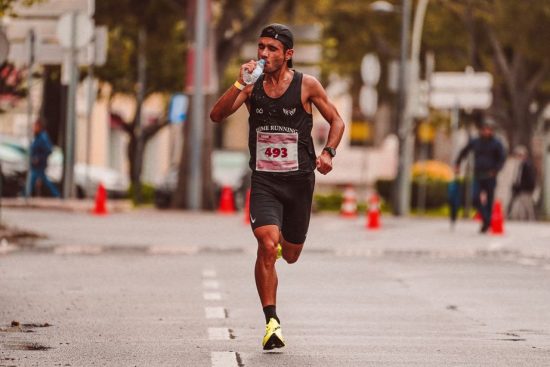

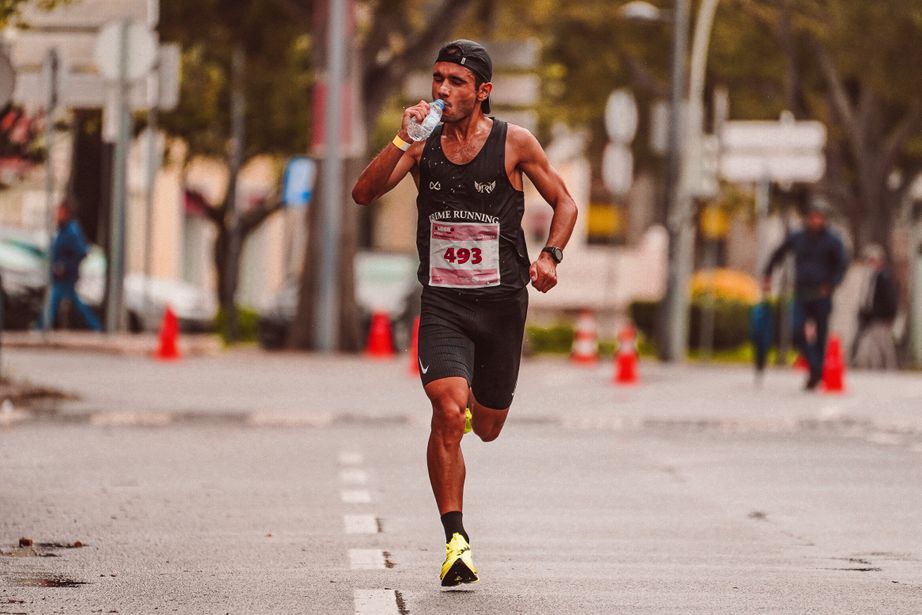
Cynthia Lucero was 28 when she started the 2002 Boston Marathon. Friends said she drank large amounts of sports drink and looked well for most of the course, then faltered late in the race, told a friend she felt dehydrated and rubber-legged, and collapsed. The Massachusetts medical examiner found that she died of hyponatremic encephalopathy, a swelling of the brain caused by a critical sodium imbalance brought on in part by drinking too much fluid.
Sodium in Marathon Sweat
Sweat sodium concentration in athletes usually ranges from about 20 to 80 mmol per liter. A runner sweating 1 L an hour at 40 mmol per liter loses about 40 mmol, or roughly 920 mg of sodium, every hour, or close to 3.7 g over a 4-hour race.
Blood sodium is a concentration, so it depends on the water in the body as well as the salt. The fluid a runner drinks can move the number as much as the sodium that leaves in sweat.
Modeling of Sodium Replacement
A modeling study ran the arithmetic across realistic combinations of sweat sodium from 20 to 80 mmol per liter and sweat rates from 0.5 to 2.5 L per hour, with drinking set to keep body mass losses near 2%. In every realistic scenario for an elite marathon, replacing sodium during the race was unnecessary to protect blood sodium. Replacement mattered only in a 160 km ultramarathon scenario, where runners with sweat sodium of 40 mmol per liter or higher who replaced more than 80% of their fluid losses needed to replace at least 47% of their sodium.
In a study of 51 marathon runners racing at about 24°C, the runners were grouped by how salty their sweat was, and even those with the saltiest sweat did not develop exercise-associated hyponatremia or its symptoms.
Salty Sweaters and Training in Heat
The National Athletic Trainers’ Association treats sodium intake as an individual matter. Its position statement suggests that replacing sodium may be necessary in intense conditions, especially for athletes whose sweat sodium is above 60 mmol per liter, and it recommends measuring sweat electrolytes before setting a plan. A runner who has tested in that range and trains through a humid summer can mix an electrolyte powder for hydration into the bottles used on 2- and 3-hour long runs. A runner with low sweat sodium who trains in cool weather has little reason to add anything beyond normal meals.
Training is also the time to learn how much fluid a long run needs. A runner whose weight goes up during a long run, after accounting for what they drank, is taking in more fluid than they lose, and that habit needs correcting long before race day.
The 2002 Boston Study
The same race that killed Lucero produced a large dataset on sodium problems in marathoners. Researchers led by Christopher Almond of Children’s Hospital Boston collected blood at the finish from 488 runners and published the results in the New England Journal of Medicine in 2005. Of those runners, 13% had hyponatremia, defined as a serum sodium of 135 mmol per liter or lower, and 0.6% had critical levels of 120 mmol per liter or lower. The results became a reference point for advice on drinking water during endurance sports.
Weight gain during the race was the strongest predictor, with an odds ratio of 4.2. Finishing times over 4 hours and very high or very low body mass index also raised the risk, while female sex and the use of anti-inflammatory painkillers showed no link once those factors were accounted for. Runners who gained 4.5 to 11 pounds over the course had the most serious cases. The type of fluid made no difference. Runners who drank sports drinks were no less likely to become hyponatremic than runners who drank water, since sports drinks contain very little salt.
Salt Tablets in Long Races
Controlled trials of sodium during exercise have found small or absent effects. At the 2001 Cape Town Ironman, athletes were randomly given 620 mg salt tablets, placebo tablets, or nothing, and blood sodium after about 12 hours of racing did not differ between the groups. Athletes in the placebo group took about as many tablets as those given real salt, 14.7 against 15.8 on average. A study at the 2002 South African Ironman found that sodium intake was linked to slightly less weight loss during the race, but it was not needed to prevent hyponatremia. A 2015 study at Saint Louis University gave 11 endurance athletes an 1,800 mg salt pill in 1 session and a placebo in the other, each before 2 hours of exercise and a performance test. Performance did not differ between the 2 sessions. Edward Weiss, who led the work, advised caution with salt pills and other sodium supplements and noted that many Americans already eat too much salt.
In an observational study of ultramarathon runners, sodium supplement intake had no relationship with performance. A 2019 study of a 246 km race found that sodium intake explained only 6% to 8% of the variation in post-race blood sodium, and its authors pointed out that the trials showing no benefit were run in cooler conditions with lower sweat rates.
Cramps and Electrolytes
The link between leg cramps and blood electrolytes is weak in race studies. In a study of 210 Ironman triathletes, the 43 who cramped had the same blood electrolyte levels and the same body weight changes as the 166 who did not. Faster race pace and a history of cramping predicted who would cramp. A 30-year analysis of Ironman athletes later found more dehydration among crampers, but again found no link with electrolyte abnormalities.
The main alternative explanation of muscle cramps in exercise is neuromuscular fatigue. Fatigued muscle spindles keep firing while the inhibitory signal from the Golgi tendon organs weakens, so a tired muscle contracts and fails to relax. That fits the timing seen in marathon and Ironman studies, where cramps tend to come near the end of the race. Neither theory has been proven, and the dehydration and electrolyte explanation still has supporters, but the Ironman blood data give it little support for marathon-length events.
Boston’s Advice a Year Later
The 2003 Boston Marathon responded to the death of a 28-year-old runner the year before with a brochure sent to more than 20,000 entrants. Its message was 6 words long, “Drink to stay hydrated, don’t overdrink,” and it put fluid volume ahead of sodium as the first thing a marathoner should get right. Arthur Siegel, a physician at McLean Hospital who studied Lucero’s case, said the syndrome that killed her was more complicated than taking in too much fluid, and the Boston data bear that out, since body size and finishing time mattered alongside weight gain. The amount drunk was still the factor a runner could control most directly.
Photo by RUN 4 FFWPU on Pexels.com
Contributed posts are advertisements written by third parties who have paid Woman Around Town for publication.