
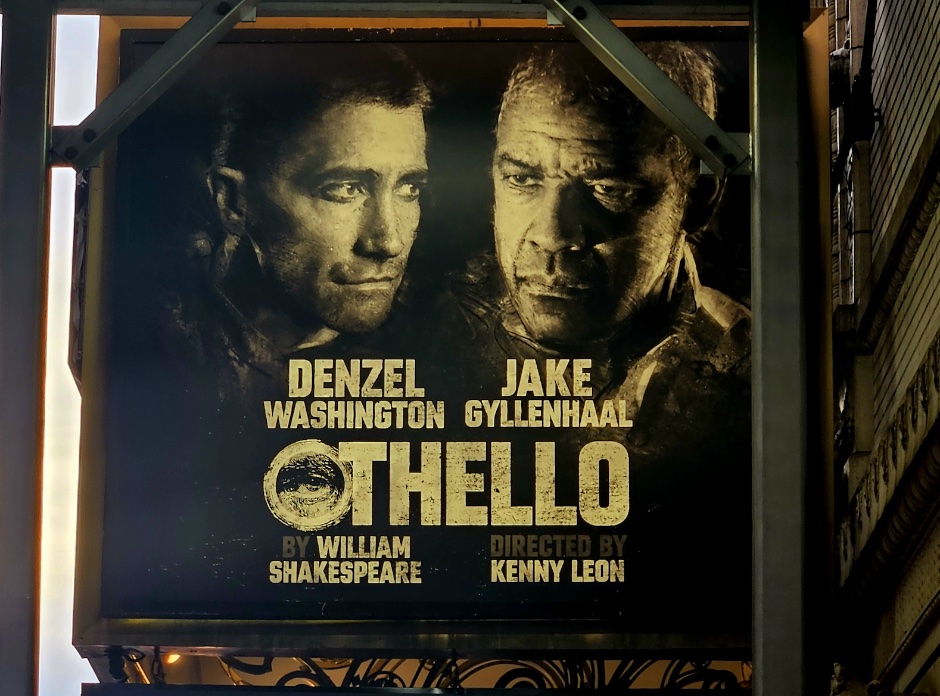
There has been much hype around the star-studded Othello currently playing at the Barrymore Theatre. Its two protagonists, Denzel Washington in the title role and Jake Gyllenhaal (Iago) are major Hollywood stars, and tickets to a performance cost as much as $921 unless you can win the lottery or be part of the “student rush” and get to pay $49 for a ticket according to The New York Times. Still, the average price for a ticket is about $339. The question I keep hearing is inevitably: Is it worth it?
Directed by Kenny Leon, this Othello is set in “the near future” as the bright projection at the beginning indicates. Its soundtrack is edgy, somewhat New Wave-y in jarring contrast with the sweet beginning of Amapola sung by Andrea Bocelli, right before the action starts, perhaps to remind us of an age of innocence in Othello and Desdemona’s love before jealousy seeps in. Ironically, the Amapola melody returned at the end in the murder scene, with harsh interferences by electronic sound, making it clear in musical terms as well that the innocence has been shredded.
The set by Derek McLane, lit by Natasha Katz, consisted of column-like structures that move to adjust the spacing. The lighting was for the most part harsh, neon-like or ominous; only in Desdemona’s bedroom the many huge candles projected a softer, more golden light.
Except for Desdemona and Roderigo, everyone appeared to serve in the army; even Emilia was a lieutenant. Costumes were created by Dede Ayite: The soldiers were dressed in fatigues, the Venetian senators in suits, and Desdemona in pantsuits.
Denzel Washington brought much playfulness and humor to the role. As he began to get crushed by jealousy and suspicion, he masterfully reflected his breakdown not just in his voice but also in his body language, as though he were crumbling bit by bit before our eyes, until for a moment he became uncoordinated–and not only due to the seizure–and Iago had to handle him like a puppeteer handles a puppet. Washington was a highly physical Othello; his body had its own language, a language that was also relatable to today’s audiences. At times, his voice modulated between a singsongy delivery and speech, soft, forceful, whimsical; he was capable of conveying a range of emotions through his voice alone.
Jake Gyllenhaal created a differrent kind of Iago from the cold, calculating creature conveyed by other actors. Leon’s directorial vision portrayed the relationship between Othello and Iago as a strong bond forged over years of fighting together. Gyllenhaal brought forth an emotional villain. It seemed like he was spontaneously inspired by evil at every turn, rather than coolly scheming or planning deliberately, as though his bond to Othello instantly triggered his every move. And he communicated his every newborn plan directly to the audience, establishing a riveting complicity.
What detracted from both Washington’s and Gyllenhaal’s performances was that sometimes they spoke too fast, as though forgetting that they were onstage and not on camera. Fortunately, as the evening progressed, both gradually slowed down their phrasing and seemed to relish and taste Shakespeare’s text much more than in the first half, but it was too little too late.
The clearest diction belonged to Molly Osborne (Desdemona) and Andrew Burnap (an excellent Cassio in his swaggering presence and lively delivery). Osborne gave us an executive-type Desdemona, and it was not just because of the pantsuits. Her attitude was less that of a young, innocent woman in love with her foreign, older husband, but more that of a strategic business planner. Her retorts to Othello’s taunting and insistence that he hear Cassio out were delivered sharply without a hint of fear or timidity. It’s as though she were already an experienced woman, capable of showing passion and affection, but too knowledgeable and wordly in a sense, which ironically might make Othello’s suspicion more valid.
What was problematic about this production was that parts of it came across as Shakespeare-in-the-age-of-sitcoms. There was much laughter in the audience at various remarks, and the actors, especially Denzel Washington, played into that laughter and invited it with gestures and body language, meant to incite comic entertainment. For those who are used to seeing Shakespearean tragedies, that laughter could be disconcerting and at times, downright annoying. Ultimately, Leon’s Othello is wrapped up as a glossy package meant to appeal to pop culture and precisely because of that, it fails to make the impact that it would in a traditional setting and concept.
Still, there were gripping moments such as the Act IV confrontation between Othello and Desdemona where the audience was forgotten and the interaction between the two deepened and became actual drama. The rest of the time, it often felt like the drama got diluted by the too many comical winks at the audience, whether through a gesture or an emphasized remark. So, it took more of an effort to feel the denouement to the full extent of its tragedy, and because of that, the murders of Desdemona and Emilia, and Othello’s suicide tended to appear merely sensational. They elicited gasps from the public but were never fully supported by the climactic peak of the drama that was supposed to build in momentum throughout. This was a problem as well: There didn’t seem to be an overall cohesive arc or if there was a sketch of one, it was too often interrupted by the laughter-eliciting gimmicks, visual effects, and rapid delivery of lines. So, we as spectators were denied the satisfaction of getting to ride the tragic wave as a continuum until its final crash; therefore it was all somewhat anticlimactic.
To be fair, this production did serve in illuminating that different dimension in the Othello-Iago relationship–their strong bond of former camaraderie. And it was a laudable tour de force for its two protagonists. But the question remains: Is it all worth the extremely pricey cost of a ticket? I would say no.
Top photo by Maria-Cristina Necula