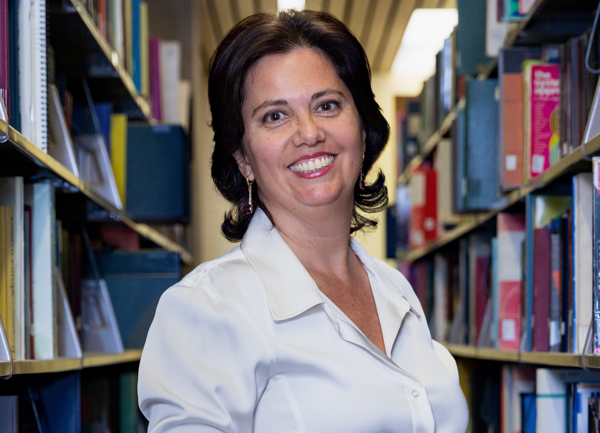
Loyal readers of Woman Around Town, particularly those who love musical productions, enjoy Maria-Cristina Necula’s opera reviews and her interviews with its stars. There are many reasons why Cristina, as she prefers to be called, brings such a wealth of information and depth of understanding to everything she writes about each performance. As a young girl growing up in Communist Romania, opera proved to be a life raft as Cristina and her mother were tossed around in the political waves made by the country’s brutal dictator, Nicolae Ceausescu. When Cristina’s father, a telecommunications expert and professor, defected to Great Britain and then to the U.S., Cristina and her mother were left to handle the fallout. Her mother, bravely handling the circumstances and attuned to her daughter’s needs, introduced her to opera. It turned out to be a lasting love affair.
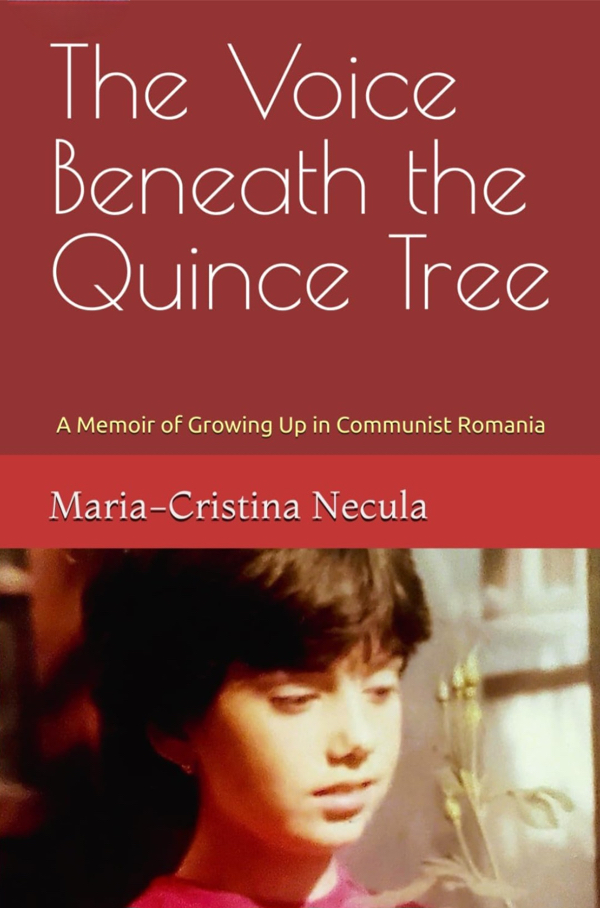
Cristina’s heartfelt memoir, The Voice Beneath the Quince Tree – A Memoir of Growing Up in Communist Romania, is a beautifully written story of survival, perseverance, and the power of music to create an environment where hope can grow and never be extinguished. Cristina took time from her busy schedule to answer our questions.
What’s the significance of the title, “The Voice Beneath the Quince Tree”?
In the garden of my house in Bucharest, there was a quince tree. As a kid I used to marvel at how the quinces transformed into delicious jam once my mother got a hold of them, and I thought the tree enchanted. When I discovered opera, I would enact scenes from performances in my garden using the quince tree as a character. A favorite scene was Violetta’s death from La Traviata, and the tree would become my Alfredo. I would hug it and speak the words of the libretto since I really couldn’t sing at the time. So, the quince tree was both my audience and my play partner. When I was writing this book, it dawned on me that it wasn’t just my singing voice trying to find its way out beneath the quince tree, but also my writer’s voice. I would read for hours and write poems seated at a table by the quince tree. That tree was family and a witness to my voice in all of its manifestations.
Maria Callas was a huge influence on you. But when you first encountered her as a young girl, you had a different reaction. Do you laugh when you think about that initial reaction to one of the opera world’s most iconic voices?
Yes, I laugh when I think about it now, but I’m also amazed at how my initial reaction to make fun of those operatic sounds instantly turned into a desire to imitate her. Just a few minutes after my parents kicked me out of the living room so they could watch Callas on TV without my snickering, I tried to produce those sounds in front of my cats outdoors. I had a terrible voice as a child and was not too fond of singing. But for some reason hearing Maria Callas made my throat almost act on its own to try to create those sounds.
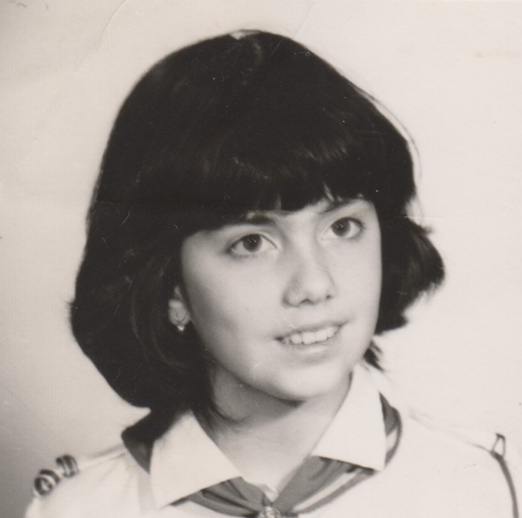
Maria-Cristina Necula, 11 years old in her school uniform, when the events in the book took place.
When your father, Tati, didn’t come back from a trip, how did you process what had happened?
I was upset and shocked. I was very close to my father and couldn’t understand why he wouldn’t come back to me. Even when my mother explained that we would join him to live a much better life, I didn’t connect to that idea right away. I loved my house, my garden, my cats, my friends, I loved Bucharest, and I knew no other life. At first, it was hard to get used to the thought that this painful separation from him would lead to a wonderful future.
So much fell on your mother to manage. Where did her strength come from?
I would say that, like most Romanians, my mother is a stoic. Throughout history, Romanians have endured enormous hardships and challenges. They resisted occupations and invasions. They lived through one of the most oppressive dictatorships of the Eastern Bloc, and their innate resilience, stoicism, and sense of irony and humor have always sustained them. Romanians are survivors endowed with these innate traits that my mother has in abundance. Also, she never faltered in her faith that we would be able to leave, and that my father would do everything in his power to bring us to the U.S. When she opened up to me about her ordeal, my mother told me that the terrible dread she felt each time she was summoned to an interrogation by the Securitate—the secret police—ultimately cured her of fear forever. Either you face fear with everything you’ve got or you succumb to it, and to my mother, succumbing was never an option.
How did those around you react to your father’s actions?
I’m not sure. Most people we knew stayed away from us after my father defected. Much later, my mother explained that, because my father had been declared a traitor, we were considered undesirables. My grandparents, whom we saw often, never commented on my father’s defection or manifested any worry. Maybe they were trying to shield me from anything that would scare me. The few relatives or friends of the family whom we did see on occasion never said anything either, at least not to me.
As a child, did you understand that you were living under a communist dictator?
I knew we were living under communism. But I didn’t know that anything else existed. I don’t think anyone gave me the idea to think of Ceausescu as a dictator at the time. I didn’t even know what “dictator” meant. We used to call him “the supreme leader.” I was also aware that adults made jokes about him and his personality cult. For instance, when we saw him on TV addressing a crowd and he’d wave, sometimes someone would say: “Look! He’s cleaning the TV screen again!” So, there were ironic or sarcastic comments about Ceausescu’s megalomania, they just didn’t happen too often. Also, children were usually minding their own business, playing with other kids or by themselves, or doing homework; they weren’t really paying much attention to the adults and their conversations. And the adults had to be careful because you never knew who could inform on you simply because you told a joke or made a funny comment about the regime or the supreme leader.
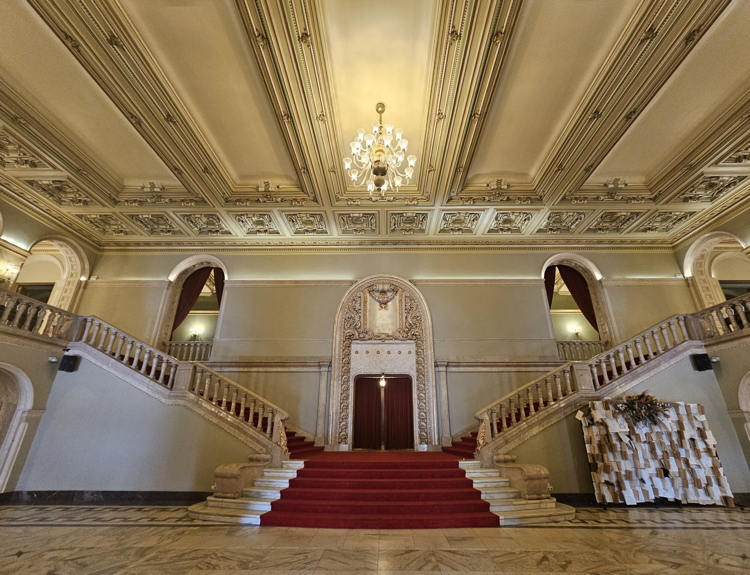
The lobby of the Bucharest National Opera (Photo by Maria-Cristina Necula)
Can you describe how you felt sitting through your first opera in Bucharest? What stood out to you?
From the first notes, I was instantly entranced, especially by the singers. The sounds they produced fascinated me and I longed to be there onstage with them. All of a sudden, while seeing that performance at 10 years of age, a charmed realm opened up to me and I wanted to be a part of it. It seemed to me that if I could be one of the singers I would never be afraid of anything. I could create my own magic if I could just make those sounds too.
Music, all forms of music, can help in the healing process. Did you realize that opera was having that effect on you?
I didn’t think specifically about healing. Opera felt like an escape, and it inspired in me my first big childhood dream: to become an opera singer. I don’t remember having a dream of what I wanted to be when I grew up. But that first encounter with opera made everything clear to me: I wanted to be an opera singer, and that wish was my lodestar for many years.
The opera star, Victor, had a huge impact on your life. When you look back at it, did you see him as a father figure? A mentor?
Yes, at first Victor was both a father figure and a mentor. Then it became more complicated because I was growing up and constantly seeing him onstage as the dashing, romantic hero of many of my favorite operas, and I was reading fairy tales too. So, in time, I also developed a puppy love for him, like an infatuation a teen or preteen would feel for a movie star. Except, Victor was not an inaccessible hero on the silver screen. I actually had the chance to get to know him in real life since my mother and I were close with him and his family for a while. Between seeing him onstage and spending time with him in real life, the lines got really blurred and it often felt that opera was spreading into real life through our interactions with him. At the same time, he also taught me so much about operatic singing and repertoire, and he appreciated my eagerness to learn. It was a complex connection; now I think that Freud would have probably had a field day analyzing it!
Did you ever feel in danger after your father left and the authorities kept their watch on you and your mother?
I don’t know that I felt the danger consciously. Of course, my mother contributed to my insulation bubble a great deal. She never let me see her fear, she never complained or panicked in front of me. She tried to keep daily existence as normal as possible and inject fun into it whenever she could. She always made me feel as though everything was all right and would end happily for us. However, I do think that I must have felt a sense of terror and fear on a visceral level; children pick up on such things. But I never dreaded what would happen to us. I was more afraid of the strict teachers in school than of our situation.
How did you imagine what the U.S. would be like? Did that vision measure up when you arrived in New York?
The early images I had of the U.S. came from Raymond Chandler’s detective novels that I read in Romanian. They painted for me a vision of glamorous life in California, with gorgeous and dangerous people, crime and sly maneuvers. Then there was the TV series Dallas that we were somehow allowed to watch even though TV programming was censored. I formed an idea of life in the U.S. as big, bigger than anything I could ever imagine, filled with beautiful people, passions, and sprawling abundance. But I had no real sense of New York or the East Coast at all, except from the few postcards my father sent. And when I actually arrived here at 12, nothing I read or saw could have prepared me for the diversity of people I came across at JFK and the rich variety of products in the first American supermarket I ever saw. I felt truly excited and overwhelmed!
When you go back to Romania, what feelings are brought to the surface? Is it painful? Freeing?
I love going back to Romania! What was heartbreaking years ago was my first visit to the place where my house had been and where the quince tree had lived; this was after the house was demolished and the garden destroyed. Even now when I think of how the tree must have suffered when they cut it down, the vision stabs my heart. But Bucharest remains one of my great loves, and every time I see it, my soul feels restored. Many people I love still live in Romania—relatives and friends—and it’s a joy to spend time with them whenever I go back. Romania will always be a heart magnet for me. The contact with the place, the people, the language, the food, the energy tunes me up like a musical instrument, and then I can continue to play my own life tunes in other parts of the world and still feel in harmony.
What role does opera play in your life now?
Opera remains an important part of my life. I serve it by writing reviews, doing interviews, introducing it to college students, and promoting it as much as I can. This art form has offered me immense treasures in many aspects of my life. Almost no day goes by without my being in contact with opera in some form or another. Having studied voice and pursued that path, I understand what singers go through and I try to be supportive of them through my writing. I know that it takes so much courage and perseverance to become an opera singer, to expose yourself to hundreds of thousands of ears and eyes, to be so open and vulnerable, dependent on those two vocal cords and on your physical, mental, and emotional state. I did become a writer, but I will always love opera and do my best to fight for its future.
What do you hope people take away from your memoir?
You know, someone told me that my memoir may be too uplifting, and that misery, doom, devastation, and violence sell more. I thought about that remark a lot. And I realized that, if this story is uplifting, then I have fulfilled my purpose in telling it. I would love nothing more than for readers to be uplifted. I’d love for them to travel with me through that time in history—the time of the Iron Curtain and the Eastern Bloc—and to see it through the eyes of my childhood. Yes, there was oppression, scarcity, danger, and violence. Yet in the midst of that dangerous situation, with a father who defected and a mother who was interrogated and persecuted, there were moments of magic and joy to be found or created. There was an art form that offered shelter, strength, and hope. And I would love for people to laugh with me, especially at my culture shock in coming to the United States that resulted in all kinds of comical situations, whether in a supermarket or my first day of class in an American public middle school. So, if I have been able to offer an illuminating glimpse into the everyday life of a child in that historical period and at the same time entertain and uplift, then I’d feel like the happiest writer in the world.
The Voice Beneath the Quince Tree on Amazon
Maria-Cristina Necula’s website
Top photo of Maria-Cristina Necula by Michelle Martinez
Our editors love to read and independently recommend these books. As an Amazon Affiliate, Woman Around Town may receive a small commission from the sale of any book. Thank you for supporting Woman Around Town.