Inspired by a Smithsonian Associates lecture by science editor/journalist Kelly Beatty.
Built not at once but over centuries from 3000BC to 2500BC (Mesolithic to Neolithic periods) Stonehenge continues to challenge historians and archeologists. When construction began, England was not an isolated island. There was, we’re told, a land bridge called Doggerland flooded by rising sea levels around 6500–6200 BC. An agrarian peoples migrated to southern England. It was about this time primitive monuments began to rise – burial mounds, stone circles, and henges (large prehistoric earthwork, usually but not always circular, whether of stones, wood, or earth.)

Map of Doggerland Bridge (by Francis Lima; Creative Commons)
A lot of what is now Salisbury Plain was cleared of trees so that crops could be planted. There were no mountains or bodies of water with which to align, yet one pathway of the edifice conforms accurately with the sun’s route at winter solstice. Was Stonehenge an observatory, a place of religious ceremony? British researchers have re-exhumed more than 50,000 cremated bone fragments of men, women and children from where they were discarded as unimportant by earlier digs. A burial site, then? Or perhaps a pilgrimage destination for healing. Apparently many skeletons recovered showed signs of illness or injury.
Woodhenge, two miles northeast of Stonehenge, is a Neolithic henge and timber circle monument that dates about 2500BC. Constructed of giant tree trunk pillars that rotted away, the site now has concrete stumps indicating original placement. It’s conjectured that proximity indicates Woodhenge may have been a monument to the living, Stonehenge to the dead.

Schematic diagram of Stonehenge and its astronomical alignments (by Astroskiandhike; Creative Commons)
The latter was always in private hands, on somebody’s estate. In the 18th Century, owners were the Antrobus family. (Thornton Wilder used the name for beleaguered protagonists in The Skin of Our Teeth.) The last surviving heir auctioned off the land in 1915. It was purchased by Sir Cecil Chubb for 6600 pounds ($194,740 today) and donated back to the British people. Then a tumbled pile of rocks, the government commissioned renovation by an army core of engineers.
At this point, 56 Aubrey Holes (chalk pits) were found and named after their discoverer. Many believe the pits were used to support stones or posts, but their actual purpose remains a mystery. Some prefer astronomical explanation. The holes are in an accurate, 271.6m circumference circle, distributed around the edge of the area enclosed by Stonehenge’s earth bank. Sarsens that fell in 1900 were repositioned and stabilized as were bluestones which created arches. (A sarsen is a sandstone boulder which occurs on the chalk downs of southern England – derived from the medieval English word “saracen,” which once referred to Arabs, but came to mean anything pagan.)

1573 watercolor (Public Domain)
Sandstone is believed to come from Marlborough Downs, 20 miles away, but where did the bluestone (each rock 25-30 tons) come from? In 2019, chips discovered on site were tracked with geochemical analysis to Wales. Why did builders go all that way? How did they move the immense stones? A partial circle remaining near the Preseli Hills bluestone quarry in Wales is thought to have been a potential model for Stonehenge. At 110 meters/360’ they match in size. Perhaps the original circle was taken apart to create Stonehenge. We’re reminded that there were no sharp tools excepting deer antlers, and surprisingly not even horses to help the project.

Construction of Stonehenge by Merlin with help from Giants- the oldest known illustration of Stonehenge 1325 (by Wace; Public Domain)
In the 12th century, writer Geoffrey of Monmouth wrote that Aureoles Ambrosias, 5th Century King of Britain, wanted to build a war memorial using the Giants’ Ring, a stone circle in Ireland, as model. The stones had ostensibly been brought from Africa and were considered healing totems. His highness sent Merlin to Ireland with either 15,000 men or giants, depending on which tale one favors, to carry stones to England. When even after killing 7000 Irishmen this failed, Merlin used magic.
Another legend finds an invader king, Hengist,( as in Beowulf) inviting 420 Britons to a feast on Salisbury Plain under the auspices of truce. At his signal, sated and drunk, guests were slaughtered. When rivers of blood ran on the chalk white ground, the royal grew remorseful and had what we think of as Stonehenge built as a memorial. (These nobles would have been the men for whom Ambrosias was also thought to build.) A third story “claims that Stonehenge was formed when giants who lived on the plain were suddenly turned to stone while dancing in a circle and holding hands. This story arose because the stones look like they could be figures holding hands.” Tyler Vuillemot 2015

John Milton’s “Paradise Lost” (Public Domain)
In the 17th century, construction was attributed to Druids, but mid-20th century, radiocarbon dating demonstrated that Stonehenge stood more than 1,000 years before the Celts arrived. This hasn’t stopped latter day Druids from gathering.
How were the stones moved? They were too heavy to be transported on logs atop earth so soft it couldn’t steadily bear the load. It’s possible that sleds were built, then pulled along the ground on top of logs that were repositioned again and again or that rafts floated them first along the Welsh coast, then up the River Avon toward Salisbury Plain. How were the capstones put in place? The hypothesis here is that men made giant earthen mounds as tall as the stones, dragged the stones up, then got rid of the soil. Imagining tipping the length and weight!
Why was it built? What would’ve compelled people to keep constructing for centuries? “A study published recently in the journal Antiquity shows the largest stones at Stonehenge may embody a solar calendar with 365¼ days each year- almost the same as the 365.2425 days used in modern solar calendars… By aligning Stonehenge to the solstice and then using it to count the days in a year, the ancient monument could have accurately reflected the annual solstices and seasons for hundreds of years.”

Druids at Stonehenge 2007 (by sandyraidy; Creative Commons)
“… smaller rocks may have been used inside the ancient stone circle to point to the current day, month and year, and moved as they changed…There’s some really interesting bits and pieces found at Stonehenge, including some balls called maul stones – maybe one of those was used as a marker…the calendar at Stonehenge may have been influenced by ancient sun-worshiping religions in the Eastern Mediterranean, such as the cult of the Egyptian god Ra.” Weird Science by Tom Metcalfe writing about theories of Professor Timothy Darvill of Bournemouth University.

The solstice; photograph by Mike Peel (www.mikepeel.net) (Creative Commons)
Millions of tourists have visited Stonehenge, now a UNESCO World Heritage Site. Druids and the like used to celebrate the solstice within its circle. Unfortunately, a great deal of damage has been done. Now one can only walk by the stones unless on an especially sanctioned solstice tour. Questions remain unanswered. Of course, there’s always the possibility as many believe, that Stonehenge was constructed by visiting aliens.
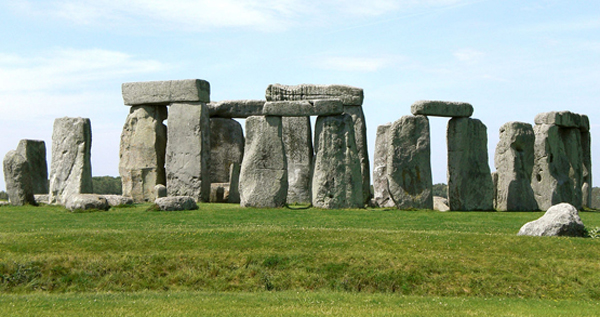
Opening: Stonehenge (Creative Commons)
Smithsonian Associates has many fascinating lectures.