The Art of Elegance: Fashion in the 1930s

Based in part on a lecture by fashion historian Elizabeth Lay for Smithsonian Associates

Elizabeth Lay will focus today’s lecture on Hollywood, Paris, and American fashion reflecting, as apparel always does, what happened during the era. On October 29, 1929, fashion changed from flapper razzle-dazzle to more sober and mature looks. Despite the Depression, “it was once of the most exciting periods of design in decades. A lot of mid-century modern emerged during these years. A streamlined look was pervasive.”

Hemlines became midis, dresses narrower; puff sleeves, accentuated waists, large yokes, wide shoulders, and collars appeared. Zippers became staples. Evening gowns had low, low backs. “It’s not that the idea of a sexy female had left. In some ways, appearance was smokier, more body conscious,” our host says. Loose, drop-waist boyish looks disappeared.
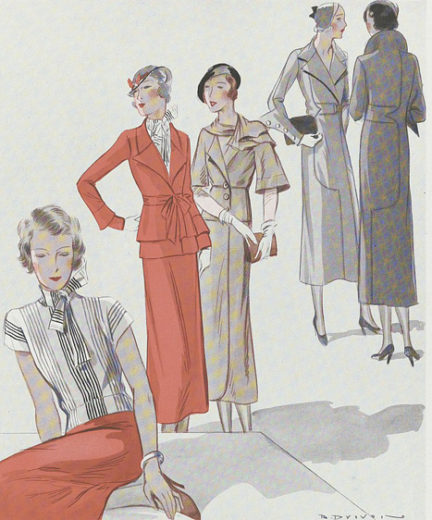
Fashion Plate 1932 (Creative Commons CC0 1.0 Universal Public Domain Dedication).

The average woman was shopping ready to wear at Sears Roebuck and Montgomery Ward. More were required to look well at the workplace. $4.98 Dresses needed to be flexible- with or without belts, collars, jackets; shoes to be sturdy in order to walk or catch a bus. “In 1924, women were annually spending an average of $156.00 on clothes. By 1936, the dollar amount was $78.00”

Lay tells us there are two ways of looking at the period. She calls them Venus and Diana. Venus was ladylike, refined, graceful and chic. Diana epitomized workplace needs, an active lifestyle including sports. Norman Norell (working for Hattie Carnegie) purchased samples in Paris, brought them back here, took them apart, and made patterns with more ease of movement. This was common practice at the time.

Column skirts – later flared just below the knee-and coordinating jackets combined to create women’s suits. These skimmed the body. Gores and narrow pleats created interest. Winter coats, and Hollywood gowns sported fur collars.
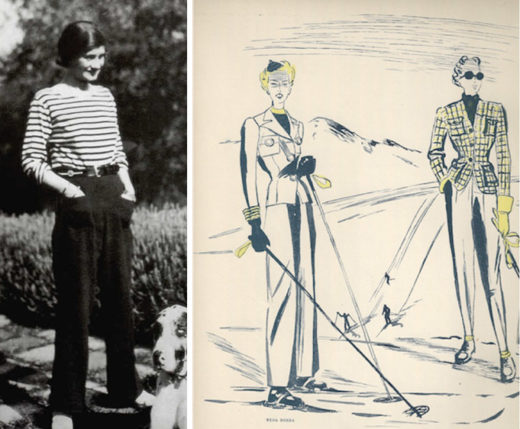
Left: Coco Chanel in pants (Public Domain); December 1937 Femina Magazine (Public Domain)

American women played tennis and golf. They bathed in public, skied, hiked, and drove cars. Trousers were logical. Personalities like Amelia Earhart and Marlene Dietrich popularized, or perhaps legitimized a new norm-Earhart’s were pragmatic, Dietrich’s by Chanel. When Katharine Hepburn was photographed in her usual off apparel, a headline read “Surely pants are the gateway to feminine perversion.” Wide-legged palazzos arrived first on beaches and then evening wear. Skirt-like shorts made activity easier. Culottes emerged.

Katharine Hepburn 1938 Publicity Still (Public Domain)

In the realm of Venus, Lay begins with French designer Madeleine Vionnet (1876-1975) who’s associated with bias cut garments, an important trend in the 1930s. (Cutting against the normal grain of the fabric is known as a cut on the bias. When fabric is cut normally, the pattern is laid out along the grain of the weaving.) “When one walks in a bias cut dress, the legs and body look more graceful. It’s also very comfortable to wear. A romanticist, Vionnnet was known for Grecian draping. She also twisted and wrapped fabric.
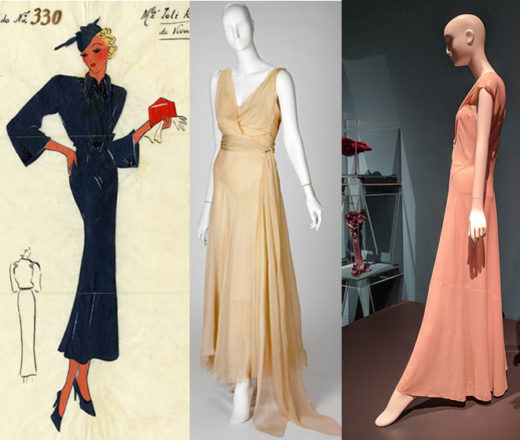
Vionnet- Left to Right: Suit ’32-34 (Creative Commons Attribution-Share Alike 4.0 International) Gown- silk, chiffon crepe (Creative Commons CC0 1.0 Universal Public Domain Dedication), Pink Silk Crepe Dress Creative Commons Attribution-Share Alike 4.0 International

Deceptively simple design elements during the period were in construction, not, as in the 20s, ornamentation. Undergarments were slinky or rare as everything showed in a gown.

Elsa Schiaparelli (1890-1973) saw herself an artist, we’re told. She was active with the Surrealists. Salvador Dali (The Duchess of Windsor famously wore his lobster dress) and Jean Cocteau designed fabric for her. Coco Chanel (1883-1971) was the face of her brand. Her designs were shocking in the ‘20s, but matured in the ‘30s. The look was sophisticated and cool. The label’s iconic suit continues in some form to this day. Trousers were common.
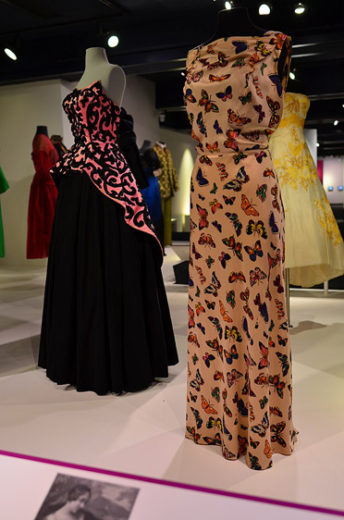
Elsa Schiaparelli 1937 Photo by Joe Mabel (Creative Commons Attribution-Share Alike 4.0 International)

Meanwhile in the USA, sturdier fabric like cotton broadcloth was utilized for day dresses, silk or rayon crepe for afternoon, satin, taffeta and velvet for evening. Summer suits and dresses were made with linen, wool was the predominant fabric for winter with tweed and corduroy not far behind.  Mix and match separates came into fashion so one could size each separately. Claire McCardell, who designed under other labels, ruled sportswear for years. An early success was what was called a “monastic” or shapeless dress cinched in with a belt. Pockets became ubiquitous.
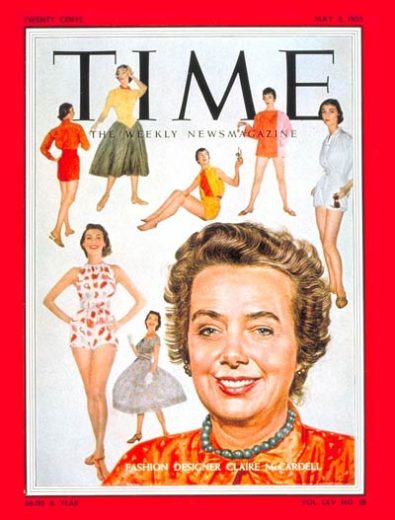
A later magazine cover saluting the long career of Claire McCardell (Public Domain)

When the 1929 films hit theaters, on screen fashion looked out of date and scrambled to catch up. “Hollywood wanted France to look to them,” Lay comments. Valentino brought Adrian to Hollywood. The designer stayed and was quickly hired as head of the MGM Costume Department. Male actors had to provide their own clothes, while women’s were created for them. In 1932, Macy’s licensed a Joan Crawford dress, ran it up in a less expensive version, and sold 50,000.

The ideal men’s silhouette was broad shoulders, narrow waists, high-waisted trousers and armholes, larger lapels and narrow sleeves via haute couture Saville Row. The most photographed man of the age, the Duke of Windsor exemplified England’s dictate ushering in plus fours, the Windsor knot and window pane plaids. (Elsewhere European suits had no shoulder pads presenting a softer, often unlined silhouette closer to the body.)

Ginger Rogers in Swingtime-Gown by Bernard Newman- Publicity Still (Public Domain)

“Now we get to the two people best identified with elegance of the period, Fred Astaire and Ginger Rogers. It was fifty cents to see a double feature, an escapist opportunity to step into glamorous situations.” Rogers was dressed by Irene in 1937, but a great many of her later gowns were designed by favorite, Bernard Newman. Because films were black and white ensembles had to be over the top, evening wear sheer and shiny. “Newman had a real sense of how a dress moved. Beads can weigh 25-30 pounds. A beaded garment moves slowly even after a dance step is completed.”
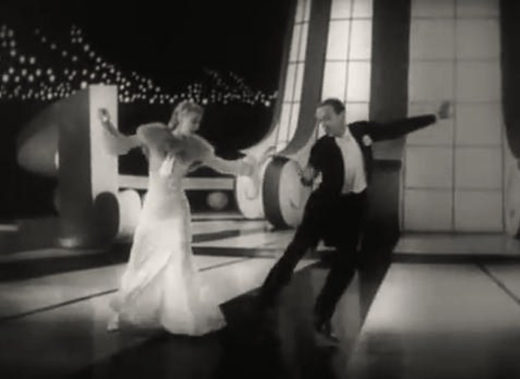
Follow the Fleet 1936 Gown by Bernard Newman (Public Domain)

Astaire hated Rogers’ gown in Follow the Fleet. Its sleeves hit him in the face. When he complained, the director agreed until he saw the way it moved. We watch “Let’s Face the Music and Dance,” the epitome of grace. In Top Hat, the actress’s big number gown is covered in feathers that flutter when she moves. To enhance movement, Newman ran a filament down the spine of each one extending it to a higher loft, a longer pause. Picking feathers off his immaculate suit, Astaire again complained. Rogers said she’d leave the film if they took out the dress. The director watched a clip. And it stayed in.

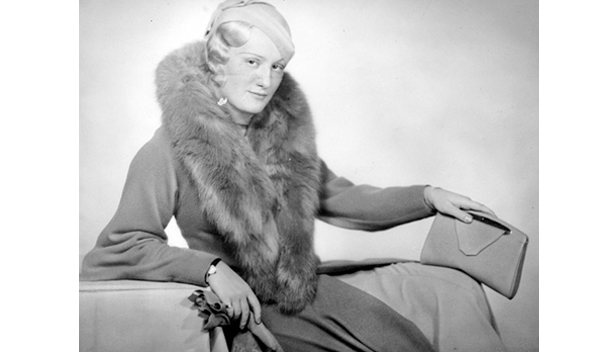
Opening Photo 1930 (Public Domain)

The Art of Elegance: Fashion in the 1930s
Fashion Historian Elizabeth Lay

Check out more fascinating streamed subjects at Smithsonian Associates: https://smithsonianassociates.org/ticketing/streaming/


Share This Post:

Bluesky Icon Bluesky
Facebook

One of the best mystery writers in the world now has an intriguing series streaming on Netflix. But one caution: Jo Nesbó’s “Detective Hole” is not for the faint of heart. But it will keep…

New York City was the epi-center  of the American Revolution. In the run up to the 250th anniversary of the revolution, the Museum of the City of New York presents a new exhibition celebrating the…

Playing at the intimate Theatre Row until May 9, specifically theatre number 5, expect to be a fly on the wall to a sharp, and fast-moving satire that takes quite a few jabs at the entertainment…

You will want to hold close your spouse or romantic partner after watching “The Madison” now streaming on Paramount+.

Michael Mayer’s production of Giuseppe Verdi’s “La Traviata” returns to the Metropolitan Opera, featuring the incomparable Lisette Oropesa as Violetta. Maria-Cristina Necula reviews.

For Catholics, murder is a mortal sin. The fifth commandment is very clear: “Thou shall not kill.” But the killers who confess to Father Brown and repent are given the chance to be forgiven and…

10 Delicious Ways to Use Caramel Syrup in Your Coffee

Caramel syrup has long been a favourite addition to coffee, offering a rich, buttery sweetness that enhances both flavour and aroma. Whether you prefer a strong espresso or a creamy latte, incorporating caramel syrup can transform your daily cup into a café-quality experience at home. Below are ten delicious and creative ways to use caramel syrup in your coffee, perfect for Australian coffee lovers seeking variety and indulgence. Classic Caramel Latte A timeless option, the

read more

Why Custom Packaging Matters More Than You Think in 2026

In an increasingly competitive and experience-driven marketplace, custom packaging has evolved from a simple branding tool into a strategic business asset. As we move through 2026, Australian businesses, ranging from e-commerce start-ups to established retail brands, are recognising that packaging is no longer just about protection. It is about perception, sustainability, and meaningful customer engagement. First Impressions Drive Consumer Decisions In today’s digital-first economy, the “unboxing experience” has become a powerful extension of your brand.

read more

Choosing the Right Brother Printer for Home and Small Office Use: A Practical Guide

Printers remain an essential part of modern home offices, study spaces, and small business setups. Among the many brands available, Brother printers are widely known for their reliability, efficiency, and suitability for everyday document printing.  Whether you’re printing school assignments, work reports, or household documents, understanding what makes a Brother printer suitable for your needs can help you make a smarter long-term choice. This guide explores key considerations and practical insights to help you choose

read more

10 Stunning Decking Ideas to Transform Your Backyard

Creating a beautifully designed deck is one of the most impactful ways to enhance your outdoor living area. In Australia, where outdoor gatherings and alfresco lifestyles are part of everyday life, a well-crafted deck can effortlessly expand your home while boosting both comfort and property value. Whether you’re upgrading an existing space or starting fresh, exploring different Decking options can help you achieve the perfect look and functionality. From modern minimalist styles to warm, natural

read more

How Developers Are Powering the Future of Digital Banking

The digital banking landscape is rapidly transforming, fueled by the creativity and technical expertise of software developers. Across Australia and globally, financial institutions are moving beyond traditional frameworks, adopting advanced technologies to better serve the needs of increasingly digital-first customers. This shift is redefining how banking services are built, delivered, and experienced in a modern economy. As innovation accelerates, concepts like development bridging finance are gaining relevance in supporting the growth of fintech solutions and

read more
You've loaded all available articles in this category

10 Delicious Ways to Use Caramel Syrup in Your Coffee

Caramel syrup has long been a favourite addition to coffee, offering a rich, buttery sweetness that enhances both flavour and aroma. Whether you prefer a strong espresso or a creamy latte, incorporating caramel syrup can transform your daily cup into a café-quality experience at home. Below are ten delicious and creative ways to use caramel syrup in your coffee, perfect for Australian coffee lovers seeking variety and indulgence. Classic Caramel Latte A timeless option, the

read more

Why Custom Packaging Matters More Than You Think in 2026

In an increasingly competitive and experience-driven marketplace, custom packaging has evolved from a simple branding tool into a strategic business asset. As we move through 2026, Australian businesses, ranging from e-commerce start-ups to established retail brands, are recognising that packaging is no longer just about protection. It is about perception, sustainability, and meaningful customer engagement. First Impressions Drive Consumer Decisions In today’s digital-first economy, the “unboxing experience” has become a powerful extension of your brand.

read more

Choosing the Right Brother Printer for Home and Small Office Use: A Practical Guide

Printers remain an essential part of modern home offices, study spaces, and small business setups. Among the many brands available, Brother printers are widely known for their reliability, efficiency, and suitability for everyday document printing.  Whether you’re printing school assignments, work reports, or household documents, understanding what makes a Brother printer suitable for your needs can help you make a smarter long-term choice. This guide explores key considerations and practical insights to help you choose

read more

10 Stunning Decking Ideas to Transform Your Backyard

Creating a beautifully designed deck is one of the most impactful ways to enhance your outdoor living area. In Australia, where outdoor gatherings and alfresco lifestyles are part of everyday life, a well-crafted deck can effortlessly expand your home while boosting both comfort and property value. Whether you’re upgrading an existing space or starting fresh, exploring different Decking options can help you achieve the perfect look and functionality. From modern minimalist styles to warm, natural

read more

How Developers Are Powering the Future of Digital Banking

The digital banking landscape is rapidly transforming, fueled by the creativity and technical expertise of software developers. Across Australia and globally, financial institutions are moving beyond traditional frameworks, adopting advanced technologies to better serve the needs of increasingly digital-first customers. This shift is redefining how banking services are built, delivered, and experienced in a modern economy. As innovation accelerates, concepts like development bridging finance are gaining relevance in supporting the growth of fintech solutions and

read more
You've loaded all available articles in this category