Award-winning pianist Donna Weng Friedman’s extraordinarily multifaceted career as a piano soloist, chamber musician, educator, curator, producer, and filmmaker has garnered her vast praise and accolades. She was selected as one of Musical America’s Top 30 Professionals of 2024 for her outstanding contribution to the performing arts, and in 2023, she was inducted into the Steinway & Sons Teacher Hall of Fame. A passionate advocate for women and underrepresented communities in music, Donna’s untiring efforts contribute immensely to bringing to the forefront untold stories and shedding long-needed light on the remarkable achievements of trailblazing artists, illuminating not only their talents but also the challenges they have endured.
I had the pleasure of meeting Donna when we spoke about her film Never Fade Away in a joint interview with choreographer Ariel Grossman on Woman Around Town. Two years later, Donna continues to thrive on her boundless energy and profound commitment, not only to her own artistic life and causes, but also to multidisciplinary collaborations with others. Whether it is her creative collaborators, her students, her audiences, or the astonishing artists she discovers along her path, she constantly uplifts and inspires others in a life deeply devoted to the arts and to humanity.
What have you been up to since the last time we spoke?
Since the last time we spoke, my film Never Fade Away has won 46 awards from film festivals worldwide. It is now archived at the Statue of Liberty – Ellis Island in perpetuity for institutions, colleges, and universities for research, and it recently just won another recognition: It will be touring with the 10000 Dreams Film Festival throughout the U.S. and Canada next year. That little film has been to more places than I have! It’s been quite a journey, but now it’s grown up and I’m letting it do its own thing, like with your own kids, you let them fly.

Donna Weng Friedman at the Winter Film Awards International Film Festival
Did you ever imagine that your film would travel so far and receive so many awards?
Absolutely not! Originally, all I did was tell my father’s story.
For those who may not know, please say more about Never Fade Away.
Never Fade Away is the story of my father who came from China to the U.S. with nothing but his hopes and dreams, and how a radio and a waltz changed his life. I started to tell his story online during the pandemic when the world was shocked and crimes against our AAPI (Asian American and Pacific Islander) community were rising like crazy. I also was a victim of an assault during that time so I thought that the best thing for us to do would to be to share our stories and heritage because those are the ties that bind. We all come from somewhere and we all have our stories, whether it’s my father or your parents or grandparents, and this really connects us. For people who don’t know me, maybe they’ll realize that we’re more alike than we are different.
When the world opened up again, I began telling the story in concert and played the notes that connected me and my father. Then I had the story choreographed and also performed in concert. After one of those concerts, a filmmaker I didn’t know came up to me and said: “You have to make a short film about this!” But the dancer who usually portrayed my father was not available for the time that I wanted to film it, so I was able to get history-making Chun Wai Chan, the first-ever principal dancer of Chinese heritage with New York City Ballet on board. I was in shock when all those news stations, ABC, CBS, NBC, WPIX, came in and wanted me to talk about the film. Fifteen seconds of it were shown on the big screen in Times Square.
From that point on, I got inundated with the film festivals which I’ve never done before. That was an incredible experience because I got to go to many of the festivals in the area and I met a whole community of the warmest people. This was my first film, and they were truly welcoming. I learned a lot about the industry, and I was happy that the story resonated with so many people. I’m not a filmmaker but I worked with a fantastic group. It’s really important to realize that you can’t do certain things on your own; you have to surround yourself with talented, wonderful people who can share your vision and bring their talents into it. Making this film was a dream that really did come true in more ways than I ever imagined.
Tell us about the special album about to be released, MICROVIDS.
This was a project that also started during the pandemic. The composer, Stefania de Kenessey, composed the MICROVIDS pieces during the lockdown time because she was thinking about the vulnerable people, the younger kids and the elderly.
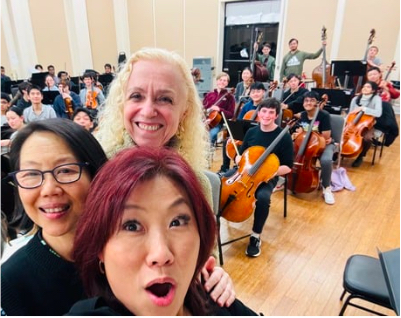
MICROVIDS, part of the dream team in rehearsal: Stefania de Kenessey, composer, Helen Cha-Pyo, conductor with the New Jersey Youth Symphony, and Donna Weng Friedman
What does the title signify?
It is a nod to Béla Bartók’s Mikrokosmos. The wonderful composer Béla Bartók wrote the Mikrokosmos pieces for beginner piano students. These pieces were very short and got increasingly more difficult; they were very imaginative and incredible. Stefania is partly Hungarian, like Bartók. Each of her pieces in MICROVIDS are indeed micro, from 20 seconds to a minute long. I call them classical music’s answer to TikTok! She wrote them thinking about kids, the elderly, and vulnerable communities and how they were coping with their emotions during the lockdown. But the truth is that we have continued to be on a roller coaster of emotions in this country and in the world, and I think that each of these miniatures beautifully reflects the different feelings and emotions that we all experience on a daily basis, from anxiety, isolation, anger, and frustration to moments of pure joy.
The work has grown and flourished wonderfully. At the time, Stefania wrote MICROVIDS for solo piano and asked me to record it. As soon as I played it, I not only fell in love with it, but I felt that there was so much more to do around it. The way that she crafted each miniature was amazing; to be able to tell stories in such short periods of time, you have to be an excellent storyteller and editor, like she is. So, I recorded the piano solo, and I told her: “I feel like this is going to be the modern-day Carnival of the Animals but instead of animals, it’s about feelings.”You know, teens and tweens especially are an underrepresented group in classical music. There are a lot of people writing for very young kids and then there’s a gap, and teens are trying to play music that was really written for adults. They need something of their own to play.

Broadway Tony award-winning star Krystal Joy Brown and Donna Weng Friedman having fun at the MICROVIDS recording session
I suggested to Stefania that each of her pieces be introduced by a poem. Three days later, she sent me 19 charming rhyming couplets that she wrote herself as introductions to the pieces before the music starts. I got us a wonderful reader for the poems, actress Krystal Joy Brown, with whom I had worked for one of the previous programs I created for the National Women’s History Museum called Heritage and Harmony: Her Art, Her Voice. We recorded the work with the poems, and I asked Stefania what she thought of the possibility to add in orchestra as well. So, she expanded MICROVIDS for piano, orchestra, and poetry. The piano stays the same and the orchestra brings a completely different life to it; it’s quite extraordinary so we performed it with the New Jersey Youth Orchestra, because we wanted kids to participate. We recorded this and also had the poetry translated into Spanish to reach as many people as possible. The upcoming album is in both languages: Krystal is reciting the English poems with the solo piano, and actress Lola Lopez Guardone recites them in Spanish with the orchestra.
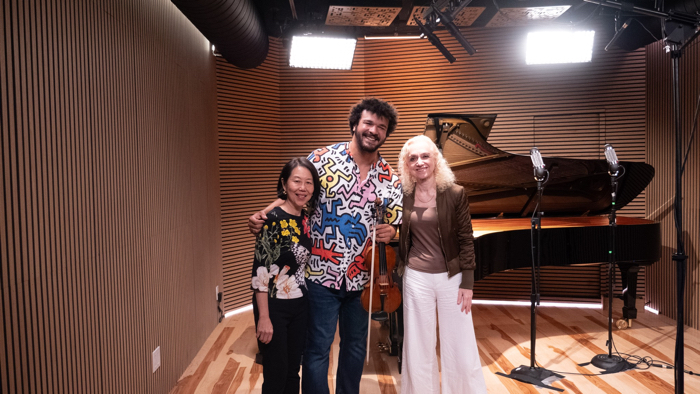
Donna Weng Friedman at the MICROVIDS recording session with composer Stefania de Kenessey and six-time Grammy-nominated violinist Curtis Stewart
Stefania is so patient, because I have all these ideas. I’ve been telling stories since I was a kid, and with music. I grew up in a traditional Chinese family, so I kept these stories to myself. Then I went to Juilliard Pre-College and all those years I always wanted to improvise but I never felt free enough to improvise. Throughout my life I’ve been afraid of improvisation, and I believe that it’s something that all children should experience. At a young age, they need to be free to express themselves. The inability to recognize and express emotions plays a part in mental health issues. So, I asked Stefania who is very gracious: ‘Would it be okay with you if we invited Curtis Stewart—a six-time Grammy-nominated violinist also very well known for his improvisation—to join us?’ Stefania said “sure” and we got together with Curtis. She had written the violin part, and based on that, Curtis improvised with me. It’s on the recording and it’s spectacular! In this huge album about to be released, the piano solo stays the same but there are all these different iterations—I don’t call them arrangements because they’re not; they’re not even versions. They are new pieces that show life through a different lens.
You also continue teaching and are very supportive and proud of your students. Some of them practically grow up with you…
I love teaching! I’ve been teaching at Mannes Prep since 1989, and I also have private students. I have learned as much from my students as they’ve learned from me, and my students are like my family. When you’re teaching somebody once a week, every week, since they’re four and a half years old all the way through college, you’re not just a regular teacher. Some of my students come to me just to talk things through because there’s a trust there, of course built through music. Since we are discussing our feelings about the music, they feel comfortable talking to me so some of the parents call me teacher-therapist. Aside from piano, I teach chamber music at Mannes Prep as well, groups like trios, quartets or quintets, and it’s a blast; I love it!
Two of my students who study with me at Mannes Prep are both juniors in high school at Horace Mann. One, Derek Lee, is an excellent classical musician who won the Mannes Prep Concerto Competition and has gone to the Brevard Summer Institute now. The other, Matthew Brand, is also a great pianist and a jazz musician; he also writes pop music. At my request, he wrote a classical jazz piano concerto and recorded it to be released this October. They are both spectacular talents and wonderful people; they’re like my kids.
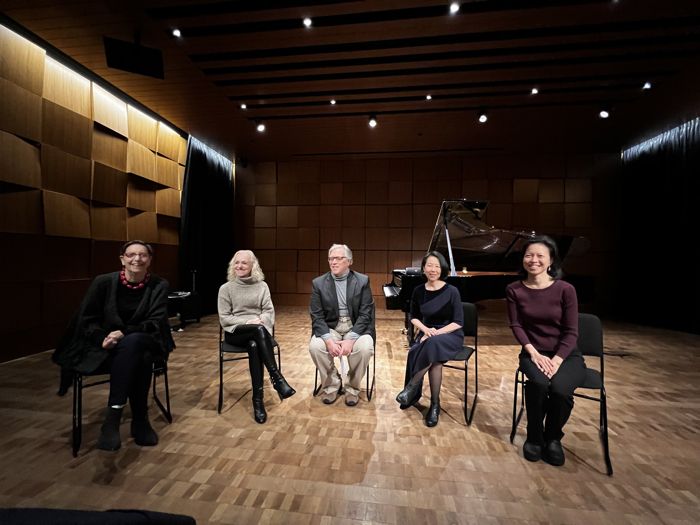
“Five Composers and a Pianist” panel discussion following a concert at Steinway Hall, left to right: Composers Kim D. Sherman, Stefania de Kenessey, then-moderator Jed Distler (radio host of “Between the Keys”), Donna Weng Friedman, and composer Beata Moon
What about your own live performance schedule?
I created a series called “Five Composers and a Pianist” – a concert series featuring the works of five living contemporary women composers, performed by me on the piano. I got to play at various venues including Steinway Hall, Hunter College, and most recently, Kent State University. I did this because I love all kinds of music, but I feel like new music gets a bad rap. A lot of it has to do with my dear friend, the great late Milton Babbitt, with whom I studied while I was at Princeton. He was a brilliant composer, but his music was incredibly atonal, based on math and wasn’t meant to be listened to like all music. It’s historically important and a different way of looking at music, but I think, along the way, people got confused and started thinking that: “If this is contemporary music, I don’t want anything to do with it.”
In “My Five Composers and a Pianist” program, I tell the stories and play the music of these women composers, and then at the end, I invite the five of them for a panel discussion because I feel like the more audiences know about the composers, the more they understand the music. I love seeing the reactions of the audience when they discover they love the music.

I’m also working on two other projects. I loved the pieces from MICROVIDS, and one especially: the performance of Curtis Stewart with me in Clouds. It’s breathtakingly beautiful; the music and his improvisation are just stunning. It tells such an incredible story in my mind that I wanted to create something with a message around it. So, I did a microfilm called A Silent Cry, two and a half minutes long. It’s set against the breathtaking backdrop of the Himalayan Mountains—one of the world’s most vital and fragile ecosystems. The Himalayas are not only a symbol of natural beauty and cultural significance for India, but they are also crucial to the planet’s environmental health. Through this project, I hope to highlight the urgent need to sustain and protect this unique ecosystem, which supports countless species and provides life-sustaining resources for millions of people. Through a blend of evocative visuals and music, A Silent Cry explores themes of loss, resilience, and hope and it has already been selected by some film festivals; right now, it is screening in India.
In the meantime, I created a new initiative called Brava Maestra! to spotlight female conductors of color in partnership with the International Alliance for Women in Music, the largest organization that celebrates and supports women in music globally. I’ve been in touch with conductors from our AAPI and BIPOC (Black, Indigenous, and People of Color) communities talking about their struggles and challenges, and we’re planning to have a roundtable soon. I also found out that there were only three Black women conductors in this country, and four in the world! I did a little research and discovered Dr. Anne Lundy in Houston, a trailblazer and history-maker, the first African-American woman ever to conduct the Houston Symphony, and the first woman in this country to create a Black orchestra—the Scott Joplin Chamber Orchestra. I connected with Anne Lundy and also with Kalena Bovell, a Black woman conductor who, 40 years later, is still facing the similar struggles as Dr. Lundy. Kalena Bovell recently became the first Black woman to conduct an opera in Canada.

Donna Weng Friedman (Photo: Michael Falco)
So, we have these milestones and the Brava Maestra! initiative is intended to bring them to the forefront, to create a network of these women conductors and start conversations. I plan to create a film about Anne Lundy and Kalena Bovell, called With a Wave of Her Hand. All Arts WNET/PBS is interested in airing it, but in February when the grants were cut, my whole project was defunded, so now I’m spending most of my time trying to raise funds. The story is so beautiful, and I’ve gotten to know Anne and Kalena. In the historic 1989 concert with the Houston Symphony, Anne Lundy said that she would conduct the Houston Symphony if, on the stage, both Black and White musicians were represented equally, so she conducted the Houston Symphony alongside her Scott Joplin Chamber Orchestra. Unfortunately, in the 2000s there was a huge flood in Houston that destroyed all the archival photos from the concert. I really believe that these stories need to be told. Anne continues to conduct the Scott Joplin Chamber Orchestra to include the Black community in the music scene and also encourage the younger generations.
Do you have any special message for your audiences in New York City and beyond?
I really want to encourage everyone to support the arts because we need this country to know how important the arts are to us. I thought that was proved during the pandemic as everybody was home and turning to online music programs. People were writing to me saying they would go to more concerts once the pandemic is over. But now in our country we’re dealing with something different, so we have to keep being together and lifting each other up, especially through the arts. I used to tell myself: “Why would anyone listen to me? How would one individual person make a difference?” But I was wrong to think that. We all count. Our voices need to be heard, and we need to feel strong enough to say: I love the arts, I want to go to concerts and support the arts. I’m going to let the world know how much the arts mean to me because I know they also mean a lot to someone else, to my neighbors, to my friends and my family, and together we can keep them alive. Maybe all the negativity going on against the arts is meant to bring us, the people, even closer. That’s my hope, my wish, and my prayer.
More about Donna Weng Friedman
MICROVIDS Album – Pre-Save and Stream/Buy on July 25
Top photo: Donna Weng Friedman (Photo: Wes Steinberg)
All other photos without credits courtesy of Donna Weng Friedman