Think of your favorite opera composer. You have listened to many of his masterpieces over and over again. Even if you haven’t heard everything, you are aware of his body of published works and relish the thought that your continued exploration of his music is easily feasible, in most cases only a click away. And then one day, the composer reaches you anew, his voice resounding from beyond the grave completely novel. A piece lost and silenced for over 170 years flows to you and instantly wraps itself around the fibers of your heart, and you can almost hear the composer whispering: “I may be long gone but I’m not done surprising and moving you.” It is Giuseppe Verdi transcending time and space to make an astonishing debut.
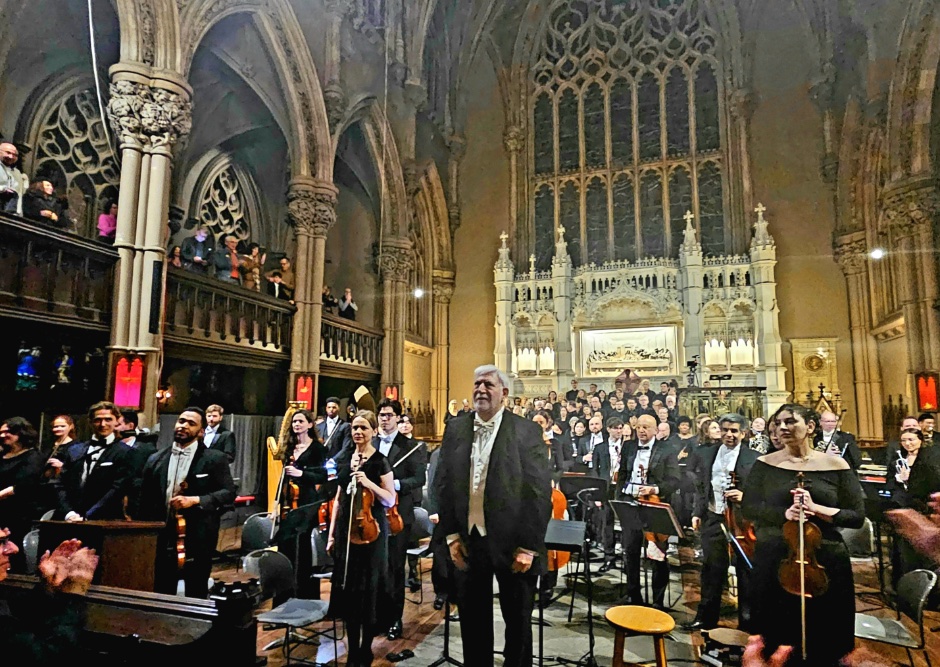
True, no matter how many times you listen to Verdi’s works, you always find something new to discover. But on April 5th at the St. Ann and the Holy Trinity Church in Brooklyn, the novelty was literal. Brooklyn Chamber Orchestra presented the U.S. premiere of Verdi’s lost ballet music from his third opera, Nabucco. It was the first time that audiences on this continent, and even in the world—with the exception of anyone who attended the Verdi Festival in Parma in 2021 or listened to the performance recording conducted by Roberto Abbado—ever heard this music, and the anticipation and emotional thrill of its historic debut ran through the public like electrical currents.
Verdi composed this ballet music for an 1848 production of Nabucco in French at the Théâtre de la Monnaie in Brussels to fulfill the ballet-requiring convention of French-language grand opéra. The music was inserted into Act III after the opening chorus. Its existence has been known but the score became lost. In 2021, it was found at last in the basement of the Villa Verdi at Sant’Agata. Danish music historian and author of the enlightening book The Verdi Ballets, Knud Arne Jürgensen, identified it as the lost ballet score: Verdi’s Divertissements for Nabucco. Only two of the three original sections had survived.
For Brooklyn Chamber Orchestra’s Artistic Director and conductor Philip Nuzzo it took immense persistence to acquire the score, as he described when he addressed the audience. After a few years and a pinball game of emails to various entities with vague to no answers, he finally got through to the leading British classical music publisher Boosey & Hawkes only to be directed to a United States website and read the words: “This title is not available on this territory,” which, at least, told him that Boosey & Hawkes had the title but no one had access to it in the United States. Undaunted, Maestro Nuzzo insisted with the publisher and at last, the score was released in the U.S.
The Maestro joked about people accidentally discovering surprising things in Brooklyn basements, so he liked to envision that something similar happened at Villa Verdi: Someone bumped into a box and the score jumped out. He added: “I’m sure that’s not the way it happened; these things are very well preserved. But for tonight, between you and I, let’s just think that some electrician kicked over a box, and there was the score!” Visibly moved, Maestro Nuzzo concluded: “We’re about to perform something that has not been performed in the United States ever before. It could easily be the world premiere of the [new] definitive edition because that wasn’t finished until 2022, and we, here in Brooklyn, have it! It’s a great honor—once in a lifetime—to present this work of the great composer Giuseppe Verdi.”
After the majestic opening chords, Verdi’s piece unfolded through an incredibly beautiful solo cello melody as soulful and singable as an aria, infused with longing warmth and sweetness, like a pleading, mesmerizing invitation to connect directly at the heart in this new encounter with the genius composer. The cello sound resembled an alluring mezzo-alto voice, caressing and very human while the orchestra followed luminously with recognizable Verdian accents and inflections, like musical gestures of reassurance. Several dancing movements developed, elegant, nimble, grand, flirtatious, predicting some of the lively moments to come more than ten years later in Un ballo in maschera, especially those belonging to Oscar, and even Gustavo’s light dismissal of Ulrica’s prophecy. There were also hints of Act I of Rigoletto that would premiere three years later, like the festive music at the Duke’s abode and the jester’s teasing motifs as well as subtle intimations of La Traviata‘s Act 1 party scene and the music accompanying the Anvil Chorus from Il trovatore—both La traviata and Il trovatore would premiere five years after this piece saw the light of day.
At one point about halfway through, after such bouncing, trilling jocularity, Verdi reminded us that inside all that fun he was, after all, Verdi the master of depicting human tragedy, and he unleashed three powerful chords, like a prophecy of the drama to come in Un ballo, Rigoletto, even in La forza del destino. Yet that was just a brief taste as he immediately returned to animated dance elements whirling with exuberance between winds and strings and percussion, increasing feverishly and causing the audience to burst into applause even before the end of the piece. For a moment, he surprised us again with yet another three dramatic chords, then launched into a more paced minuet-like sequence, and ended in a vibrant gallop of sheer exhilaration.
The two other pieces framing this historic premiere of Verdi’s lost ballet both connected to Shakespeare, a meaningful allusion to Verdi’s prowess in composing operas based on Shakespearean plays. The first consisted of selections from Dmitri Shostakovich’s incidental music for a theater production of Hamlet, a thrilling composition of grandeur displaying full orchestral force, sweeping movements, melodic fun, carnivalesque elements, and occasional delicateness as in the Lullaby, for instance. The last piece of the evening, William Walton’s film score for the 1944 film Henry V—arranged by musicologist Christopher Palmer into Henry V: A Shakespeare Scenario for orchestra and narrator—brought in chorus selections, awe-inspiringly sung by the New York Choral Society and Grace Chorale of Brooklyn, and theater: excerpts from the play rivetingly and crisply recited by actor Jose Espinosa. Under the baton of Maestro Nuzzo, Brooklyn Chamber Orchestra played as a unified force in perfect sync and multidimensional support and sensitivity when highlighting its various sections and excellent players.
Echoing Maestro Nuzzo’s words: We witnessed a once-in-a-lifetime phenomenon. The privilege and honor of hearing a Verdi piece for the first time 177 years after its composition made this evening incomparable to any other performance experience. It’s as though the composer himself returned to Earth to offer us an unknown part of him. Magic doesn’t even begin to describe the moment when those first Verdian chords resounded in Brooklyn. The feeling of it all was no less than divine.
Top photo: Brooklyn Chamber Orchestra with Maestro Philip Nuzzo
Photo by Maria-Cristina Necula