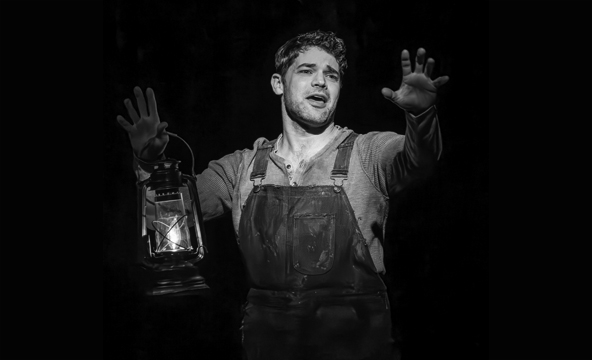
Floyd Collins is Inspired by the true story of a cave explorer who got fatally trapped and the media circus that not only ensued, but might’ve provoked his death. One might think the Vivian Beaumont too spacious for any impression of claustrophobia, but inspired sets by the collective dots, lighting by Scott Zielinski, the hero’s immobility, and echoes create effective juxtaposition of confinement and outside excess.
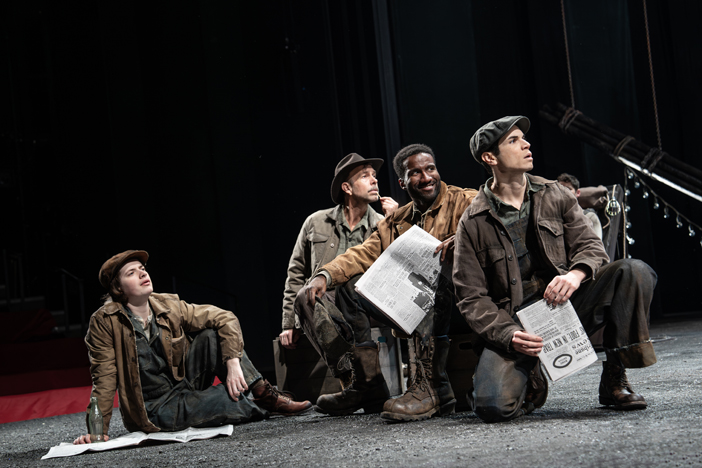
L to R: Cole Vaughan, Wade McCollum, Clyde Voce and Jason Gotay
The real story: In the 1920s, “Kentucky Cave Wars” sent struggling property owners scrambling to capitalize on tourists paying to see caverns. William Floyd Collins, an expert spelunker, thought he’d found the cave of his dreams. He spent weeks exploring and expanding passages, trying to create a more practical entrance to what he envisioned as a major attraction.
January 30, 1925, Collins accidentally knocked over his lamp, leading to misplacing his foot. Rocks shifted and he got caught by a 26.5 pound boulder that fell from the cave ceiling, pinning his left leg. He spent the last two weeks of his life in a narrow crawl-way 55 feet below ground, 150 feet from the entrance.

Jason Gotay (Homer) and Jeremy Jordan (Floyd)
On stage: We watch the protagonist climb, scrabble, duck, crawl and slide through a series of minimally depicted rock formations and tunnels not visible on stage minutes before. Floyd (Jeremy Jordan) has been in dangerous situations before. He’s a daredevil known to be lucky. There are plans to be made; he has crickets with whom to talk until freed.
Above ground, family and neighbors assume the reckless young man will work his way out. ‘Tween a rock an’ a hard place/I’ve been there plenty of’en/’Tween a rock an’ a hard place/An’ I ain’t in a coffin! men sing. Deemed small enough to perhaps reach Floyd, Jewel (Cole Vaughan) instead pockets sandwiches and boasts, writing a self aggrandizing song on his guitar. Land owner Bee (Wade McCollum) dwells on a positive financial outcome. No one worries.
By next morning, it’s clear this is not just another accident. Mr. and Mrs. Collins (Mark Kudisch and Jessica Molaskey) feel helpless, but grateful for each other. Floyd’s sister Nellie (Lizzy McAlpine), mystically close to her brother, is prevented from attempting the descent. She sings to him from above. Ed Bishop (Clyde Voce) goes down first, but can’t fit. Floyd’s determined brother Homer (Jason Gotay) gets part way, managing to hand him sustenance.
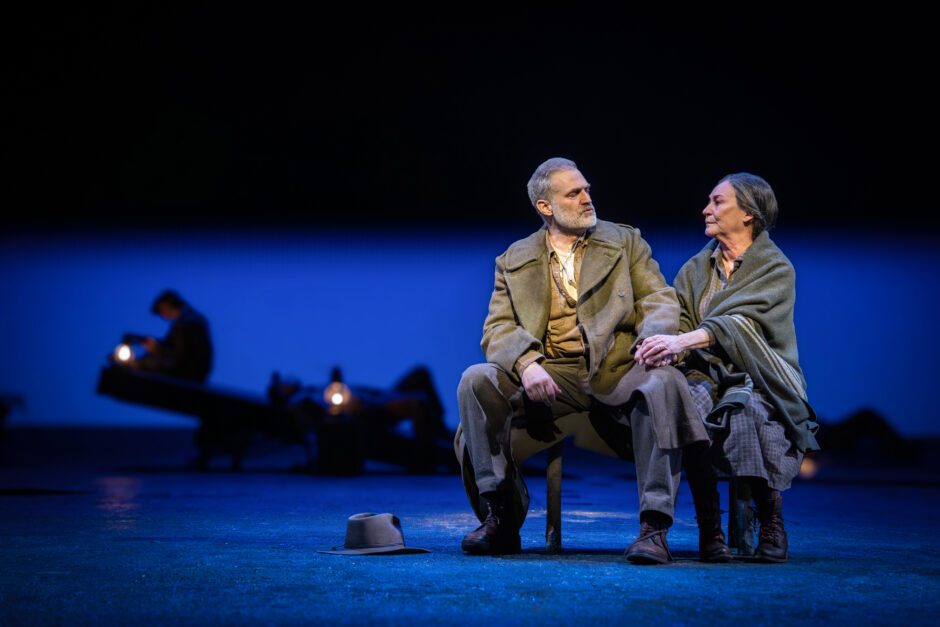
Marc Kudisch (Mr. Collins) and Jessica Molaskey (Mrs. Collins)
A duet of “The Riddle Song” is meant to distract. The brothers recall a feckless, happy past. Imagining, Floyd gets up (from where he’s lodged) to play: sword fights, fishing, rope swing, swim… It’s joyful. Back in the crevasse, he admits to being trapped. Homer is startled and alarmed.
Ingenuous cub reporter Skeets Miller, “skinny as a mosquito” (Taylor Trensch), is sent from The Louisville Courier Journal under his editor’s assumption the incident is a hoax. Not knowing any better, he volunteers, getting as far as a close ledge overlooking the victim. On repeated trips, the two develop touching intimacy. News reports are distributed by telegraph and the brand new medium, broadcast radio. Much to Skeets’ surprise his articles are syndicated. (The real journalist would win a Pulitzer Prize for the story.)
Appointed head of operations, bombastic H. T. Carmichael (Sean Allan Krill) takes over. He may be an engineer, but he doesn’t know caves and is destructively stubborn. Desperation when the character finally admits defeat comes too little too late.
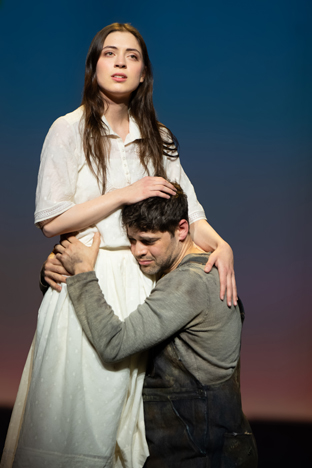
Lizzy McAlpine (Nellie) and Jeremy Jordan (Floyd)
City reporters show up in trench coats and fedoras with flash cameras and notepads. They sing and dance a vaudeville-like number I find too blithe to fit the play’s tenor. Traffic backs up four miles as explorers and tourists congregate. The area looks like a traveling carnival selling food, souvenirs, and games of chance. Even Mr. Collins exploits the moment peddling pictures of Floyd. “If it’s God’s will to take my son…” he intones, much to his children’s fury. We’ve become all too familiar with circuses/exploitation that masks or ignores victims and situations rather than aiding. Greed and misdirection rule.
The real story: An attempt at hoisting the victim resulted in injury to Floyd’s back. Outside the mouth of the cave hundreds of sightseers lit campfires that disrupted ice inside causing it to melt. (Attendees were listed at tens of thousands.) The passage shortly collapsed in two places due to melting ice. A last ditch decision was made to dig a shaft straight down to reach the chamber in which Floyd was stuck. Light was lowered.
The idea of machinery was dispensed with when it was feared fumes would suffocate the caver. Pick axes and shovels would have to be employed. A series of pulleys removed rocks, but the tunnel became narrower limiting workers. When reached February 11, it was unknown how long Floyd had been dead.
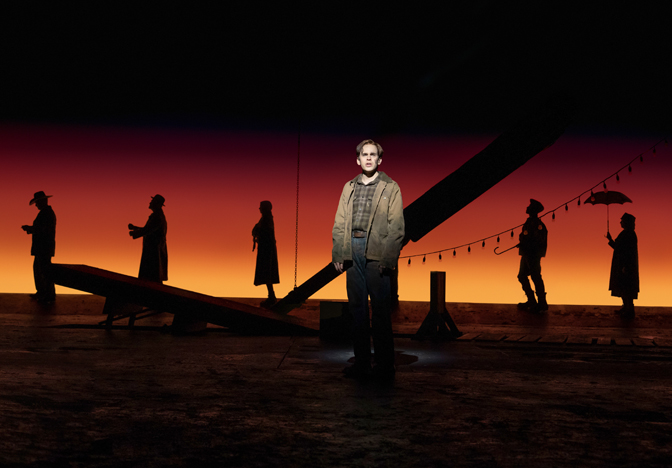
Taylor Trensch (Skeets) and the Company
On Stage: We watch Floyd dream (two numbers – one would suffice ) and die. There’s spirituality to material and staging.
Vocals are marvelous. Lizzy McAlpine (Nellie) has a gorgeous voice; both Jeremy Jordan (Floyd) and Jason Gotay (Homer) may never have been better. All three are solid actors. Taylor Trensch’s Skeets is sympathetic, nuanced, credible.
Tina Landau’s book ably defines character and relationships, but too many incidental people take time from the protagonist. (Do we really need the doctor or Bee or so much of the film director?) Adam Guettel is more tuneful than expected. Music has the spirit of time and place. Not since Lonestar have we heard this kind of evocative Appalachian sound. (Orchestrations – Bruce Coughlin.) Harmonies and canon singing draw us in lending a haunted quality to cave scenes.
Direction (Tina Landau) is masterful, both physically and dramatically. When Skeets falls on top of Floyd, when Homer shows desperation about his own future, the hero’s soliloquies, Nellie’s ethereal hope, Skeets’ tenderness, an exhausted Mrs. Collins trying to keep family together…
An unlikely challenge was taken on and met. The piece is compelling.
The 1951 noir film, Ace in the Hole or The Big Carnival, starring Kirk Douglas, is also “inspired” by the tragedy. In it, a reprobate reporter accidentally stumbling on the event, actually foments a “carnival” atmosphere delaying rescue in order to create sensational newspaper copy. There’s violence and retribution.
Photos by Joan Marcus
Opening: Jeremy Jordan (Floyd Collins)
Floyd Collins
Book and Additional Lyrics – Tina Landau
Music and Lyrics – Adam Guettel
Music Direction -Ted Sperling
Directed by Tina Landau
Through June 22, 2025