
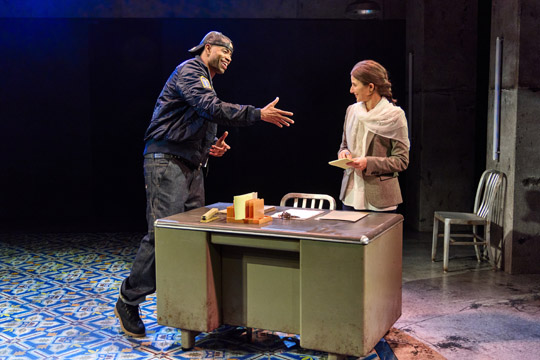
Canada, 2025. Duke, a successful American rapper, is interviewed about his 2017 visit to Kabul, Afghanistan. At the insistence of his record company, he had gone to entertain the troops, but while there, he thoughtlessly caused an international incident. Multifaceted Jay Ellis embodies the character, organically inserting hood colloquialisms into Duke’s refined speech, displaying his talents as a rapper and actor.
Kabul, 2017. Duke, charming and cocky, is laser-focused on an attractive, English-speaking Afghan translator. Roya, played by Stephanie Nur, is a remarkable actress whose accent, Afghan speech, and dignity create a whole woman. She wears a loose headscarf, not a burka. (Bravo on the choice of shoes.) They engage in playful conversation. “The concept of dating here is irrelevant because most marriages are arranged,” Roya says. Because of social restrictions, she feels free to flirt with him.
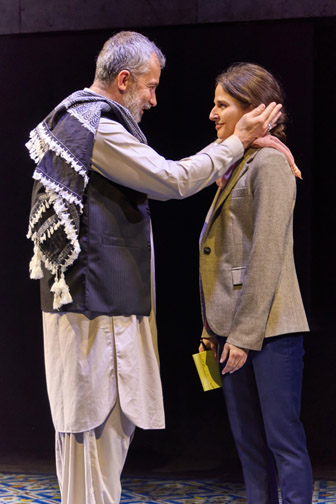
Dariush Kashani (Sayeed), Stephanie Nur (Roya)
Roya’s father, Sayeed (Dariush Kashani – grounded and appealing), has long run the U.S. base office. Having helped during the war, he was promised family visas, yet has been on a waiting list eight years. Roya translates interrogations of terrorists, but secretly works with an organization that teaches women to “find their voices” despite Taliban prohibitions. The musician admits just a bit uncomfortably that all his songs are about young partying men. Still, they’re drawn to each other.
Duke is determined to leave the base, explore the city, and purchase a piece of Lapis. (The stone is believed to promote wisdom, truth, and self-awareness.) Though dangerous and forbidden, Roya is talked into helping. To do so, she masquerades as a man, one of the bacha posh. When there are no sons in a family – one of the daughters is designated as a bacha posh, and she serves the parents in the role of a son until puberty, dressing as a boy.
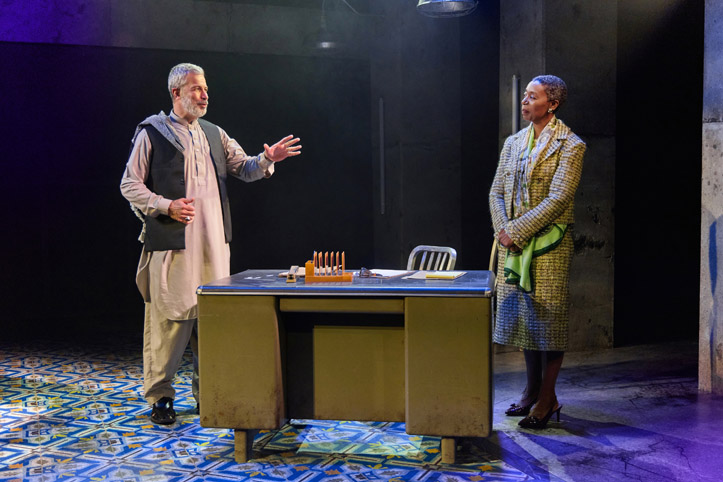
Dariush Kashani (Sayeed), Noma Dumezweni (Desiree)
The couple sits at a café. James Baldwin is quoted: “To be a Negro in this country and to be relatively conscious is to be in a state of rage almost, almost all of the time.” Raya explains the difference of living “in fear” and “with fear.” Then the incident occurs. Duke is wounded. Both lie about what happened. Roya is questioned.
The musician’s mother, Desiree (portrayed elegantly and maternally by Noma Dumezweni), a vice president at The World Bank, is unexpectedly in Dubai and flies over immediately to see her son. Their relationship is close. Reluctantly, Duke returns to the States with his mother. The “trending story” surrounding his wounds boosts the album release. Desiree promises to assist in helping Roya’s family leave. Despite distance, the young people stay in touch.
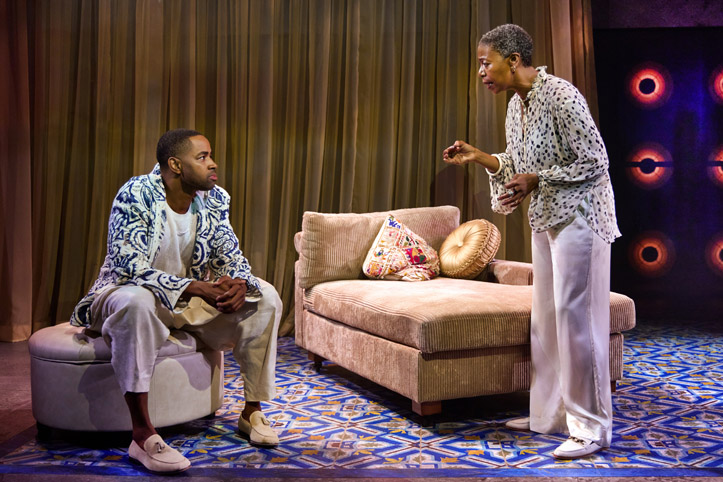
Jay Ellis (Duke), Noma Dumezweni (Desiree)
Both Roya and Duke are smart and aware. What they see in one another goes beyond adventure. Roya is truly a source of change. Duke initially appears naive, but he’s perceptive. Cultural misunderstandings and navigating unfamiliar territory pose challenges. Individual agency is at stake. Roya lives behind the fault line, while Duke exists in a facile world that suddenly appears different. Adult perspective, that of Desiree and Sayeed, is also explored, adding balance. All characters are three dimensional.
Playwright Charles Randolph-Wright was partly inspired by The Underground Girls of Kabul, a book by Jenny Nordberg that documents the bacha posh of Afghanistan. His research rewards with specificity. Understanding both the polarizing political and human situation creates a completely believable, empathetic scenario.
Estimates suggest that tens of thousands of Afghan citizens – interpreters, engineers, medics, and contractors – were left behind after the 2021 withdrawal, despite promises of relocation. It was recently announced the office that helps with relocation will close on July 1. Under a new directive, Afghan nationals who made it out and are currently residing in the U.S. under Temporary Protected Status have just under six weeks to leave, setting a deadline of July 14.
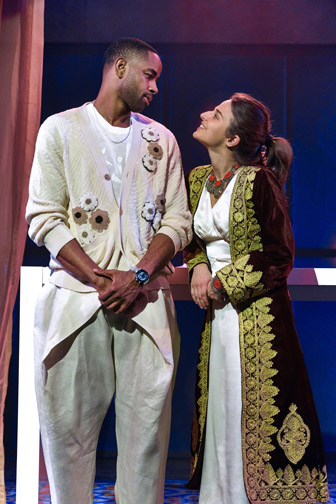
Jay Ellis (Duke), Stephanie Nur (Roya)
Duke & Roya is directed by Warren Adams with great nuance. Not a voice is raised without visible reason. The company is spectacularly good at listening. Physicality is an extension of emotional expression, rap performance authentic. Adams adroitly utilizes space between both characters and dialogue.
Scenic design by Wilson Chin is comprised only of the essential, leaving the story to rule. Costumes by Sanowber Sabrina Spanta include both an amalgam of native and western apparel and designer sophistication, suiting character and context. Spanta has two sisters stuck in Afghanistan.
Taylor J. Williams’ sound design (and additional music) and Amina Alexander’s lighting design add immeasurably, sometimes surreptitious, at others, with alarming onslaught. Original music and lyrics by Ronve O’Daniel arrive as rap, some unintelligible, some incisive.
Duke & Roya by Charles Randolph-Wright
Directed by Warren Adams
There was a talkback after the performance moderated by playwright/director/producer, Tony and Emmy winner, Mike Jackson. Each actor spoke to his/her reaction to the piece Astonishingly, this is the first time leads Jay Ellis (Duke) and Stephanie Nur (Roya) have performed in live theater, both having worked exclusively on screen. Watch for these extraordinary thespians.
“A friend had taught Shakespeare in Kabul. I met a young woman teaching here who grew up as a boy,” Randolph-Wright tells us. The young woman was forced to flee to Canada and can’t visit to see the production for fear of being sent back to her birthplace.
Several of the actors have played Middle Eastern or Afghan roles repeatedly and swore off them prior to what they feel is this important script. Nur (Roya) is Syrian. Her mom can’t get out to attend the opening. The performer was attracted to playing a boy as well as a girl, to speaking the foreign language, and “to doing something on stage that would never be allowed in life.” Ellis (Duke) was drawn to the defiant, outsider aspect of his character, and to familiarity with those who’d let success change them.
Kashani (Sayeed) is an Iranian who moved here in 1979. The artist had a roster of Middle Eastern “dad parts” behind him, but found them restrictive. “This is like a giant piece of meat that will last a long time.” Raised at Catholic School to deny his heritage, the actor’s dad told him to, “suck it up and be humble.”
Dumezweni (Desiree) who is British/Nigerian did a reading of the play ten years before being cast. This is her first American production. She’s fallen in love with the company. “My service to the world is presenting other experience.”
Not to be missed.
Photos by Jeremy Daniel
Opening: Jay Ellis (Duke), Roya (Stephanie Nur)
Through August 23, 2025
the Lucille Lortel Theatre (
121 Christopher Street