“All of it… is true. Or most of it, anyway. Names have been changed. Some of the places have been changed. Some of the boring parts, snipped away. Some other stuff has been added to make it… theoretically more interesting. But otherwise all of it is almost entirely true…” There’s no fourth wall when the protagonist begins.
Here’s the rub. Lies can be efficacious, talent for disseminating them often valued. This last election
is a prime example. Diplomatic untruths seem harmless with friends and acquaintances, but can be provocative, even destructive in politics. (“Key to Trump’s Success: Knack for Habitual Lying” by Peter Baker The New York Times)
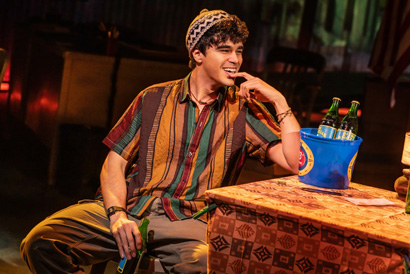
Boubs – pronounced “Boobs,” short for Boubacar (Abubakr Ali), has lived in Senegal three years. The Peace Corps volunteer found home and purpose, though the latter is frustrated by bureaucracy. (Playwright Joseph took a Senegal assignment in the Peace Corps directly after college.) When
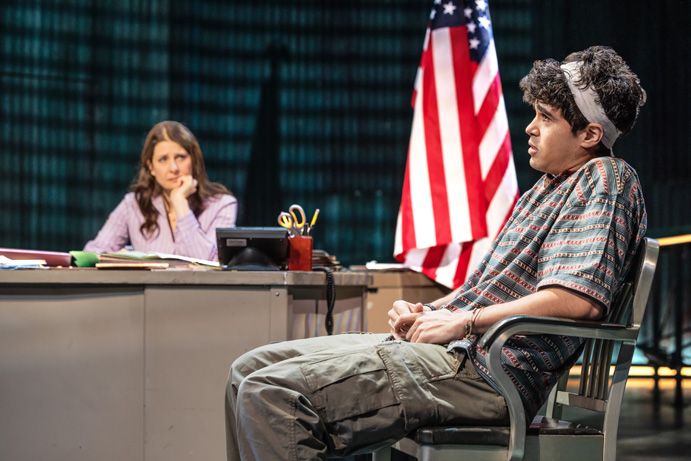
Boubs has an accident in his truck, 40 sacks of cement are discovered at the roadside. Head bandaged, he’s questioned by Dina (Mia Barron) Deputy Regional Supervisor for Safety and Security.
At first completely sympathetic, she insidiously catches each contradictory explanation. Was he drinking or did he pour alcohol over his head to disinfect wounds? Did a cat (sacred in Senegal) jump in front of the truck? Was the cement being transported to a sanctioned Catholic village to build a garden wall or was the settlement Islamic? “I speak three local languages. There aren’t any terrorists here,” Boubs protests.
Told he’s fired, expelled, and that the department would in any case reclaim the existing “garden,” the young man panics. “I was idealistic at 25,” Dina says. “You believe you’re saving the world. We could do this one thing…” A mountain of paperwork requiring signatures and fingerprints of those involved, will, she suggests, erase the situation. When everything is submitted on the cusp of deadline, it’s missing a single signature. Dina hands him a pen and turns her back.
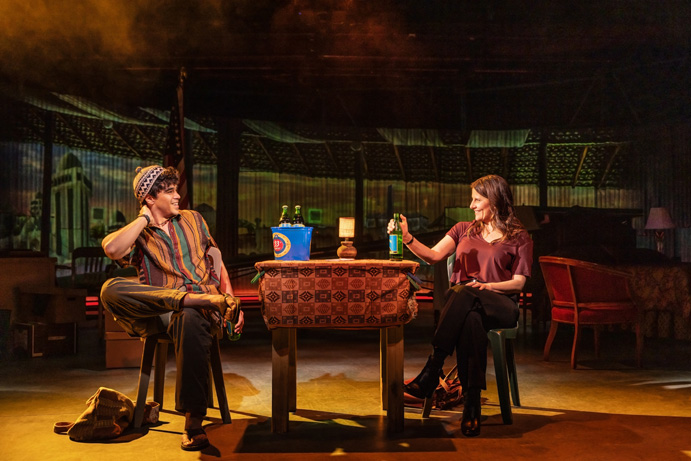
In conversation, both tell personal lies, then admit it. What begins as his defense and her professional habit quickly evolves into a “gotcha!” game. Dina seems to see a kindred spirit in Boubs. They drink a
bit too much and go up on his roof to look at stars. Assumed sexual seduction morphs into his being persuaded to execute a dangerous task, “a favor.” For Dina? For the government? There are consequences.

What kind of moral responsibility is inherent when committing unethical/illegal acts under the guise of possible greater good? “I was just following orders is a lightning rod for debates about personal responsibility, moral courage, and the power of authority in shaping human behavior.” (Neurolaunch)
The play is masterfully written. Glossed over in terms of personal decision, it clearly takes the side of soldiers and spies. I’ve been an avid Rajiv Joseph fan since Bengal Tiger at the Bagdad Zoo which won a number of prestigious awards including nomination for the 2010 Pulitzer Prize. That play, he told me at the time, was based on something in The New York Times that “troubled him.” Joseph’s comments on social attitudes and events arrive original and affecting. Characterization and economy are skilled. The hero’s last decisions might be anyone’s.
Both actors are excellent. Abubakr Ali shows impressive range and subtlety. We take the trip with Boubs.
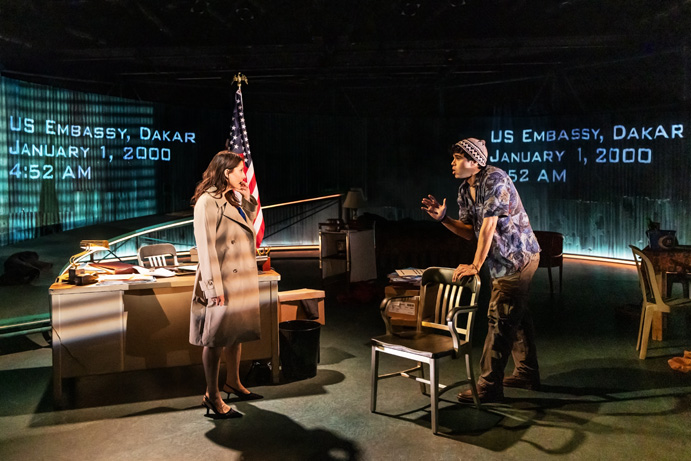
Direction (May Adrales) is marvelous. Dina’s duplicity and Boubs’s innocence; his yearning for usefulness, are realistic. The young man infectiously dances his way to Dina’s hotel room. There, despite shock at her snake-in-Eden cajoling, he absently holds fast to gift flowers. Dina repeatedly gets physically close creating a bridge of anticipatory tension, yet never broaches it. Action/reaction time is palpable.
Tim Mackabee’s set is confusing. A ramp (as in skateboarding) curls around furniture set on the floor making everything seem messy, chaotic. Emily Rebholz’s costumes are pitch perfect. Sound (Bray Poor) is pristine.
Photos by Maria Baranova
Manhattan Theatre Club presents
Dakar 2000 by Rajiv Joseph
Directed by May Adrales
New York City Center Stage 1
131 W 55th Street