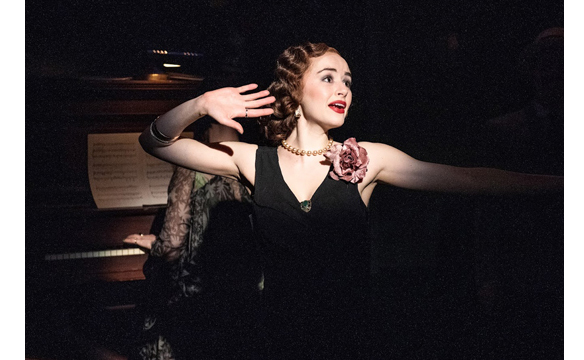
A cursory glance might call this play formulaic – virtuous young girl succumbs, sins, is punished but finds love in a rescuer. In fact, the story evolves that way before making a screeching, satisfying turn. It’s the early 1930s. Women who worked were relegated to minor jobs at meager salaries they often took gratefully to have any income at all. Many, like this heroine, helped support their families living at home until married.
We’re in S.H.Kress Dime Store, DeKalb Avenue, Brooklyn. (From 1896 to 1981 the eventually nationwide chain sold affordable, durable notions and small merchandise.) It’s likely the sales force is all females, management all men. This section, artificial flowers and 25-cent sheet music, is so visually cheerful it looks like confection.
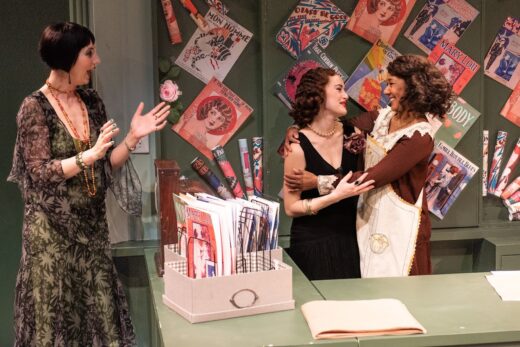
Pearl Rhein (Florrie), Emma Pfitzer Price (Francie), Tessie (Gina Daniels)
Nineteen year-old Francie Nolan (Emma Pfitzer Price) is the department’s vocalist. As was customary at the time, she sings anything a potential customer might want to buy. A great many requests come from men who address her as “baby,” withdrawing their quarters when she refuses a date. Even the floorwalker comes on to her. Francie is our innocent. Raised in an Irish Catholic, blue collar family where her bombastic father’s fire and brimstone word is law, she knows nothing about the world of men and little about the world at large.
When embarrassed or offended by socially minor situations, the actress is directed to do things like face the wall shaking. Too much. Cab driving suitor Jimmy O’Neil (Christopher Reed Brown – just right), a nice boy, hasn’t enough of a future to put him in the running.
The singer is accompanied by Florrie (Pearl Rhein, employing an ambiguous New York accent that comes and goes) who’s slightly older, street smart, and seasoned. The pianist has a cynical view of the opposite sex, but encourages Francie to follow her example, get out there and have some fun. A third section employee, Tessie (a solid Gina Daniels), is in charge of flowers. The so-called fallen woman was taken in and boards with Francie’s self-righteous parents. Her fiancé Max (tonight a very good Scott Redmond) is a steady, affable, ambulance driver.

Peter Townsend (Leonard Kress, Jr.), Emma Pfitzer Price (Francie)
Enter extremely dapper man about town Leonard Kress, Jr. (Peterson Townsend). He and Francie lock eyes. In a cartoon, her heart would thump out of her chest. His identity as son of the owner is soon revealed. This one must be different, she thinks. He has class. Spirited off by the floorwalker, Leonard arranges for Francie to get a raise then returns only to approach her with the exact same come on line as other mashers – as if to collect. The young woman reflexively refuses, but changes her mind. Off they go.
Three months of presumably idyllic dating pass. Leonard has proposed. With great trepidation, Francie invites him home to meet her parents. Pa Nolan (Jeb Brown), a cop, sits soaking his feet and has to be pressured into wearing a shirt. Bratty, bullying brothers Frankie and Johnie (Tim Webb and Jack Mastrianni) study in the kitchen. The “salon” is full of boxes packed for an anticipated move, the dining room hung with washing. There’s no place else to sit. Ma Nolan (Antoinette LaVecchia, whose subjugation and fussing ring true) knew this was the important night, yet even defending her daughter’s right to invite a man, offers no aid or support. Francie’s anxiety is palpable.
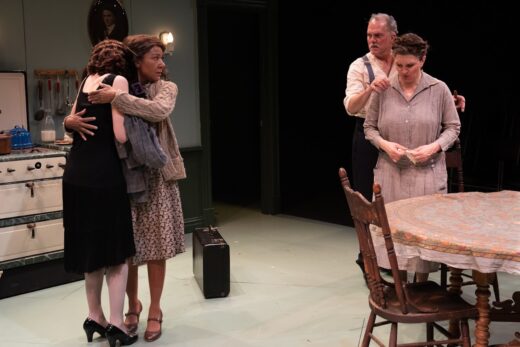
Emma Pfitzer Price (Francie),Gina Daniels (Tessie), Jeb Brown (Pa Nolan), Antoinette LaVecchia (Ma Nolan)
The ensuing meeting is as painfully obvious as it is painful. Here’s the screech of brakes. Leonard turns his disdainful back. Francie, no longer chaste, is summarily thrown out of the house. When Pa threatens Leonard, the young people are forced to make a bargain.
The third act is a revelation and Smith’s best writing. Betrayed, abandoned, and shunned, Francie manages with help from Tessie and Max. Eight months later, she’s made a questionable offer by a theatrical agent (Phillip Taratula – terrific) and is visited first by Leonard Kress, Sr. (Duane Boutte), then by his errant, up-till-then absent son. Not only are Boutte and Townsend fine actors – one believably conservative/stern, the other oily – but they resemble one another so closely, they might be related. It’s interesting to note while the Kresses are played by African Americans, the store chain was notorious for not allowing Black people at their lunch counters. Bravo Mint Theater. (In truth, Mr. Kress had no son.)
Francie has radically changed. Temptation and violence follow. Note to lighting designer Mary Louise Geiger: A ceiling full of brightly colored lanterns at the last sober moment is amiss – a mistake?
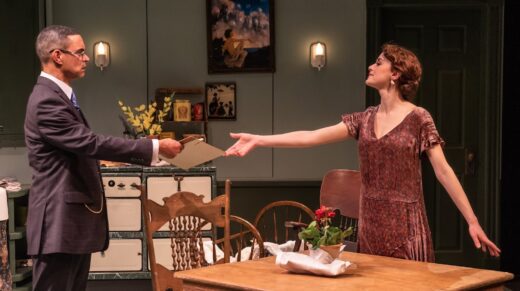
Duane Boutte (Leonard Kress Sr.), Emma Pfitzer Price (Francie)
Though somewhat long, the play is well produced and like most Mint Theater, intriguing in its unfamiliarity and reflection of its time. Mores are illuminated by characterization, not exposition. Francie broke the mold much like her creator Betty Smith who never finished high school, but among whose writing is the universal favorite A Tree Grows in Brooklyn.
Emma Pfitzer Price takes a few beats to fully inhabit Francie. ( I saw a preview.) This is not helped by direction that makes her seductive while singing and otherwise guileless. When Price hits her stride, we’re with her all the way. At one point, the audience cheers. The actress also has an extremely attractive singing voice.
Director Britt Berke is skilled with blocking and small business. Most personalities are spot on. Confrontation scenes are loud only when they need be; one is effectively venomous. The work of Intimacy and fight director Cha Ramos arrives seamless.
Vicki R. Davis’ morphing sets are apt and beautifully detailed. A particularly evocative stove is featured in the Nolan’s kitchen; the addition of flowered curtains and Maxfield Parish posters in Act III speaks volumes to the situation before a word is spoken. Chris Field’s props are just right.
Costumes by Emilee McVey-Lee are appropriate and attractive – not a given. Francie’s black dress, however, fits poorly.
Dramaturge Amy Stoller has done a marvelous job hunting down songs without specific matches in the script, each with title and mood to fit. The reliable M. Florian Staab offers pristine sound.
This is an entertaining piece with a heroine to root for and a blaggard to hate.
Photos by Todd Cerveris
Opening: Emma Pfitzer Price (Francie)
Becomes A Woman by Betty Smith
Directed by Britt Berke
Through March 18, 2023
Mint Theater Company New York City Center Stage II
131 West 55th Street
https://minttheater.org/