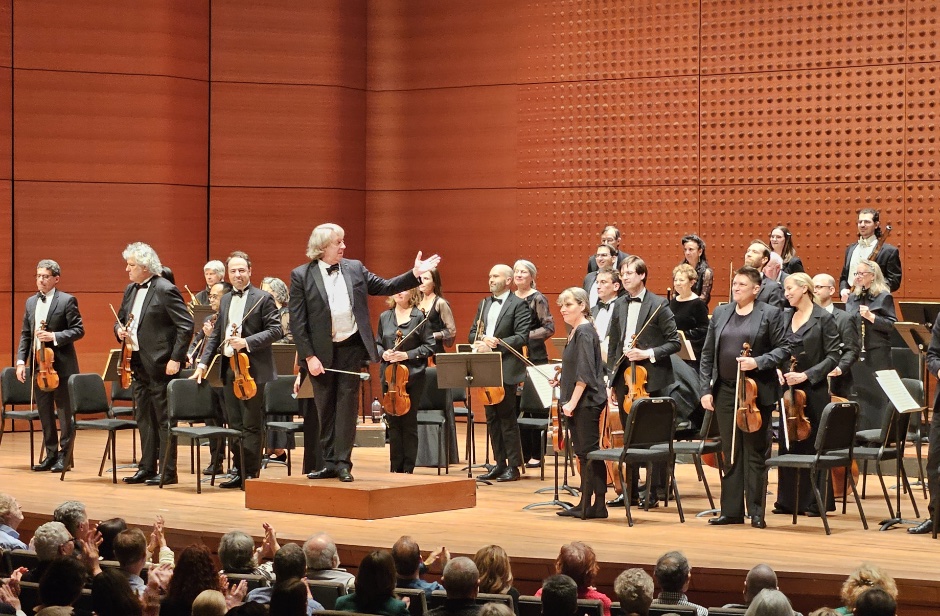
On May 7th, American Classical Orchestra (ACO), led by its Artistic Director and Founder Thomas Crawford, regaled audiences with a splendid concert at Alice Tully Hall—it was the last concert of ACO’s 40th anniversary season. The performance offered two of Mozart’s early works: the “Haffner” Symphony No. 35 and the Bassoon Concerto in B-flat Major with ACO principal bassoonist Andrew Schwartz. The concert ended with Beethoven’s Piano Concerto No 4 played by fortepianist Petra Somlai.
After Maestro Crawford highlighted the principal themes of Mozart’s “Haffner” Symphony and Beethoven’s Piano Concerto No. 4, the concert began with Mozart’s Symphony No. 35 in D Major, K.385. This work, known as the “Haffner,” was commissioned by the Haffner family, one of Salzburg’s wealthiest, most prominent, and most distinguished families, for Sigmund Haffner the Younger’s ennoblement ceremony in 1782. Initially a serenade, Mozart transformed it into a symphony.
Played exquisitely on ACO’s period instruments, the work’s musical textures were displayed to the full extent of their sophisticated sweetness, in pure articulation, precision, and crisp grace notes. Under Maestro Crawford’s masterful direction, the winds and strings blended together beautifully without overpowering each other, and even in its lively pace, the first movement, Allegro con spirito, offered the opportunity to hear the various colors and harmonic richness within the fluid interplay of sections. The second movement, Andante, flowed with nobility and elegance, and the Menuetto started off majestically then revealed alluring lyrical mysteries. The final movement, Presto, burst forth in vibrant energy and radiance.
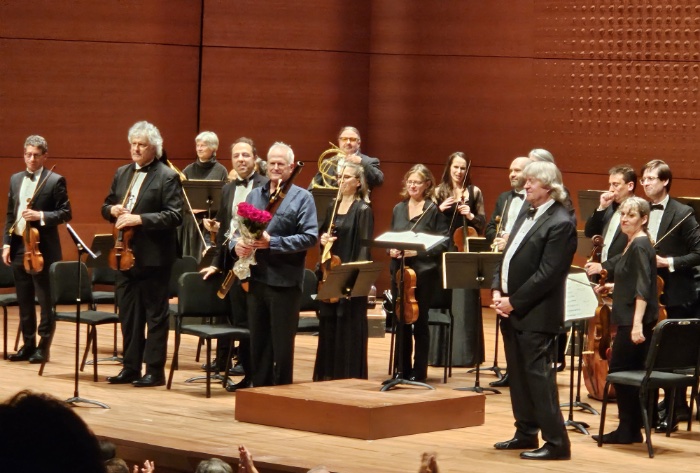
Bassoonist Andrew Schwartz with Maestro Thomas Crawford and ACO
Mozart’s Bassoon Concerto in B-flat Major, K.191 followed, featuring Andrew Schwartz as soloist. Mozart composed this work in 1774 at only 18 years of age; it was his first concerto for a wind instrument. Scholars believe that Mozart wrote five bassoon concertos, yet only this one survived. Known as the most often performed and studied piece in the entire bassoon repertoire, learning this work is a must for all professional bassoonists who will most likely perform it at some stage or another in their careers.
On his period bassoon, Andrew Schwartz showcased technical and artistic brilliance in his ability to sustain long, sinuous phrases that often sounded like a human voice, a soulful alto, coupled with extraordinary agility in mind-blowing runs that flew into a surprising high register. The bassoon’s sound is unusual to listen to as a solo instrument; its lower register is usually more recognizable, thus its range of tonal colors proved astounding. In the opening movement, Allegro, Schwartz displayed remarkable nimbleness and precision in jumps from low to high, in agility, trills, and fast-paced repetitions. In the Andante ma Adagio, the singing aura of this instrument emanated even more human warmth and longing. Expressive and poetic, Schwartz’s phrases floated above the orchestral support creating a mesmerizing mood. In the final movement, Rondo, Schwartz had some fun with the conductor, orchestra and audience in a playful, sprightly dance.
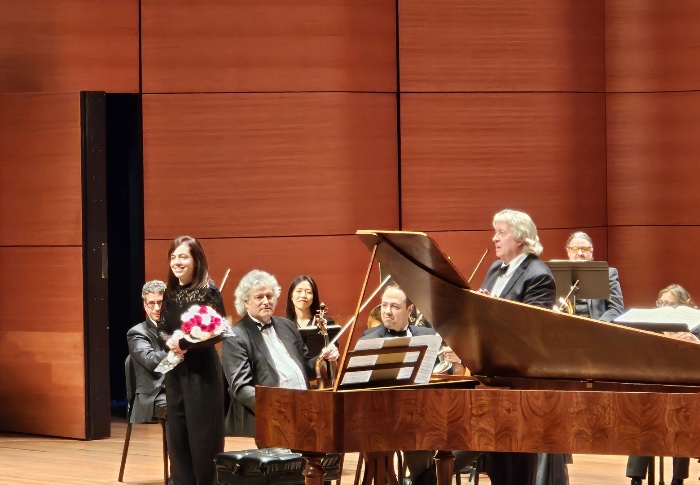
Fortepianist Petra Somlai with Maestro Thomas Crawford and ACO
Beethoven’s Piano Concerto No. 4 in G Major, Op. 58 concluded the concert, with Petra Somlai on fortepiano. Premiered in March 1807 in a private concert, this work had its public premiere at Vienna’s Theater an der Wien in December 1808, with Beethoven himself as soloist. Its opening is famous for the fact that the soloist begins alone without an orchestral introduction, a groundbreaking innovation for its time.
Less resonant than a modern piano, the fortepiano’s more translucent and gentle sound infused the work with an irresistible intimacy painted throughout by the ethereal sounds brought forth through Somlai’s incredibly delicate touch, as though both she and the pianoforte were sharing the softest, most mysterious secrets with the audience. In the first movement, Allegro moderato, Somlai established a well-paced, profound mood with elegantly nuanced dynamics and crystalline articulation. In the Andante con moto, that profundity deepened on a canvas of strings in exciting dynamic contrasts and Somlai pulled the audience in even more by bringing forth a kaleidoscope of muted yet thrilling colors from her instrument. The vivaciously rhythmic finale, Rondo, sparkled with vitality, precision, and radiant energy in Somlai’s nimble, captivating playing in thrilling communion with the orchestra.
It was an entrancing evening of beautiful music and virtuosic performances played on instruments that took us back in time to the sounds of Mozart and Beethoven’s epoch, as Maestro Crawford and ACO concluded yet another wonderful and illuminating season.
Top: Maestro Thomas Crawford and ACO
Photos by Maria-Cristina Necula