But there’s another number that a player treasures – the one on the back of his jersey. With the New York Yankees, that number becomes part of a player’s identity and there’s no greater honor than having that number retired with a plaque in Yankee Stadium’s Monument Park.
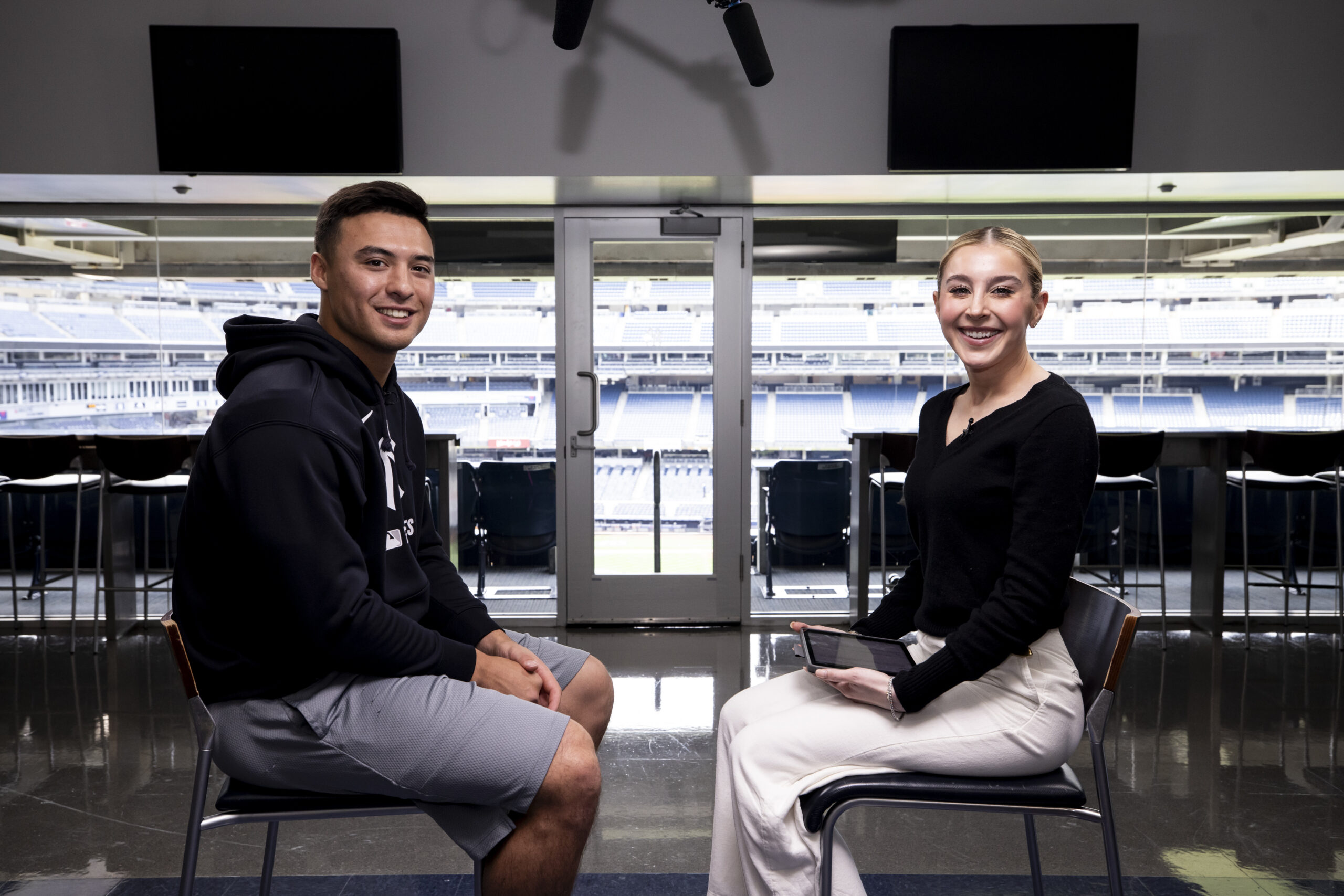
Daniel Laikind a producer at the YES Network, came up with the idea of a show that explores the relationship between Yankee players and their numbers. After considering and rejecting the idea of having a former player host the show, the focus turned to Gracie Cashman, the daughter of Yankee General Manager Brian Cashman. As an actor and vocalist (she once sang the National Anthem at a Yankee game), Gracie has built an impressive resume in her budding career, with roles in 2024’s Christmas Cowboy and the upcoming California Skate, alongside Brooke Shields, Bridget Moynahan, and Henry Winkler.
On a phone call with Gracie, Laikind described his vision for the show: The Story of My Number. After every game, win or lose, players face a phalanx of cameras and microphones and answer questions about great plays and missed opportunities. Rarely do the questions become personal to give fans a glimpse of what it’s like for the players off the field. “I’ve always wanted to chat with the players about the behind the scenes stuff,” Gracie said in an interview. It didn’t take much coaxing for her to sign on as the show’s host.

Gracie Cashman (Photo Credit: Emily Hayman)
Gracie grew up in Darien, Connecticut, and attended Sacred Heart Greenwich, transferring to St. Luke’s in New Canaan, before her sophomore year of high school. “I can’t remember a time that I didn’t think I was going to be an actor,” she says. “My aunt would take me to Broadway shows. That was something we would do together. I was born with a little bit of a creative side and then going to all those shows with her made it clear that was the path I was going to take.” The first time she was on stage, outside of school, was when she was ten and played the title role in the musical Annie for a community theater in Stamford. “That was the most magical step into a semi-professional experience,” she says.
Gracie’s relationship with the Yankees began, quite literally, the moment she was born. “I was born in `98 in October,” she says. “It was my dad’s first year as GM, and there was a huge game happening.” An infamous play during that game is part of Yankee lore. In game two of the 1998 American League Championship Series against the Cleveland Indians, Yankee second baseman Chuck Knoblauch failed to retrieve a ball that was overthrown to first base. Instead, he argued with the umpire that there was player interference. Since the ball was still live, Cleveland scored a run and eventually won, 4-1. “It was a very big deal, and my dad wasn’t there,” Gracie says, with a laugh. “He was in the delivery room because I was there.” Although her father has been asked about that game “a hundred times,” no one has ever asked him where he was. According to Gracie, if they did ask, he would say: “I was in the delivery room and I had it on. We were watching.”
From that time on, Yankee baseball became a constant presence in Gracie’s life. “The YES network was always on in our house,” she says. “Part of my dad’s job is to keep up with the other teams as well, so it’s not just what the Yankees are doing, it’s what every team is doing.” When her brother, Theodore, was old enough, he became interested in baseball and now plays for Lafayette College’s NCAA Division 1 team.
“I was lucky to be born into a franchise like the Yankees and to be surrounded by the most amazing Yankee family,” Gracie says. “When you’re a kid, you don’t think how incredible the organization is. You’re just experiencing the humans that you’re dealing with. And then you grow up and it’s kind of crazy to look back and be like, that was such a wild thing that I was doing as a kid!”

Paul O’Neill and Gracie Cashman (Photo Credit: YES Network/The Gotham Sports App/Eephus Entertainment)
Having a history with so many of the Yankee players, past and present, Gracie sees them, not as celebrities, but as real people with amazing stories to tell. Now as host of The Story of My Number, she helps them share their experiences, on and off the field, with their fans.
Each episode begins with Gracie asking the player, “Tell me about your number.” But the discussion soon veers off into other areas that can be emotional for the player. Managing these parts of the interviews can be tricky. Gracie credits Josh Moss, who crafts the questions, but it’s her own skill that elicits answers without making the players feel uncomfortable. Gracie has made it clear that she wants each player’s experience to be positive. “We try to give them a lot of freedom in the things that they want to talk about,” she says. “So far, we’ve had a lot of people be willing to be really vulnerable about a lot of really difficult things.” Along the way, there’s insights into playing the game and many humorous anecdotes.
Some of the highlights from the first two seasons:
Paul O’Neill talked about losing his dad 18 hours before the first pitch of the fourth game of the 1999 World Series. The Yankees swept the Atlanta Braves, but Paul said he couldn’t celebrate. Although he can remember every pitch, every play of every other World Series game in which he played, that “World Series was just dark. I was numb.” But Paul injected a humorous note into the interview when he admitted he still receives a residual check for $57 whenever a Seinfeld episode in which he had a cameo is shown.
Nick Swisher wore the number 9 to honor his father, Steve, who was also a major league player. At Ohio State, the number 9 was unavailable, so he settled for 33, which, he told Gracie, can be viewed as 3 times 3 equals 9. When he was traded to the Yankees, a pitcher, Brian Bruney, wore 33. “It was the first time I had to pay for something,” Swisher says. “He wanted cold hard cash.” When he was with the Oakland Athletics, his grandmother died of cancer. Nick grew his hair for ten months and donated the locks to a cancer charity.
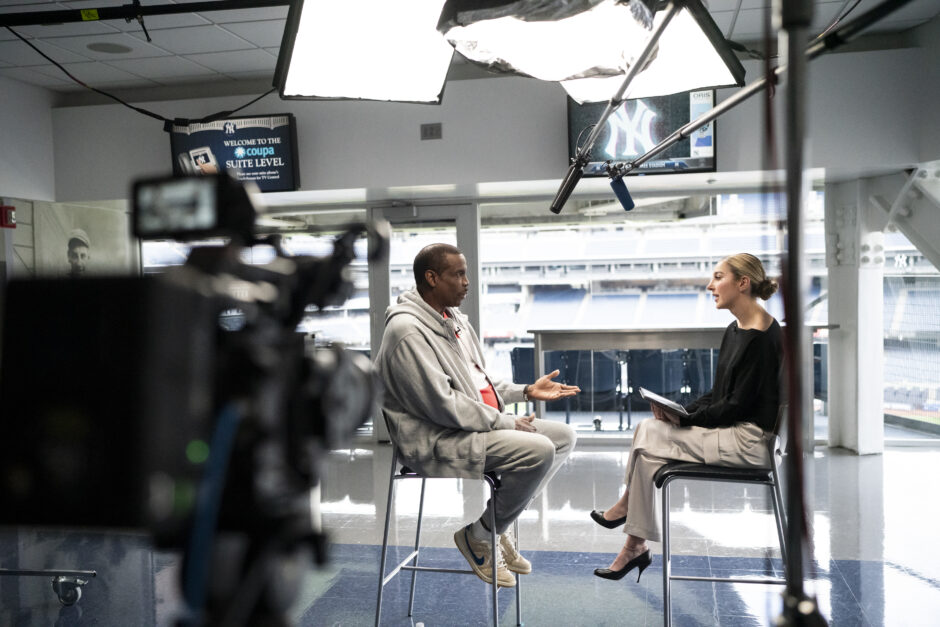
Doc Gooden and Gracie Cashman (Photo Credit: YES Network/The Gotham Sports App/Eephus Entertainment)
Doc Gooden explained how one of his father’s friends predicted he would be a doctor someday. That led to stadium chants giving him the nickname, “Doctor K.” Gooden, who battled addiction during his baseball career, became emotional talking about the support he received from Yankee owner George Steinbrenner. “He meant everything to me,” Gooden said. “He was like a second father to me.”
When shortstop Anthony Volpe was offered number 11, he called the last Yankee to wear that number, Brett Gardner, and asked for his blessing. During his time as a Yankee, Gardner always treated new players well. “Even though he wasn’t there, I wasn’t able to be teammates with him, I got to still feel his effect on the clubhouse. Hopefully one day I can pass that on and keep that legacy alive.” And yes, Volpe did talk about his mother’s cooking and his favorite dish, chicken parmigiana.
Gracie says that the Volpe episode sparked a reaction from Yankee fans. “Everyone was like, oh, my God, we’ve never seen Anthony Volpe like that,” she says. “It’s sometimes difficult for me to zoom out because that’s how I’ve always known him, like that’s how he always is.”
Gracie finds time to volunteer with EndoFound, championing awareness and education around endometriosis and related health issues. “I have endometriosis and PCOS (Polycystic Ovary Syndrome),” Gracie explains. “I spent years going to the emergency room, just doubled over from pain. You’re not treated kindly in those situations, especially when there’s not something obviously wrong. They would just make sure my appendix hadn’t burst and send me home. It was really frustrating to learn what it was, and then to learn that one in ten women have endometriosis and the average length of diagnosis is seven to 10 years. So then I got mad.”
Endometriosis “is under researched, it’s underfunded,” Gracie says. “Even if you get pain medicine or whatever, a disease having ten years to wreak havoc unchecked on your body, there are lifelong consequences to that. And I’m dealing with those now. I’m now insulin resistant because my hormones went unchecked for so long. I’m infertile because of all of it. And it’s frustrating to look back and think if someone had taken it seriously 15 years ago when I was in the emergency room, all of that could have been prevented. EndoFound is working to try to make sure that stops happening to women.”
Professionally, Gracie will continue to work on her acting and, of course, filming new episodes of The Story of My Number. Engaged to Brian Stute, who was a classmate at St. Luke’s, she will also be planning a wedding. One thing that’s certain: there will be a number of Yankees at that celebration.
Top photo: “The Story of My Number” Anthony Volpe episode at Yankee Stadium on April 2nd, 2025 in Bronx, New York. ©Michelle Farsi/TSOMN
The Story of My Number can be seen on the YES Network and streaming on the Gotham Sports app.