I went to a marvelous party
Where Billy and both the Teds (Billy Stritch, Tedd Firth, Ted Rosenthal)
Played front to back pianos –
A trio of thoroughbreds.
We toasted Rodgers and Hart,
Whose “Manhattan” everyone crooned,
With voices both fine and forgiven;
A chorus most opportune
The host was infectiously jolly.
Piano cake was sublime.
We sat hip to hip,
Hum to hum, quip to quip,
Having a wonderful time

Scott Perrin
On Monday, May 19, theater producer Scott Perrin hosted a musical salon in his midtown apartment to celebrate the 100th anniversary of the first public performance of Rodgers and Hart’s song “Manhattan,” a living thread connecting Old Broadway to the modern-day soundtrack of New York. And the 35th anniversary of his highly lauded, Rainbow and Stars “Rodgers and Hart Revue.”
It was the kind of lively, sophisticated gathering Midwesterners who read Vanity Fair and The New Yorker imagine behind every lit Manhattan window. In an era when young people, even theater and music students, are scandalously unfamiliar with the forefathers of American Songbook, this kind of salute resonates all the more. Tedd Firth, Ted Rosenthal, Billy Stritch (and later Steve Ross) played cheek to jowl pianos. “Between Tedd, Ted, and Billy, we have thirty of the most talented fingers in the universe.” (Will Friedwald)
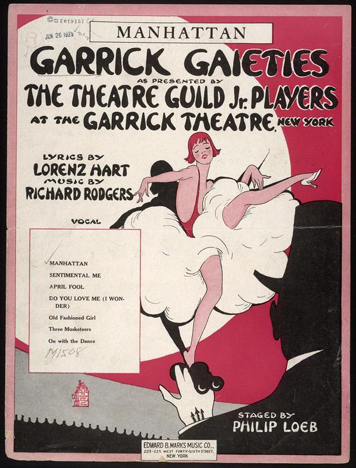
(Public Domain)
In 1919, Lorenz/Larry Hart was 23 and just out of Columbia when he met 16 year-old Richard Rodgers. It was kismet. Neither had to struggle while pursuing art. “For the sake of color, I should have been a singing waiter… Unfortunately, I was a doctor’s son and very well-fed as a kid.” (Rodgers) Hart was the son of a promoter. Their first effort was the Columbia Varsity Show of 1920 created when Rodgers was a freshman. He quit school and the next five years the collaborators plugged along.
Writer/historian Will Friedwald regales us with the story of the drapes: In 1924, The Theatre Guild decided to move its Garrick Theater uptown to Times Square, started building, and ran out of money. Having people vote on the color of the drapes was a funding hook, but didn’t garner enough to have them made.
Rodgers and Hart were offered enough to produce two nights of The Garrick Gaities featuring hummable songs and satirical topical sketches, rather than the usual vaudeville slapstick. They didn’t have time to write a whole new score, so they reused a lot of earlier material, including then three year old “Manhattan” from 1922’s unproduced Winkle Town.
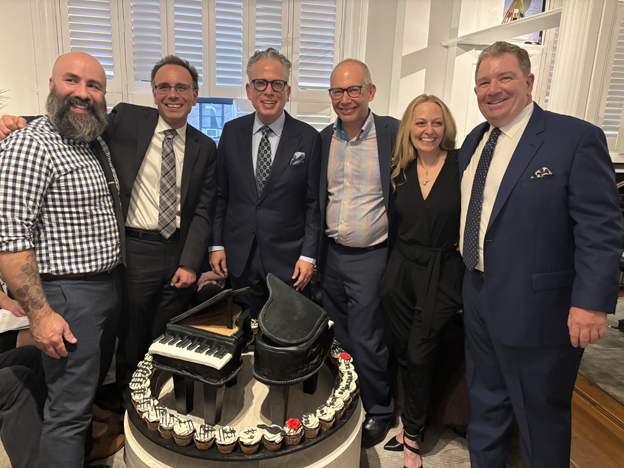
Chris Stefanski, Tedd Firth, Billy Stritch, Ted Rosenthal, Kim Clarke, Scott Perrin
Sterling Holloway and June Cochrane debuted the now iconic song which playfully romanticizes everyday sights. “We’ll have Manhattan, the Bronx and Staten Island too…” It was such a hit that in one year the collaborators had three shows produced on Broadway. The Gaities extended 211 more performances becoming both the first hit and the first Broadway show by Rodgers and Hart. …” (There were two more editions of the show.)
A couple of years later, Dick Rodgers nodded to the drapes and commented to Hart, “We made those. We should get some credit.” “No, no,” Hart responded. “Those drapes made us.” The gentleman who actually fabricated the drapes was named Meyer Roth – so Rodgers and Hart wrote a song for the occasion titled “The Drapes of Roth.” Success cemented a partnership that would last 24 years; 28 musicals and over 500 songs.
“… As Rodgers and Hart see it, what was killing musicomedy was its sameness, its tameness, its eternal rhyming of June with moon. They decided it was not enough just to be good at the job; they had to be constantly different.” Time Magazine 1939 – The Boys From Columbia (University)
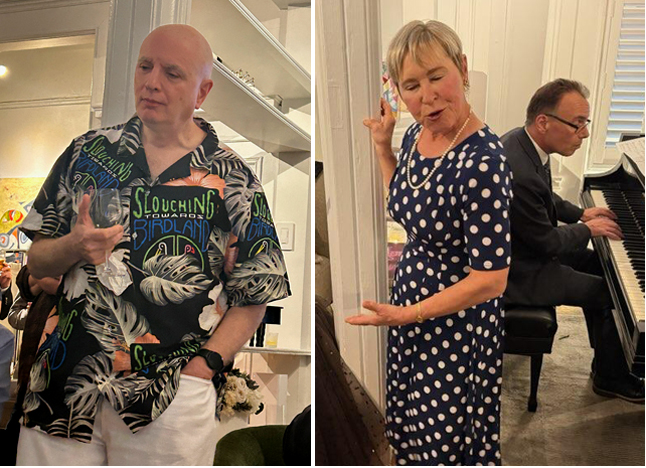
Will Friedwald (by Alix Cohen) Amber Edwards (with Tedd Firth)
At The Library of Congress, in search of public domain material for a new version of A Connecticut Yankee in King Arthur’s Court, producer/filmmaker/vocalist Amber Edwards came across the unknown “Queen Elizabeth” sheet music in Richard Rodgers own hand: “A royal marriage is a mockery/A husband just a piece of crockery…” sings the Queen who despite referring to relationships with Shakespeare and Sir Walter Raleigh remains a virgin in her own mind… “Still, one must have a moment or two…” Performance is flirty and charming.
Scott Perrin produced A Grand Night for Singing (Tony®-nominated for Best Musical), Our Sinatra, The Flying Karamazov Brothers, and Secrets Every Smart Traveler Should Know. His revues at Rainbow & Stars — paying tribute to Rodgers & Hammerstein, Cole Porter, Gershwin, Bernstein, and others — earned widespread acclaim. Oh for those days!

Perrin Revues – Photo by Alix Cohen
Will Friedwald recommends A Ship Without a Sail, The Life of Lorenz Hart by Gary Marmorstein from which he learned the tale of the drapes.
The scrumptious, commemorative two piano cake was created by Kim Clarke, Winner and Chris Stefanski, Semi-Finalist “The Great American Baking Show” Season 3. They both have other careers, but are highly recommended as confectionary artists.
Opening: Richard Rodgers and Lorenz Hart 1936 (World Telegram staff photographer – Public Domain)
Unless otherwise identified photos by John Munson